

Email marketing isn’t just about sending campaigns.
It’s about understanding what happens after you hit send. That’s where email marketing analytics becomes your competitive advantage.
By tracking key metrics like open rates, click-through rates, conversions, and subscriber behavior, you can uncover what’s working, what’s not, and where revenue is leaking.
When you use data to guide your email strategy, every campaign becomes smarter, more targeted, and more profitable.
In this guide, we’ll break down the essential analytics you should monitor, how to interpret them, and the actionable steps you can take to boost performance and drive measurable growth.
Table of Contents
What is Email Marketing Analytics?
Email marketing analytics is the process of tracking, measuring, and analyzing your email campaigns to understand how your audience engages with them. By examining these insights, you can optimize campaigns, improve engagement, and drive higher revenue.
The key metrics every email marketer should monitor include:
| Metric | What It Measures | Formula |
|---|---|---|
| Open Rate | Percentage of delivered emails that are opened | (Opened / Delivered) × 100 |
| Click-through Rate (CTR) | Percentage of opened emails where users clicked a link or CTA | (Clicked / Delivered) × 100 |
| Orders Placed | Number of purchases generated from emails | Count of completed transactions from the campaign |
| Total Revenue / ROI | Revenue generated by email campaigns compared to cost | Revenue ÷ Campaign Cost |
| Conversion rate | Percentage of delivered emails that led to the desired action (sale, sign-up, etc.) | (Conversions / Delivered) × 100 |
| Unsubscribers rate | Percentage of recipients who opted out after receiving an email | (Unsubscribes / Delivered) × 100 |
| Revenue Per Email (RPE) | Average revenue generated per delivered email | Total Revenue ÷ Emails Delivered |
Tracking these metrics allows you to see what’s working, identify areas for improvement, and make data-driven decisions to boost engagement, conversions, and revenue.
Why Email Analytics is Important?
Email marketing analytics are essential for understanding your campaigns and making data-driven decisions. Here’s why they matter:
- Measure Campaign Performance: Track open rates, click-through rates, conversions, and revenue to see what’s working.
- Identify Improvement Areas: Spot underperforming campaigns or emails and tweak strategies accordingly.
- Focus on Key Metrics: Prioritize metrics that drive impact, such as open rate, click-through rate, unsubscribe rate, conversions, and revenue per email.
- Optimize Campaign Strategy: Replicate high-performing campaigns and refine weaker ones to improve engagement and ROI.
- Make Data-Driven Decisions: Turn raw email data into actionable insights for smarter marketing decisions.
- Maximize ROI: Understand what drives revenue and engagement so every email contributes to your business goals.
In short, email analytics transforms guesswork into strategy, helping you boost performance, engagement, and revenue.
7 Email Marketing Metrics That You Should Track
To get meaningful insights from your email campaigns, it’s essential to use the right analytics tools.
We recommend using FunnelKit Automations, a complete CRM and email marketing solution trusted by over 20,000+ WordPress users.
This email marketing tool lets you create automated email campaigns and send broadcasts.
And for each campaign, you can
- Track how each campaign performs over time
- Analyze key metrics for better decision-making
- Access detailed subscriber information to tailor your campaigns

Here are the seven essential email marketing metrics every marketer should monitor:
1. Open Rate
Your open rate can tell you a lot about your email campaigns. Such as:
- Is the timing of your emails right
- Are your subject lines effective
- Is the frequency of your emails right
And so much more.
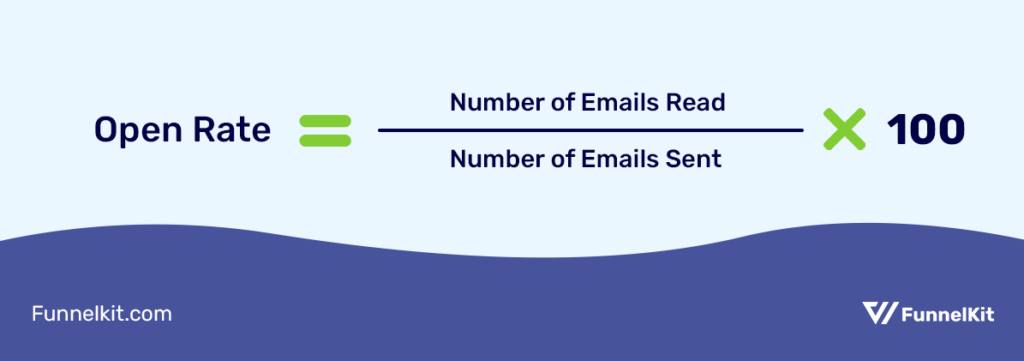
Open Rate Formula: (Opened ÷ Delivered) × 100%
Open rate is the ratio of the number of opened emails to the number of emails sent. The higher, the better.
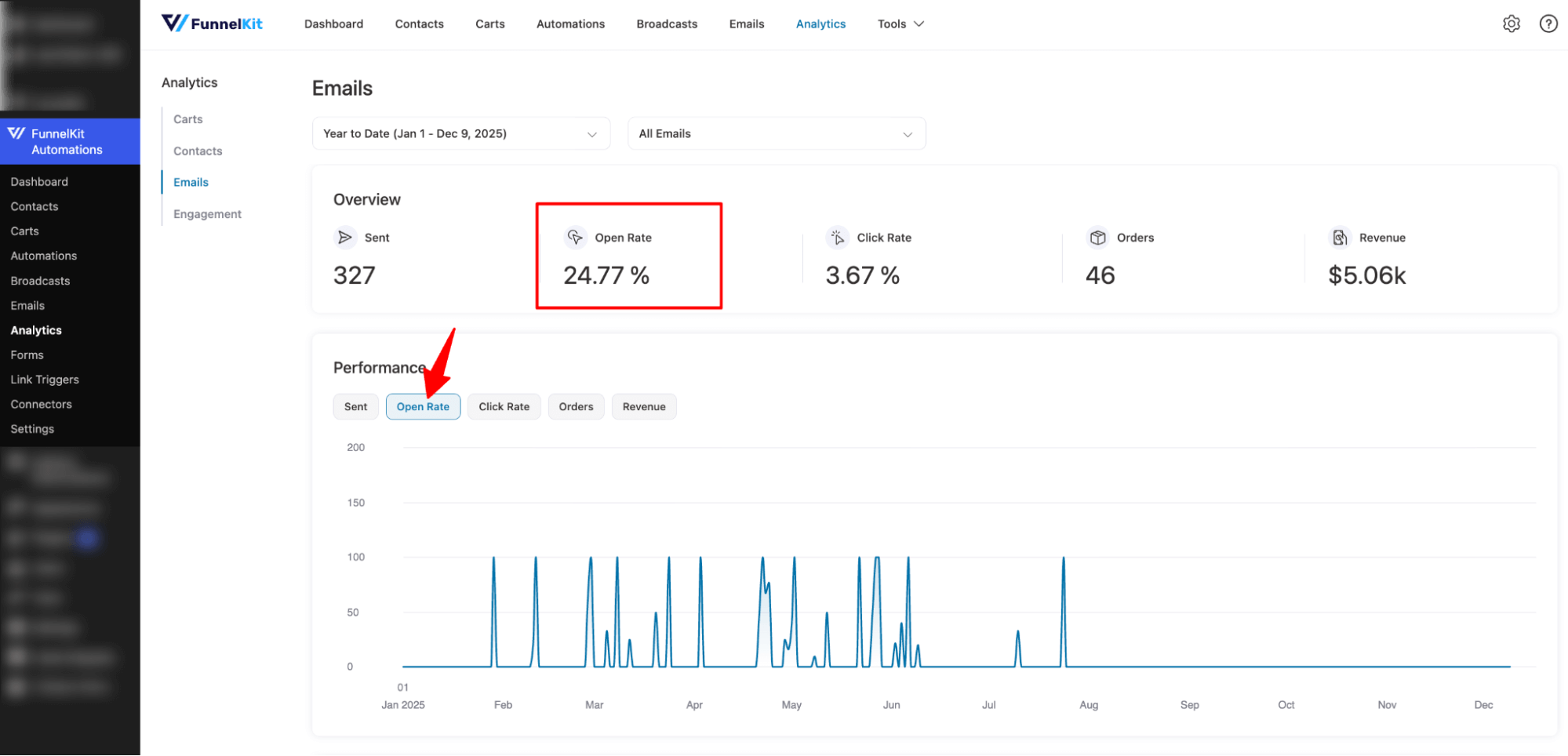
In FunnelKit Automations, navigate to Analytics and select Emails.
Your open rate will be visible directly on the dashboard, and you can adjust the date range to view performance for a specific period.
You can also review open rate trends through the graphical performance chart.
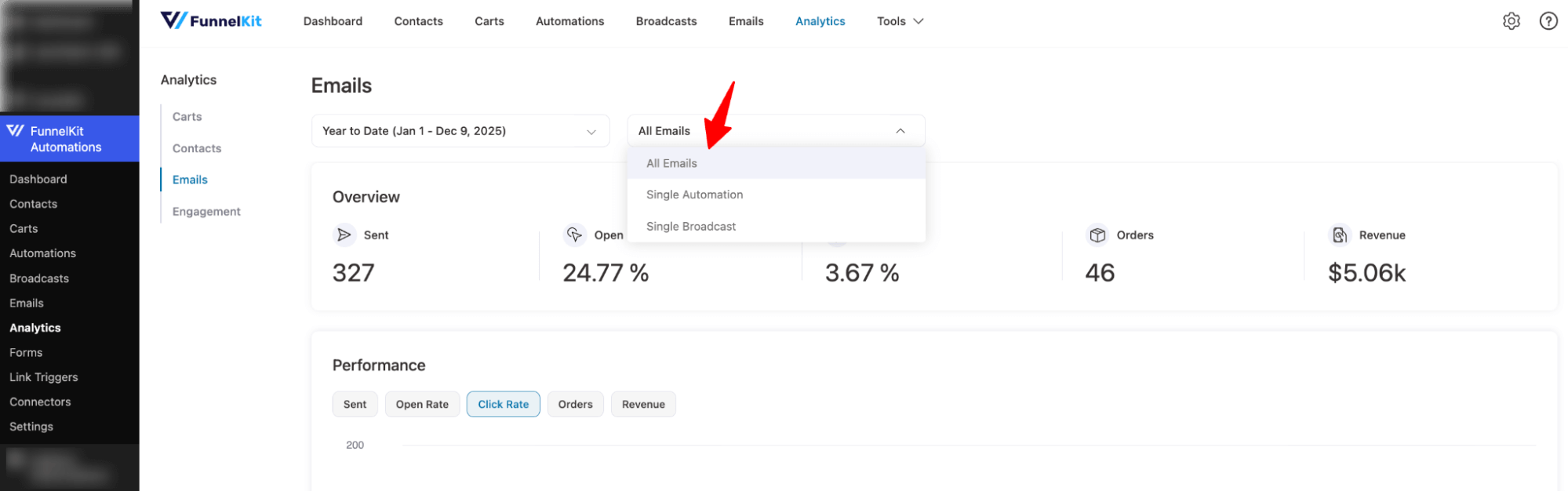
Using tools like FunnelKit Automations, you can monitor open rates and other essential metrics for each email, including automations and broadcast or filter data with each automation or broadcast.
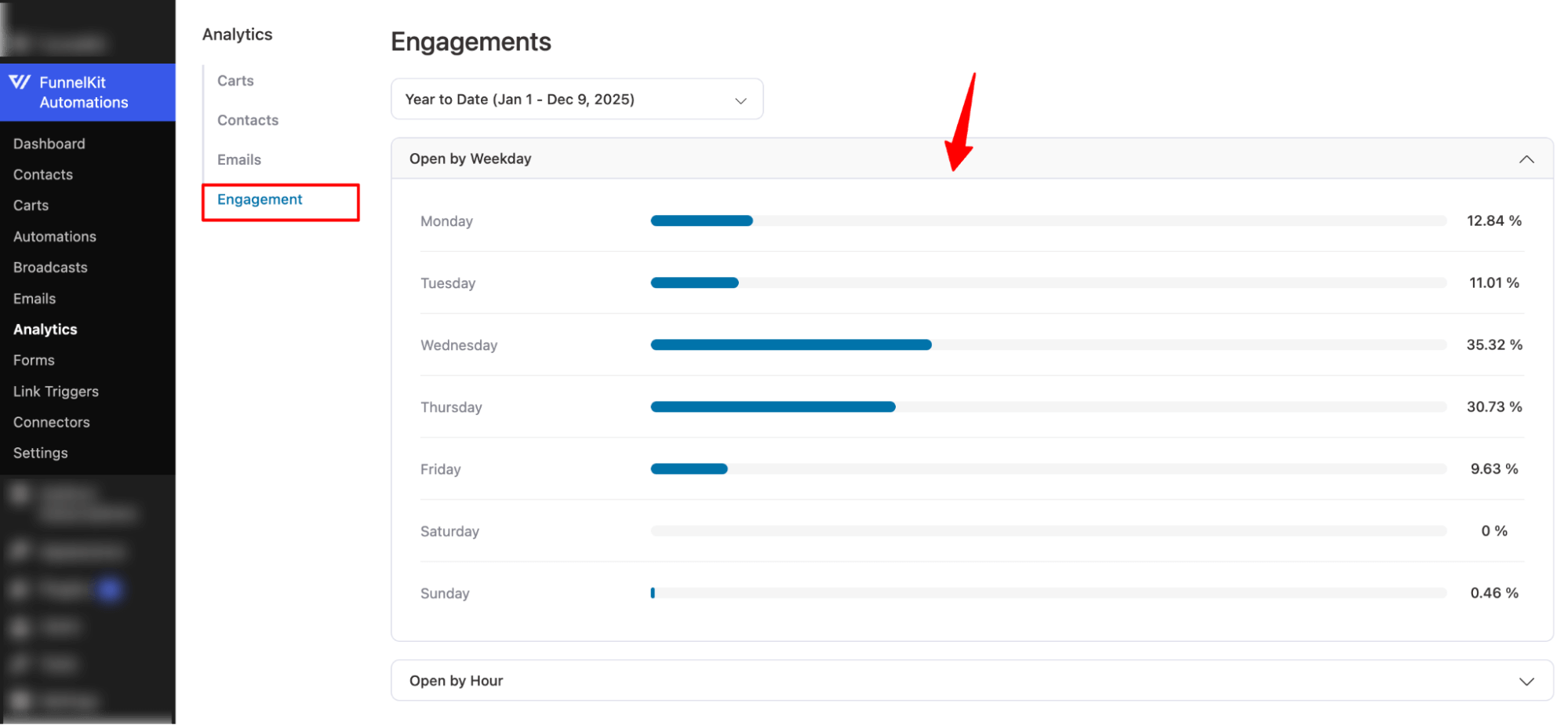
In the Engagement tab, you can also see the best-performing days for your emails. You can customize the date to get more accurate results.
Not just days, but FunnelKit Automations also shows you at what hour of the day your audience engages the most with your emails. This helps a lot in scheduling your broadcast campaigns and future email automations.
2. Click-through Rate
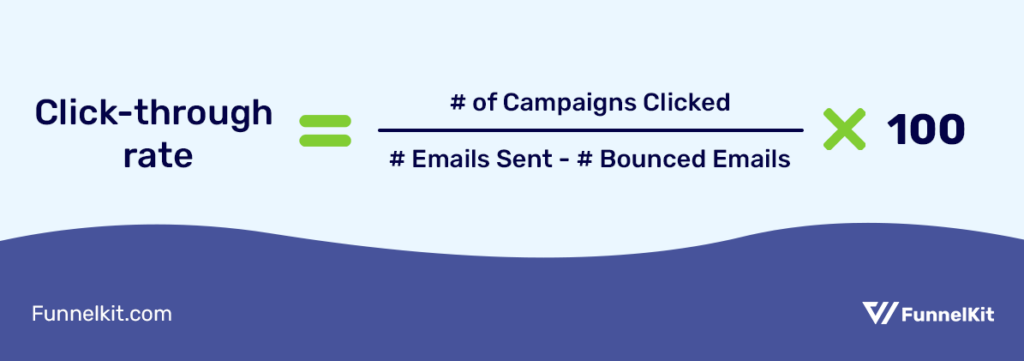
Click-through rate, also known as Click Rate, is as important an email metric as the open rate.
CTR Formula: (Clicked ÷ Delivered) × 100%
Click Rate means how many people click on the CTAs inside your emails.
Many times, marketers get a good open rate, but their click-through rate tends to suffer because of:
- Unclear message
- Confusing links
- Lackluster CTAs
These CTAs could be a button, an image, or another link. Click Rate gives you a deeper insight into whether the email was able to convince the user or not.
Here are some email marketing benchmarks for some of the most popular industries.
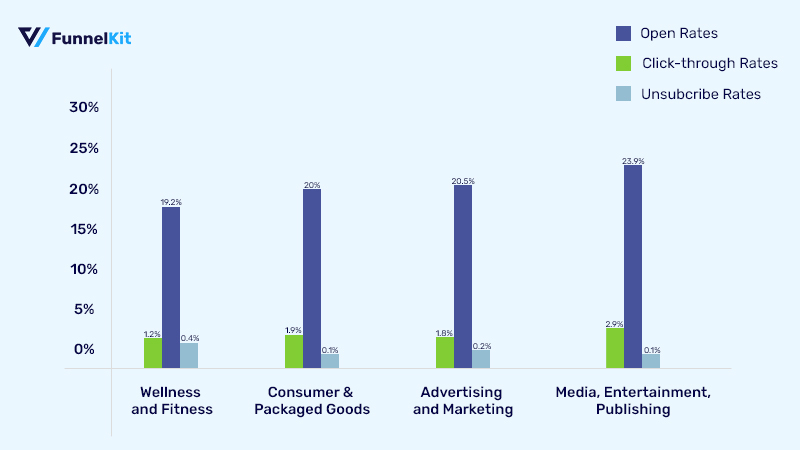
Source: Campaign Monitor
So, you need to keep your CTAs bold and clear. Write compelling emails that make the user click the CTA. And modify the CTAs that are inefficient.
In FunnelKit Automations, you can go to Analytics and then click on Emails.
Under this, you will find the Click Rate.
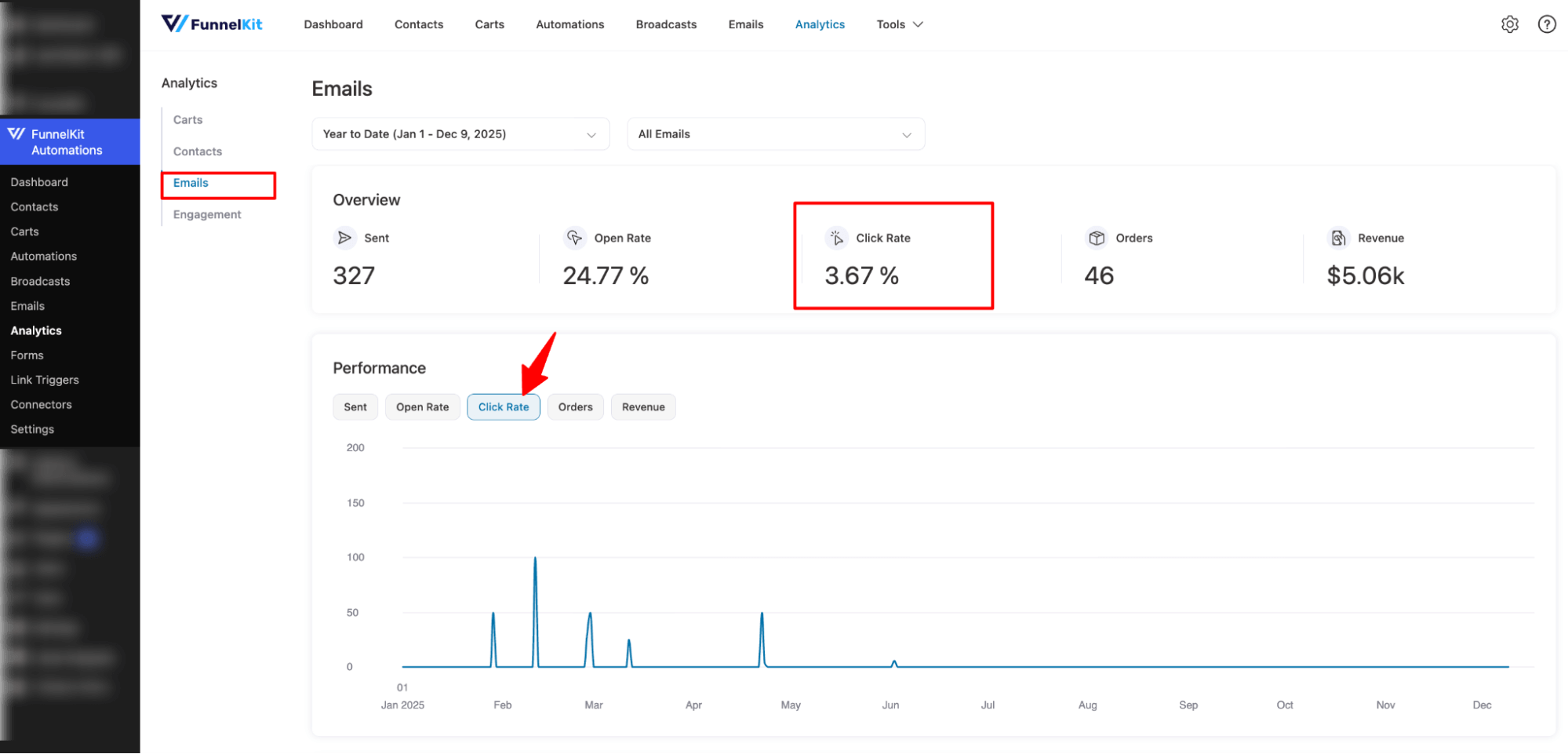
You can adjust the date to see this email marketing analytics for a different time period, or you can toggle between a line graph and a bar graph.
3. Orders Placed
Orders Placed is an email marketing analytics that denotes the number of successful orders you get from your email campaigns.
This metric can tell you whether your email copy is convincing enough to encourage the user to place an order.
If your email campaign hits the right note with your audience, you will undoubtedly get more orders. Just replicate these campaigns or emails.
With FunnelKit Automations, you can easily see the Orders Placed metric right on the dashboard.
Click Analytics, then go to Emails.
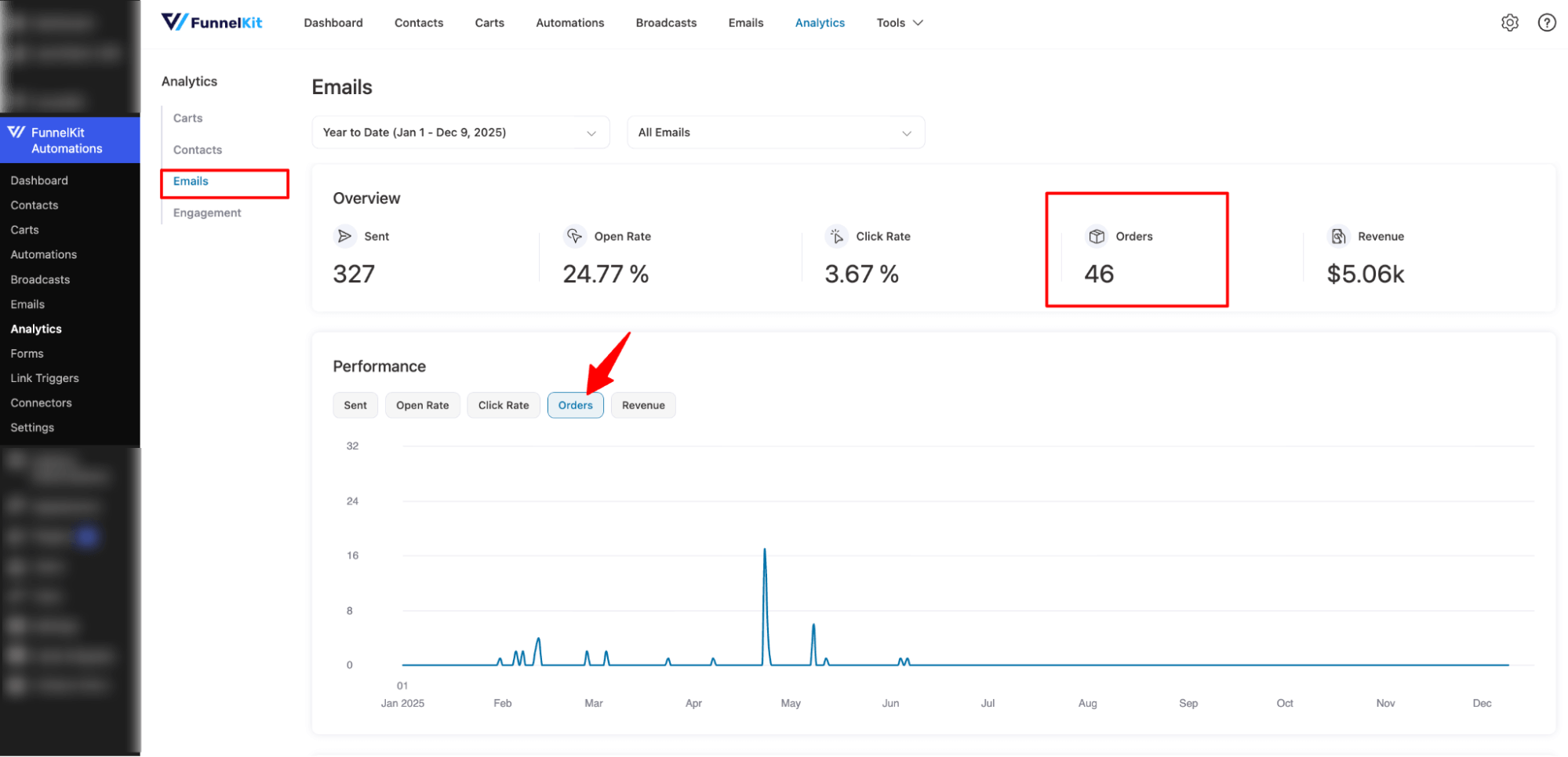
Under Emails, you can see orders for a particular time frame. However, if you want to see orders from a specific automation or broadcast, you can do so.
This nifty trick can help you filter out your best-performing email and broadcast campaigns with high interaction so that you can replicate them with ease.
You can try WooCommerce per-product emails to send more relevant messages to new buyers and drive more sales.
4. Total Revenue
Revenue is the amount of money you make from your email campaigns. You can see this email marketing metric right on your dashboard itself.
Your revenue metric tells you how profitable your email campaigns are.
The total revenue is the overall ROI of your email campaigns. In other words, total revenue is divided by total spending.
Under FunnelKit Automations, you can see the total revenue made. You can adjust the date and even see the revenue made from a specific campaign or broadcast.

Not all emails give a pecuniary ROI. Some have a different kind of return, such as improved brand awareness. But if you only care about financials, then this is the metric that defines your email marketing strategy.
After all, total revenue is the metric that any marketer cares the most about in their email marketing report.
5. Conversions
You send an email with a motive in mind - to get conversions, in other words, to get sales.
Sending newsletters is a great way to reach your audience. But it's also a great medium for suggesting products to your audience and eking out a few sales.
Conversion simply means a sale made from a broadcast email.
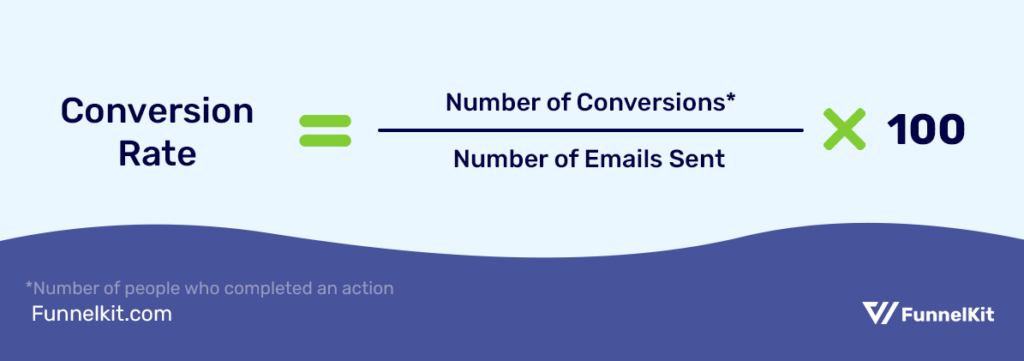
In FunnelKit Automations, click on Campaigns, and go to Broadcasts.
Select the Broadcast of which you want to see the conversions metric.
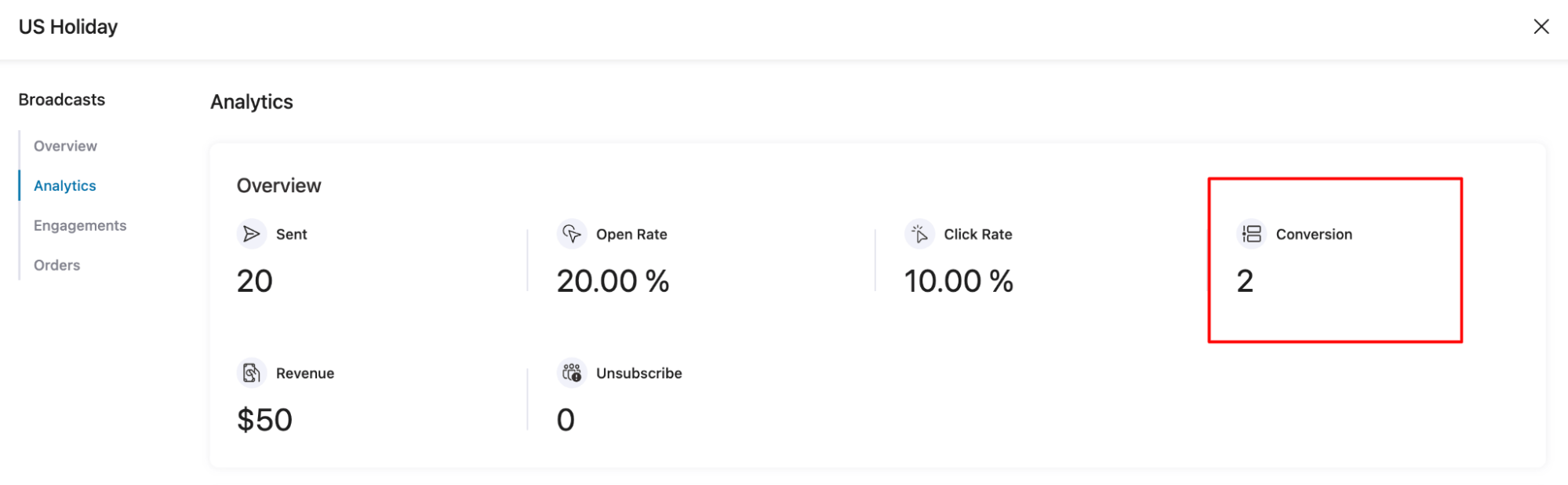
Conversions can be combined with other email marketing analytics, like Open Rate to come up with a precise marketing strategy.
For example, if an email has a high open rate but a low conversion rate, then you know that users are opening the email but are not convinced to place an order.
So, here you need to edit the email copy and make it more persuasive.
Another trick to increase conversions is to send dynamic discount coupons in your emails. After all, who doesn't like discounts?!
6. Unsubscribers
One of the most commonly tracked email marketing analytics is Unsubscribers.
Unsubscribers are the audience that opted out of your email list. This can happen after a particular email or a particular email campaign.
The reason for unsubscription can be anything. In fact, according to a study done by Hubspot, the top 3 reasons for unsubscriptions are:
- Too many emails (34%)
- Spammy or over-promotional emails (17%)
- Emails are no longer relevant (9%)
Unsubscriptions mostly occur after a particular email campaign, and that’s why you need to study each campaign individually and get to the roots of what went wrong.
In FunnelKit Automations, for broadcasts, you can find unsubscribers.

7. Revenue Per Email
Revenue per email gives you a clear insight into which emails are performing the best. The emails that bring the most revenue are important, and that’s why you need to replicate the template in your other emails.
In FunnelKit Automations, you can see this metric right on the performance dashboard.
Click on Analytics and go to Emails.
Now, scroll down, and you will see a list of your most popular emails and the Revenue Per Email.

Study these money-making emails, and try to understand what’s so unique about this email. Maybe it's the catchy subject line, the content of the email is persuasive, or the CTA buttons are placed optimally.
Understand why this email is connecting with the users, and replicate the formula.
More Questions About Email Marketing Analytics
Here are some frequently asked questions about email marketing analytics with answers:
Track key metrics like open rate, click-through rate, conversions, revenue per email, and unsubscribe rate. Compare these against past campaigns to identify trends and improvements.
Plugins like FunnelKit Automations provide built-in analytics for opens, clicks, conversions, revenue, and subscriber activity directly inside WordPress. We shared more details in the blog above.
Higher opens and clicks boost engagement, while conversions directly increase revenue. Strong performance across all three significantly improves your return on investment (ROI).
Email analytics focus on how subscribers interact with your emails; general marketing analytics evaluate your entire customer journey across multiple channels like search, ads, and social media.
Analyze which emails trigger unsubscribes, refine your content frequency, improve segmentation, and send more relevant, personalized emails based on user behavior.
Look at trends over time rather than single sends, segment your audience before drawing conclusions, run A/B tests on one variable at a time, and cross-reference metrics (like open rate against conversion rate) instead of judging any number in isolation.
Are You Ready to Enhance Your Next Email Campaign?
Having the right analytics in your email marketing report is like having your finger on the pulse of your email performance.
Track all your important metrics with FunnelKit Automations in one glance and understand your analytics better with line and bar graphs - right on your performance dashboard.
FunnelKit Automations gives you the powerful arsenal to collect all the crucial email marketing metrics and plan your next email campaign successfully.
Import essential pre-built email sequences in one click and tweak them as per your email marketing report.
So, get on the bandwagon and grab your copy of FunnelKit Automations today.
Start tracking your emails and make more effective strategies.

Editorial Team
September 1, 2026Ever had a customer claim they never got their order confirmation or shipping email? Ideally, you would double-check, but there’s no way to know if it was sent or why...
Editorial Team
August 27, 2026WooCommerce Zapier is the difference between a $180 order sitting quietly in your dashboard at 11:40 p.m. and that same order showing up in your spreadsheet, CRM, and accounting software...

Editorial Team
August 27, 2026WooCommerce frequently bought together offers are one of the easiest ways to increase revenue on a product page. Think about the counter at a kitchen appliance store. Let's say someone...