

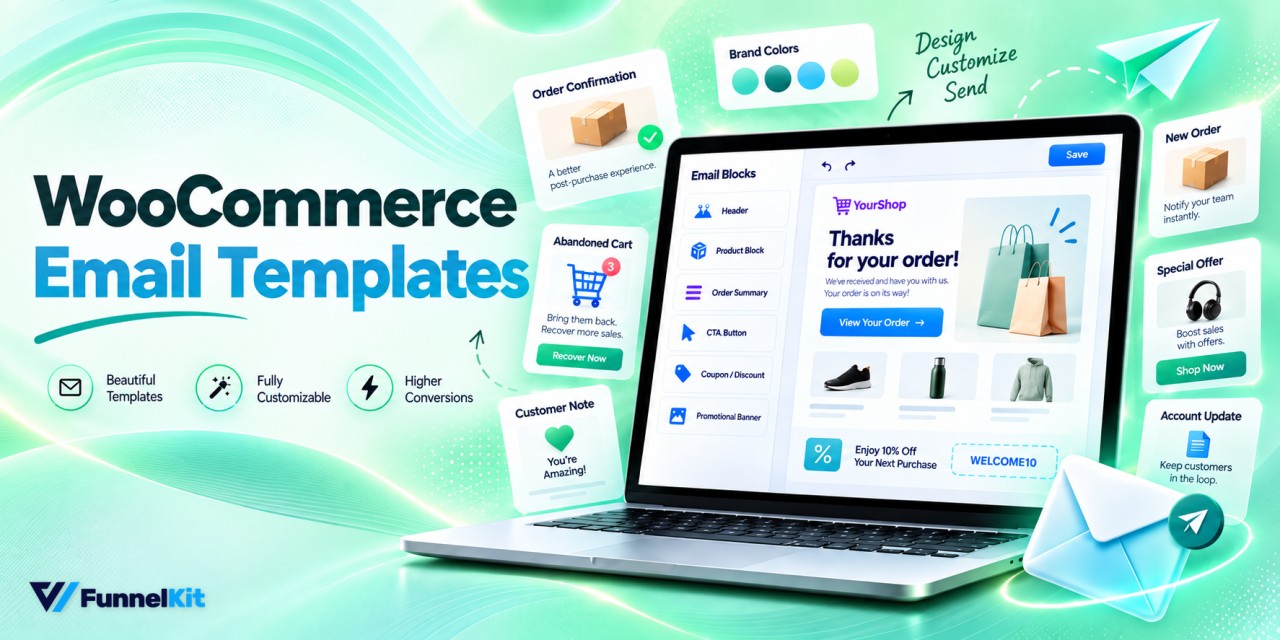
WooCommerce email templates are usually one of the last things a store owner thinks about styling, even though they're among the first things customers see after placing an order.
Every notification uses the same header, footer, and stylesheet, so an order confirmation and a password reset can end up looking like the same grey document with different text.
The order confirmation is a message customers are actively waiting for, so it's one of the most reliably opened emails a store sends.
Yet on most stores we look at, it's also one of the first things nobody has bothered to customize.
The default emails work, but they leave an easy branding opportunity on the table.
WooCommerce includes a dozen emails by default, with three newer ones available behind feature toggles.
You can customize these WooCommerce email templates in three ways: use the built-in controls under WooCommerce email settings, install a customizer plugin with ready-made designs, or override the templates in a child theme.
Below, you'll find every default email, the file that controls it, copy-ready subject lines and headings you can use today, a redesign idea for each one, and the code-level details for anything the settings screen can't change.
Table of Contents
- 1 What Are WooCommerce Email Templates?
- 2 Where the Template Files Live (and Which Email Editor You're On)
- 3 Before and After: A Redesign for Each Order Email
- 4 How to Apply a New Email Design in WooCommerce (3 Methods)
- 5 Method 1: Brand Your Emails With WooCommerce's Built-In Settings
- 6 Method 2: Apply a Pre-Designed Template Without Code
- 7 Method 3: Override the Template File in Your Child Theme
- 8 Where to Get Free WooCommerce Email Templates (and When to Pay)
- 9 Marketing Emails Your Store Needs Beyond Order Updates
- 10 5 Must-Have WooCommerce Email Templates to Have in Your Store
- 11 Email HTML and CSS: What Actually Shows Up in the Inbox
- 12 7 Best Practices to Make Your WooCommerce Emails Convert
- 13 Fixing Common Email Template Problems in WooCommerce
- 14 Frequently Asked Questions
- 15 Redesign Your WooCommerce Emails, Starting With the One Every Customer Opens
What Are WooCommerce Email Templates?
WooCommerce email templates are the PHP files WooCommerce uses to build the notifications your store sends.
They live in wp-content/plugins/woocommerce/templates/emails/, with the plain-text versions in the plain/ subfolder.
Each email has its own template file, plus a few shared files that handle the header, footer, order details, addresses, and email styles.
That shared structure is what keeps your emails consistent.
Change the shared styles, and those changes can affect multiple emails.
If you want one notification to have a completely different layout or design, you'll usually need a customizer plugin or a template override.
All default emails at a glance
WooCommerce includes these default email notifications:
| Sent to | Trigger | Template file | Email ID | |
|---|---|---|---|---|
| New order | Admin | New paid or on-hold order | admin-new-order.php | new_order |
| Cancelled order | Admin | Processing or on-hold order cancelled | admin-cancelled-order.php | cancelled_order |
| Failed order | Admin | Payment fails | admin-failed-order.php | failed_order |
| Failed order | Customer | Payment fails | customer-failed-order.php | customer_failed_order |
| Order on-hold | Customer | Status set to on-hold | customer-on-hold-order.php | customer_on_hold_order |
| Processing order | Customer | Payment received | customer-processing-order.php | customer_processing_order |
| Completed order | Customer | Marked complete or shipped | customer-completed-order.php | customer_completed_order |
| Refunded order | Customer | Full or partial refund | customer-refunded-order.php | customer_refunded_order |
| Order details / invoice | Customer | Sent manually | customer-invoice.php | customer_invoice |
| Customer note | Customer | Admin adds a note to the order | customer-note.php | customer_note |
| Reset password | Customer | Reset requested | customer-reset-password.php | customer_reset_password |
| New account | Customer | Account created | customer-new-account.php | customer_new_account |
WooCommerce also uses several shared template files:
- email-header.php
- email-footer.php
- email-styles.php
- email-order-details.php
- email-addresses.php
- email-customer-details.php
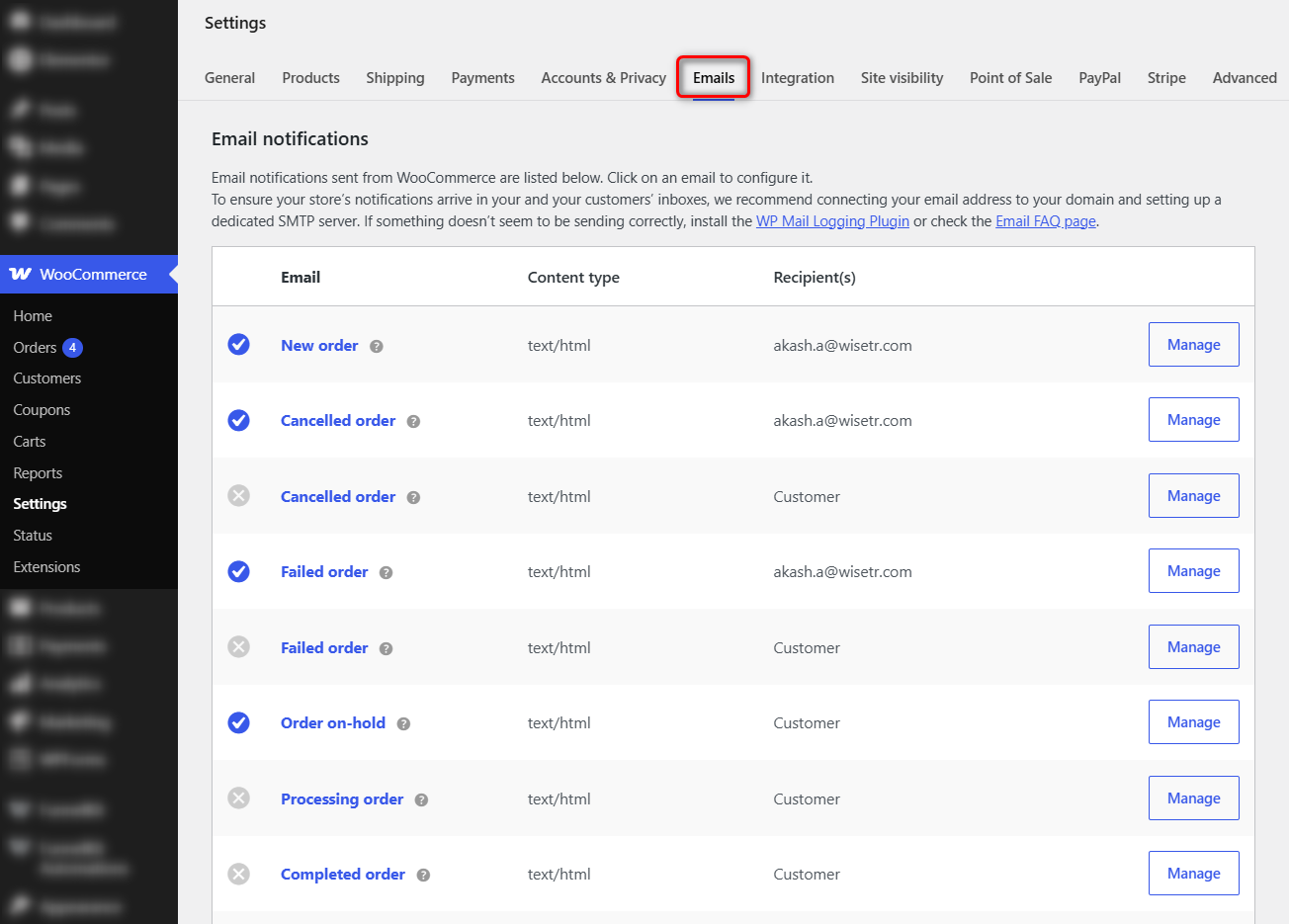
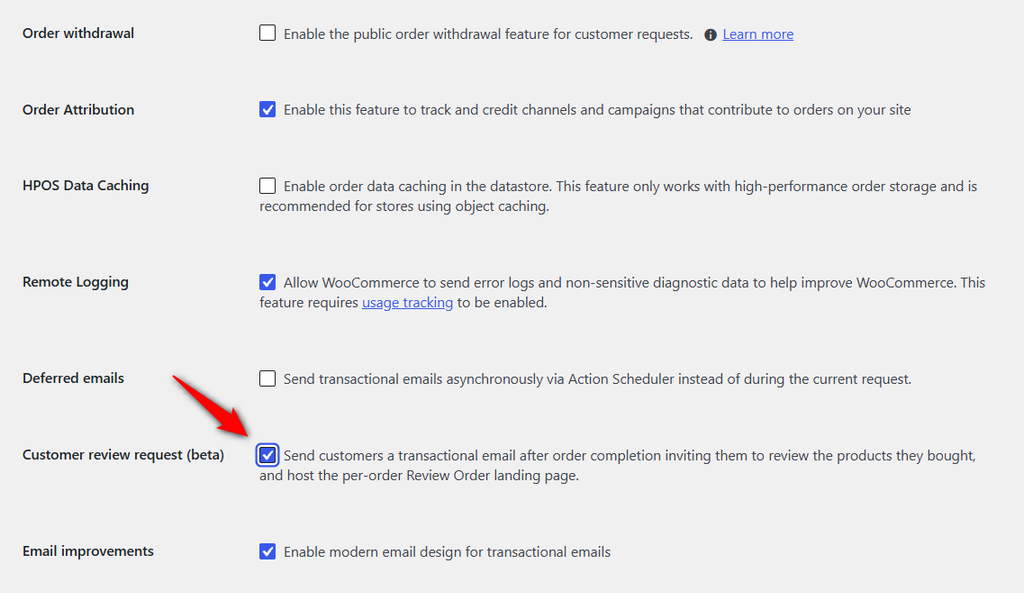
Recent WooCommerce versions also include three newer notifications. They're disabled by default and only become active when you turn them on:
- Confirm email address: Added in WooCommerce 11.0. It sends a one-time link for customers to confirm their account email address. Once confirmed, WooCommerce can attach their previous guest orders to that account.
- Review request: Turn on Customer review request (beta) under Settings ⇨ Advanced ⇨ Features, then choose a delay between 1 and 60 days. The email only goes out when the order still contains a product the customer hasn't reviewed.
- Abandoned cart recovery: This experimental notification sends shoppers a one-time link back to their unpaid checkout.
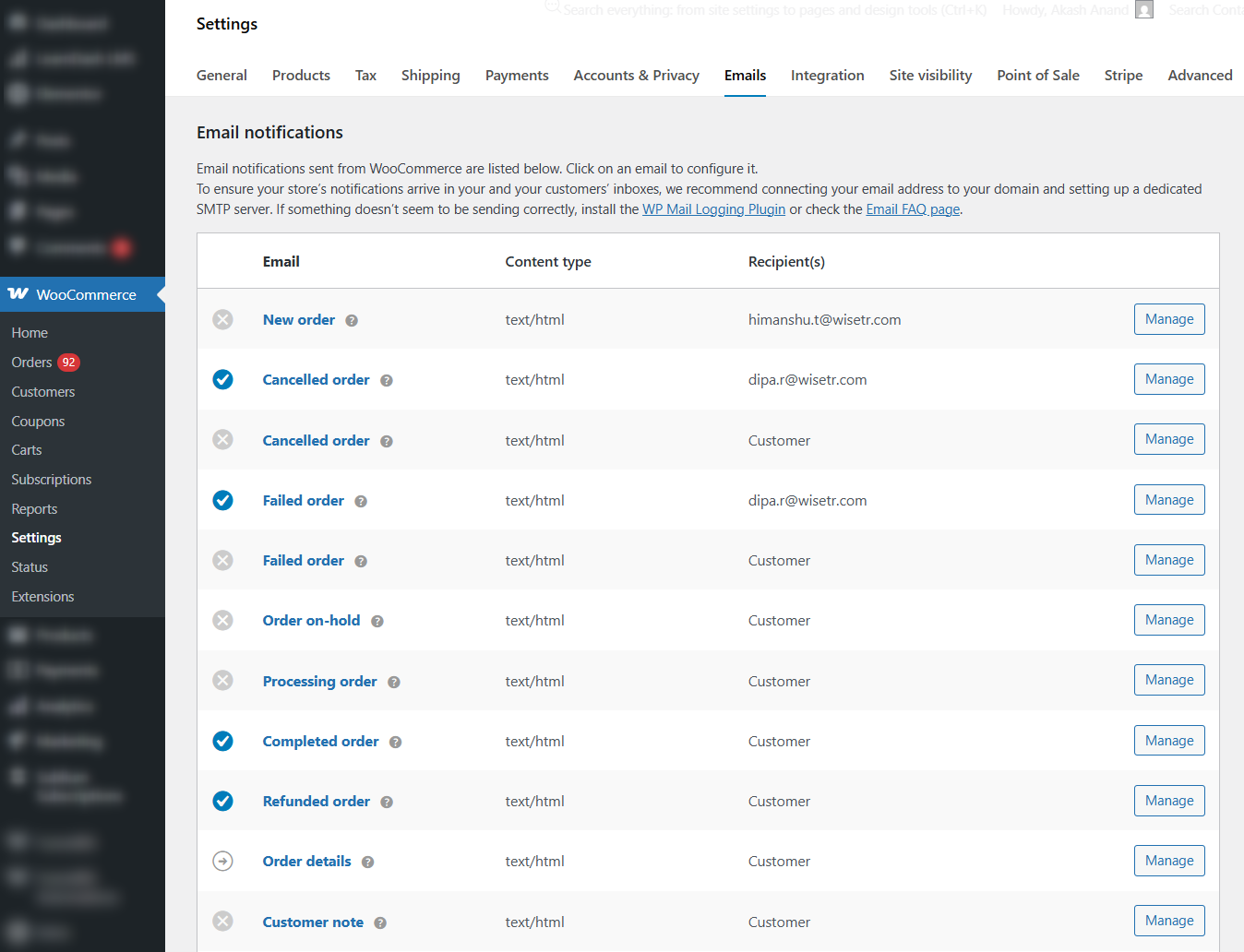
For any of these notifications, open its Manage screen to see the exact template path at the bottom.
Where the Template Files Live (and Which Email Editor You're On)
Keep your WooCommerce email template overrides in your child theme, never inside the WooCommerce plugin folder. For example, copy the file here:
wp-content/themes/your-child-theme/woocommerce/emails/customer-processing-order.phpNotice what's missing: /templates/. The original plugin path includes it, but the theme override path doesn't. Using the wrong path is the most common reason an override appears to do nothing.
You also don't have to copy the files manually. WooCommerce shows the template file and provides a button to copy it to your theme at the bottom of each email's Manage screen.
After adding an override, check WooCommerce ⇨ Status ⇨ Templates whenever WooCommerce is updated.
This screen flags overrides that are running an older template version, so you know when your copy may be missing changes from the latest version of WooCommerce.
Classic templates vs. the block email editor
WooCommerce now offers two ways to edit emails, and the one you use changes how you customize your templates.
Email improvements (WooCommerce 9.8 and later) is a toggle under Settings ⇨ Advanced ⇨ Features.
Turn it on and the email settings add controls for logo width, header alignment, font family, a theme-synced color palette, desktop and mobile previews, and test emails.
With it off, you're limited to the logo and footer text, while the newer controls remain greyed out.
Then there's the Block Email Editor, which is the bigger change. It's still marked as alpha on the same settings screen.
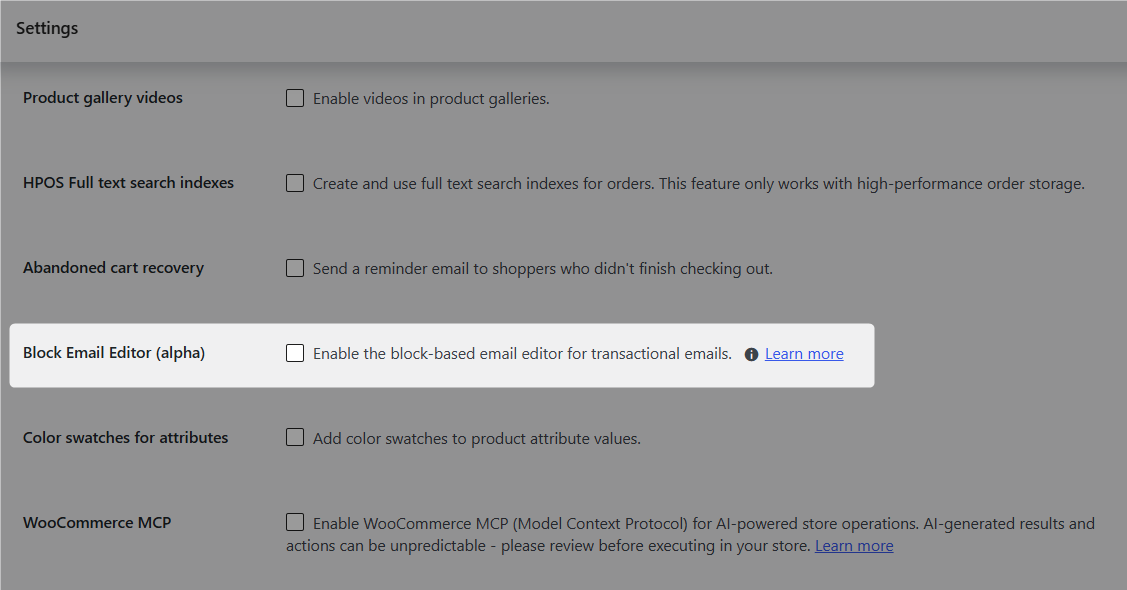
Once enabled, emails open in a block-based editor where you can change text and images much like you would when editing a WordPress post.
There are two important limitations to know before using it:
- The order and billing table is still generated automatically. You can move it, but you can't rewrite its contents from the editor.
- Block-edited emails are stored in the database, so PHP template overrides won't customize them. If WooCommerce updates a template you've already edited, the email list shows Review update in the Updates column. The editor then lets you compare the changes and choose Keep yours or Use core for each conflict.
The block editor is worth testing on a staging site, especially if you want a visual way to build your emails. For a production store, the classic template override approach is still the more predictable option.
If you want to see how each approach works, our guide to editing WooCommerce emails walks through the different methods step by step.
Before and After: A Redesign for Each Order Email
Each example below shows WooCommerce's default email alongside a redesigned version.
We've also included copy you can paste directly into the subject, heading, and additional content fields.
Everything uses WooCommerce's built-in placeholders, so you can use these changes without installing another plugin.
Processing order email template (order confirmation)
This is the email customers expect after checkout. It confirms that their payment went through and shows what they ordered.
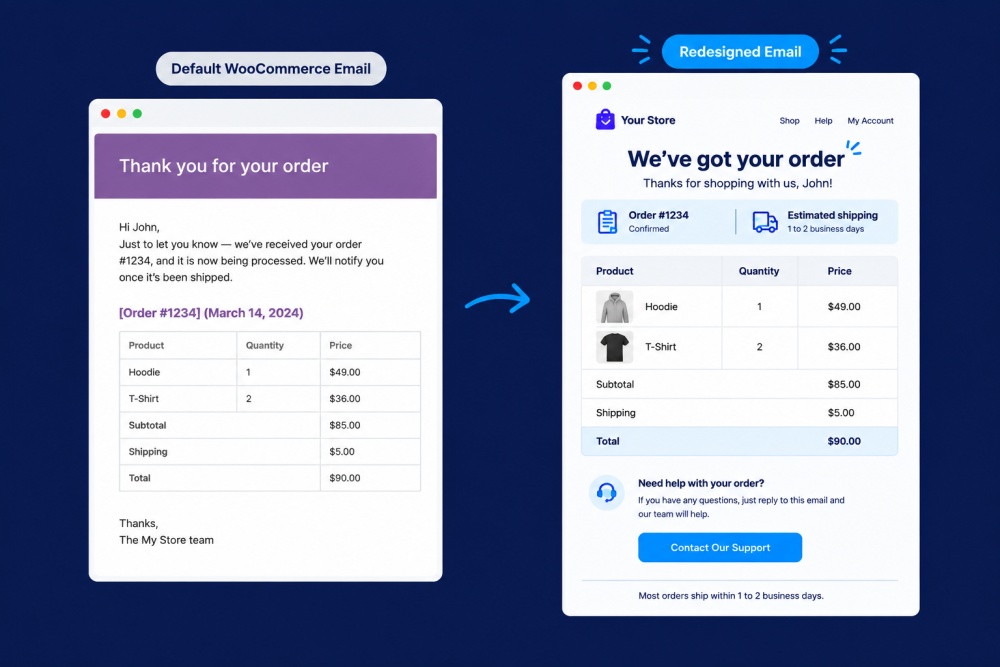
The redesign makes a few simple changes:
- Move the order number and estimated shipping window to the top.
- Keep the order table unchanged.
- Add one support link directly below the table.
- Subject: Order #{order_number} confirmed: thanks for shopping with {site_title}
- Heading: We've got your order
- Additional content: Most orders ship within 1-2 business days. If you have any questions, just reply to this email and our team will help.
For a deeper walkthrough, see our guide to the WooCommerce order confirmation email.
Completed order (shipped)
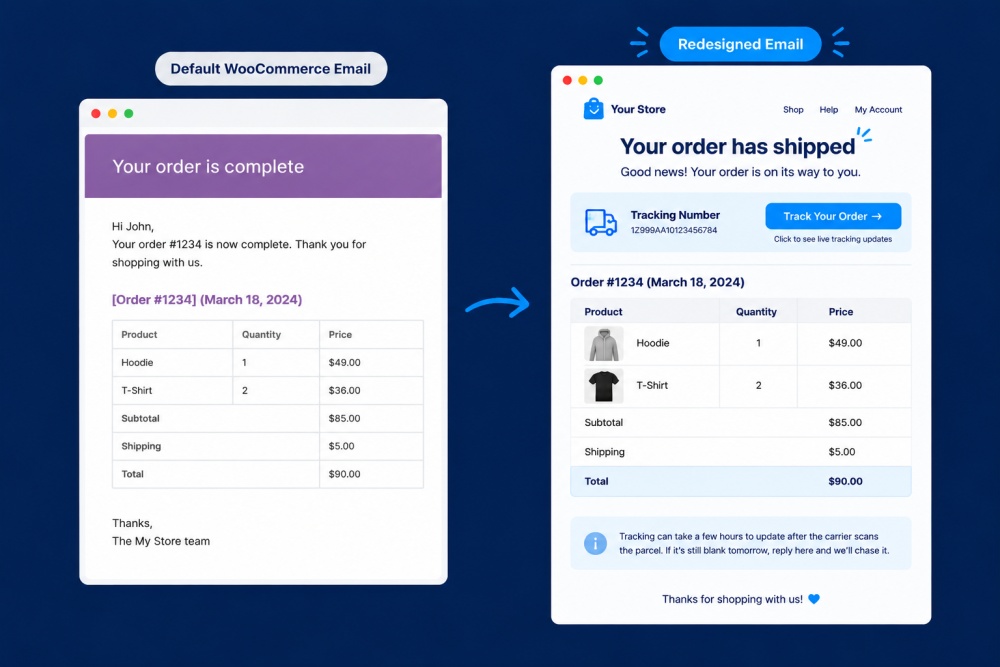
Customers usually open this email to know where their package is.
The redesign gives tracking information a clear spot and adds a small thank-you coupon at the bottom.
Since the customer has already paid, a simple next-purchase offer fits naturally here.
- Subject: Order #{order_number} is on its way
- Heading: Your order has shipped
- Additional content: Tracking can take a few hours to update after the carrier scans the parcel. If it's still blank tomorrow, reply here and we'll chase it.
WooCommerce doesn't add tracking numbers to this email by itself. You'll need a shipment tracking extension for that.
We've covered the setup in our guide to WooCommerce shipment tracking emails.
New order email (admin)
This email goes to you and your team, so clarity matters more than design. Keep the branding subtle and make the subject easy to find when you're searching your inbox.
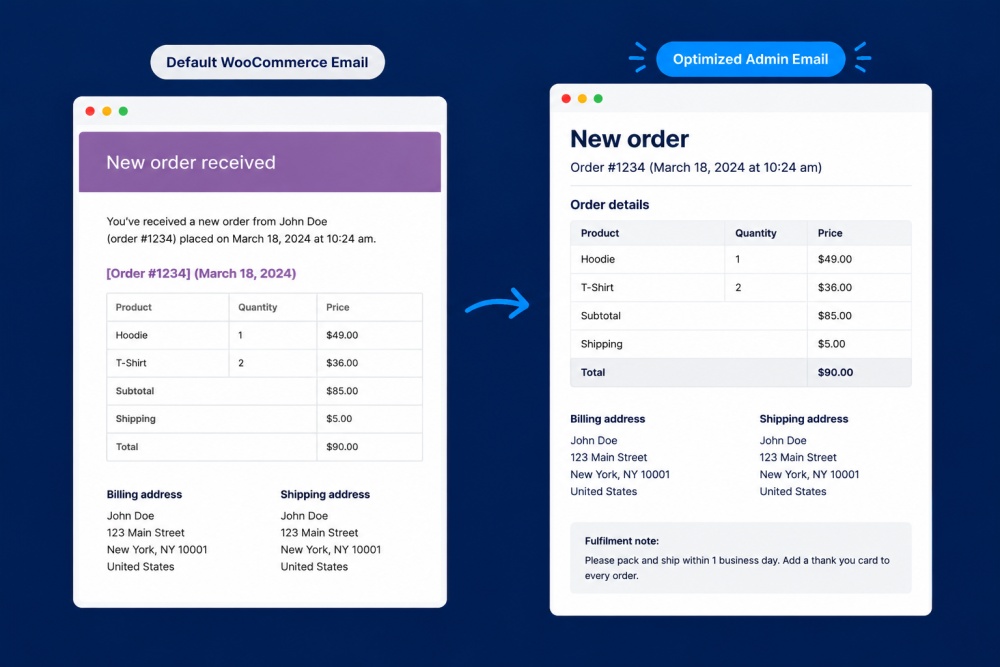
- Subject: [{site_title}] New order #{order_number} ({order_date})
- Heading: New order #{order_number}
Need more than one person to receive it? Add their email addresses to the Recipient(s) field, separated by commas.
If different orders need to go to different people, you'll need a plugin. For example, you might want orders containing a particular product category to go straight to your warehouse team.
Our guide to WooCommerce order notification emails covers both setups.
Refunded order email template
A refund email should be clear and specific. Start with what was refunded and when the customer can expect the money, then give them an easy way to get help.
We'd also leave promotions out of this email. Someone who has just received a refund probably doesn't need a product carousel at the bottom of the message.
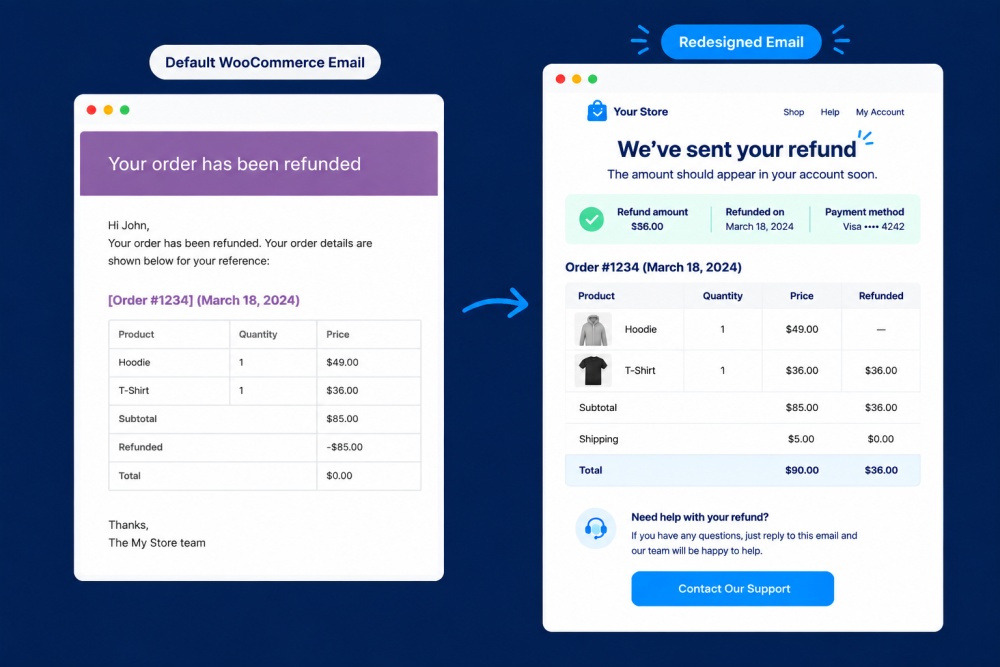
- Full refund subject: Your refund for {site_title} order #{order_number} is on its way
- Full refund heading: We've sent your refund
Partial refunds need a little more care, so we'll use that version as the running example in the customization methods below.
Failed and cancelled order emails
A failed order email goes to someone who tried to buy but couldn't complete the payment. The email should explain what happened quickly and give them a clear way to try again.
The admin versions can stay simple. They're there to tell your team what happened, not to sell anything.
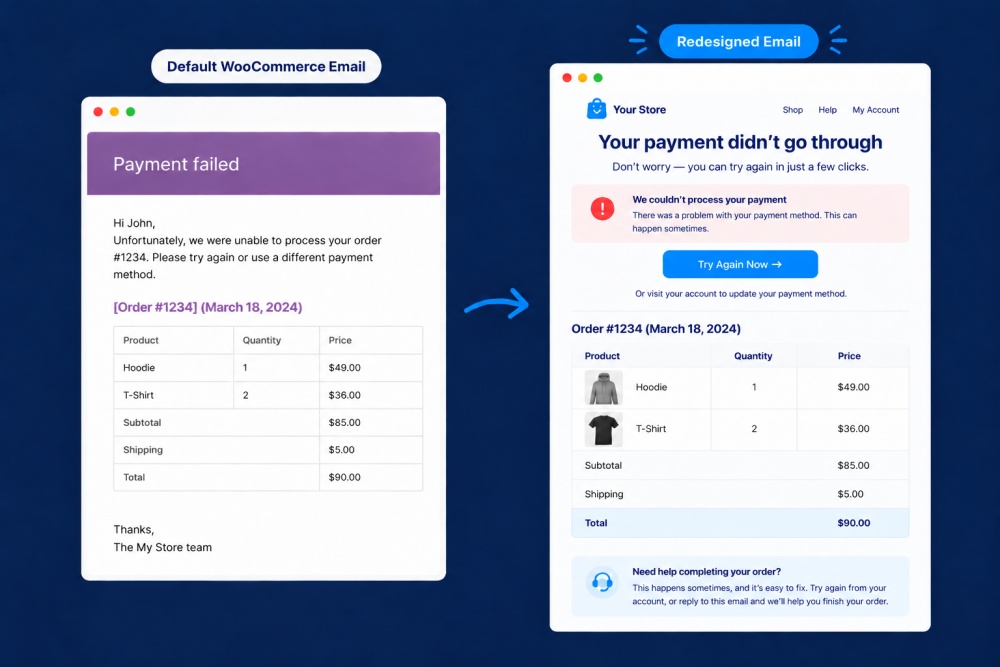
- Subject: There was a problem with your {site_title} order #{order_number}
- Heading: Your payment didn’t go through
- Additional content: This happens sometimes, and it's easy to fix. Try again from your account, or reply to this email and we’ll help you finish your order.
WooCommerce's core cancelled order email goes to the store admin, not the customer.
Before adding a plugin to send cancellation notices to customers, check your email settings. Your version of WooCommerce may already have the notification you need.
On-hold order email
Orders commonly go on hold when customers pay by bank transfer or check and you're waiting for the payment. The email has one main job: make the payment instructions easy to find.
If you use WooCommerce's Direct Bank Transfer payment method, WooCommerce automatically adds your bank details to the email.
The redesign simply gives that section more space and a clear heading.
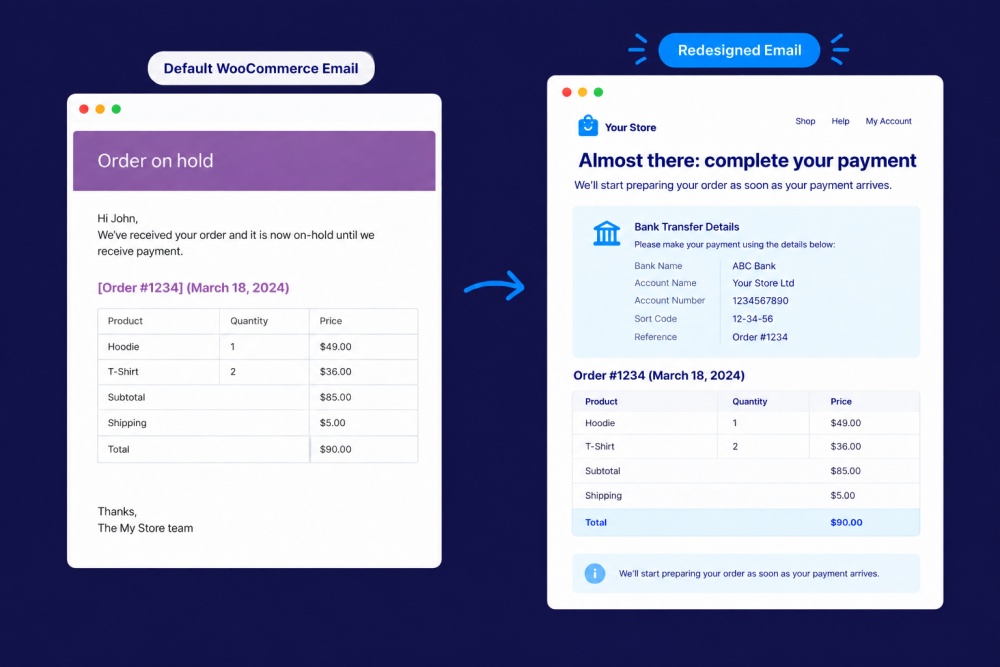
- Subject: Your {site_title} order #{order_number} is waiting for payment
- Heading: Almost there: complete your payment
- Additional content: We'll start preparing your order as soon as we receive your payment.
Customer invoice email template
You send this email manually from the order screen using the Order actions menu.
For unpaid orders, it includes a payment link, which makes it useful for phone orders, custom quotes, and orders you need the customer to pay manually.
In the redesign, the Pay for this order link becomes the most noticeable element in the email.
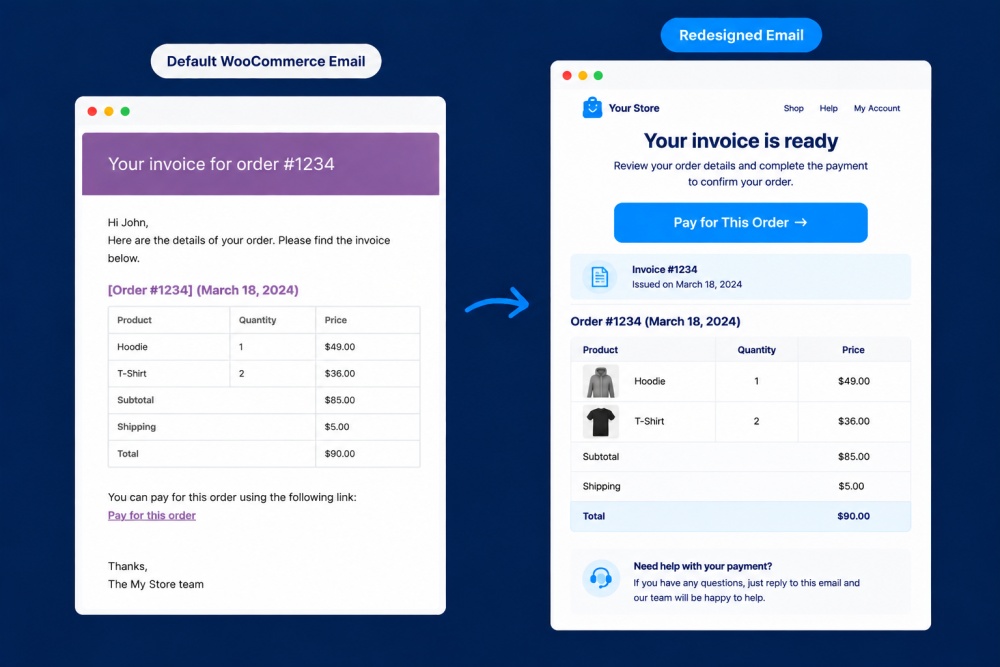
- Subject: Invoice for order #{order_number} from {site_title}
- Heading: Your invoice is ready
WooCommerce doesn't attach a PDF invoice to this email by default. If customers need a PDF for their records, you'll need a PDF invoice plugin.
Our guide to WooCommerce PDF invoices and packing slips walks through that setup.
New account, password reset, and customer note emails
These account emails are short, so the small details matter.
Keep the layout clean, make the main action obvious, and avoid turning transactional messages into sales emails.
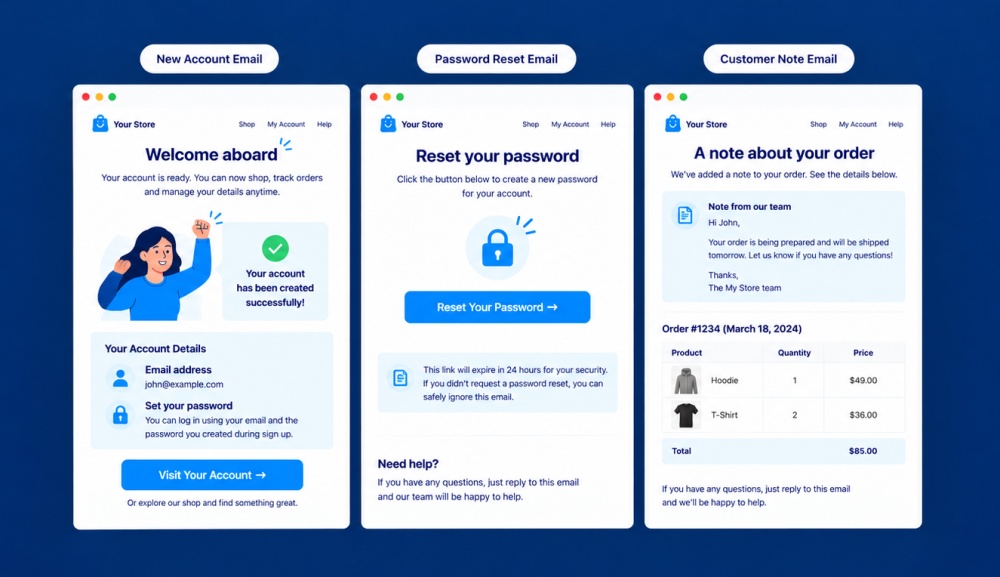
- New account: Welcome the customer and give them an easy path back to your store.
- Password reset: Keep it simple and make the reset button obvious. A security email that looks like an advertisement can make customers hesitate.
- Customer note: This email displays whatever you enter on the order screen, so clean spacing and consistent branding are usually enough.
- New account subject: Welcome to {site_title}, your account is ready
- New account heading: Welcome aboard
For the complete setup, see our guide to WooCommerce new account emails.
How to Apply a New Email Design in WooCommerce (3 Methods)
There are three main ways to change the design of your WooCommerce email templates.
The right method depends on how much control you need and how much time you want to spend maintaining it.
| Method | Good for | Code needed | Different design per email | Safe from updates |
|---|---|---|---|---|
| Built-in settings | Logo, fonts, colors, and wording | None | No, styling applies to all emails | Yes |
| WordPress plugin | Full drag-and-drop designs | None | Yes | Yes |
| Child theme override | Custom markup and logic | PHP and HTML | Yes | Yes, but copies can go out of date |
One question comes up often: whether you should edit WooCommerce's template files directly or make the changes over FTP. The answer is that neither is the right approach.
Changes made directly to WooCommerce's plugin files will be overwritten the next time WooCommerce updates.
FTP is only useful when you're using the code-based method and need to upload your customized files to the child theme.
Method 1: Brand Your Emails With WooCommerce's Built-In Settings
This method is free and takes only a few minutes.
It works well if you want to add your logo and brand colors, then clean up the wording without changing the email layout.
Step 1: Open the default email
Go to WooCommerce ⇨ Settings ⇨ Emails and click 'Manage' next to the email you want to edit.
Step 2: Edit your email
In the Email Template section, you can set your logo, logo width, header alignment, and font family.
Use placeholder values like {site_title}, {order_number}, and {order_date} to dynamically insert store and order information.
The additional content field lets you add a custom message at the bottom of the email, such as a thank-you note or a link to your returns policy.
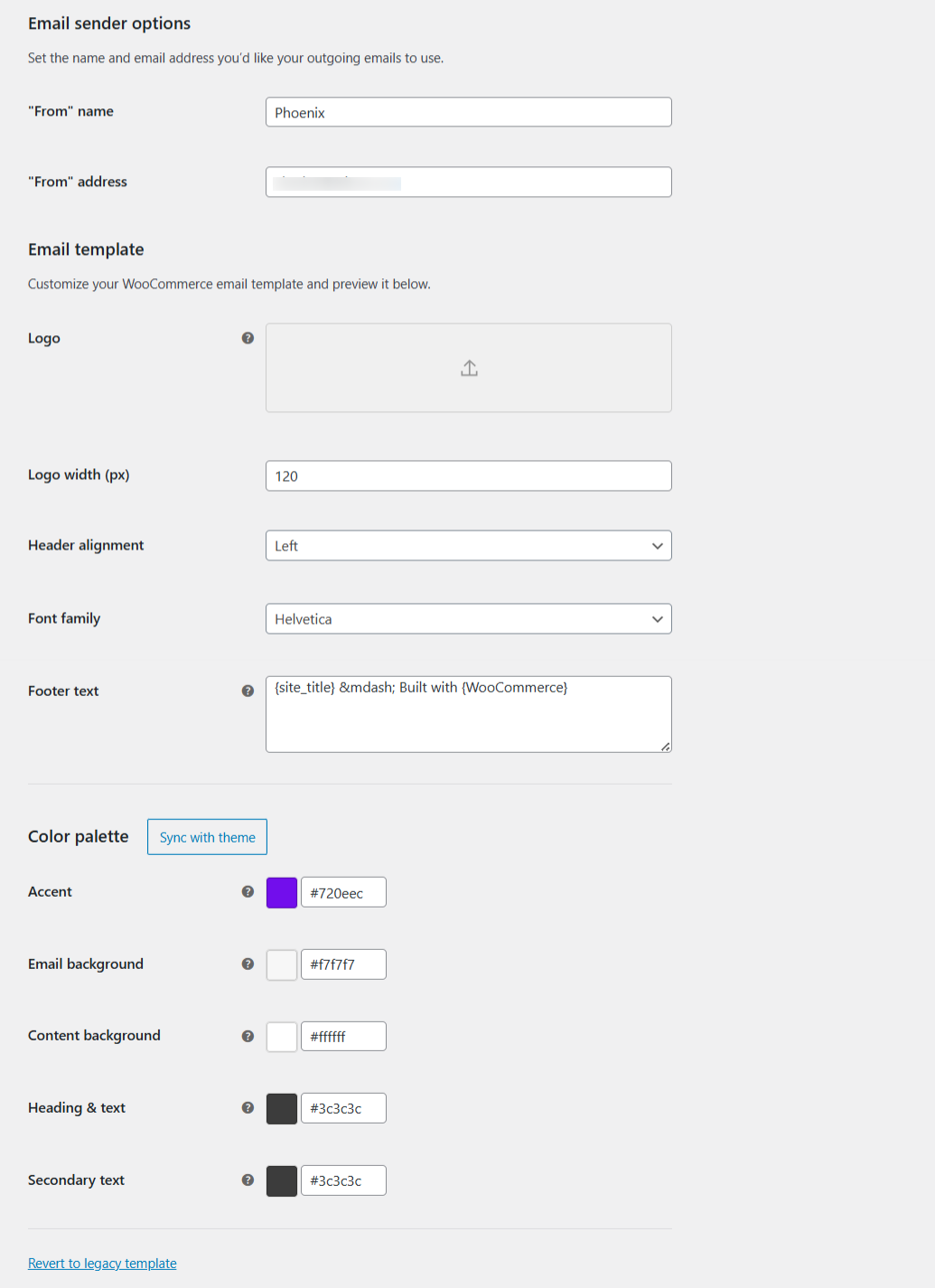
Scroll below the template list to find the global email design options. These settings apply to all email templates at once:
- Header Image: Upload a logo or banner that appears at the top of every email.
- Footer Text: Customize the text at the bottom of every email. Include your store URL and contact information.
- Base Color: Controls the color of headings, links, and the header background.
- Background Color: Sets the outer background color of the email.
- Body Background Color: Sets the inner content area background.
- Body Text Color: Controls the color of all body text.
Preview the result on desktop and mobile, send yourself a test email, and you're done.
Limitations of the built-in settings:
The native WooCommerce email editor only lets you change colors, text, and a header image.
You cannot rearrange the email layout, add custom content blocks, insert product recommendation sections, or build multi-column email designs.
There is no drag-and-drop editor.
For store owners who want full control over their email designs, a dedicated email customizer plugin is the better option.
Method 2: Apply a Pre-Designed Template Without Code
For this method, we'll use FunnelKit Automations. It lets you replace WooCommerce's default transactional emails with ready-made templates that you can customize in a drag-and-drop builder.
You can also give each order email its own design instead of using one layout for everything.
FunnelKit Automations has a free version on WordPress.org.
The visual email builder and template library are available with the Pro plan. You can compare the available plans on the FunnelKit pricing page.
Here's how to apply a pre-designed template to your email.
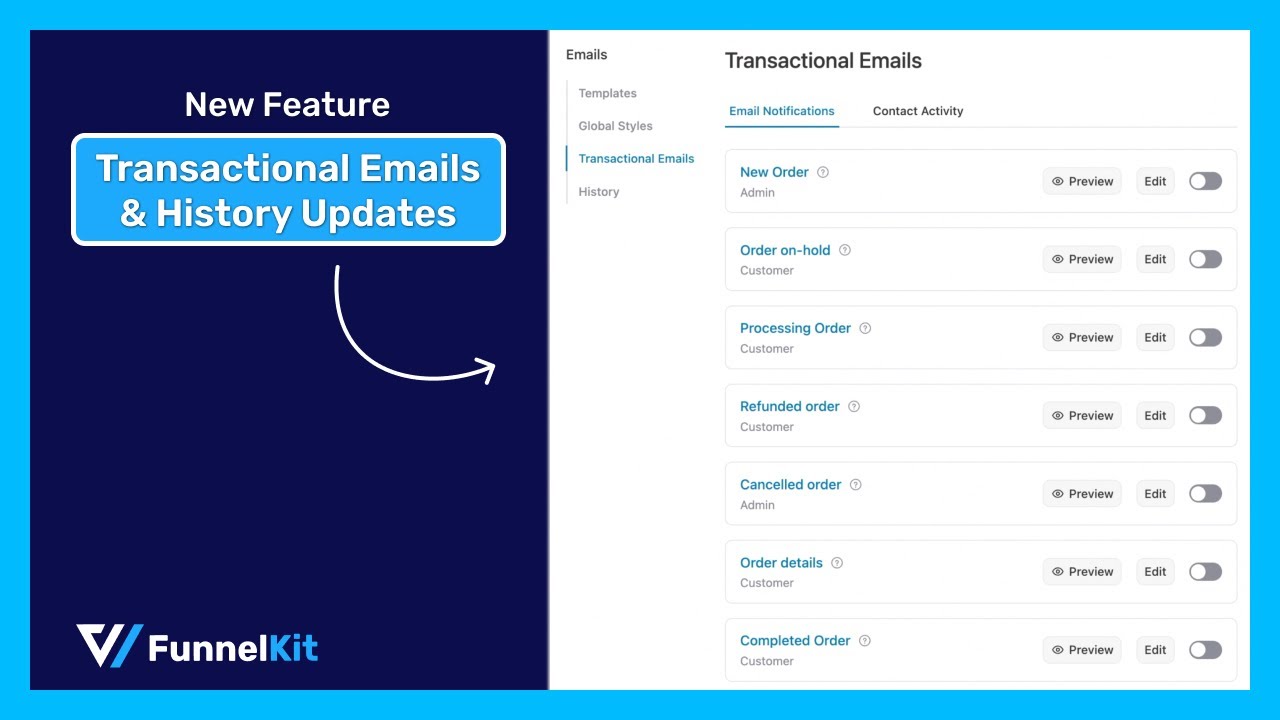
Step 1: Open the transactional emails list
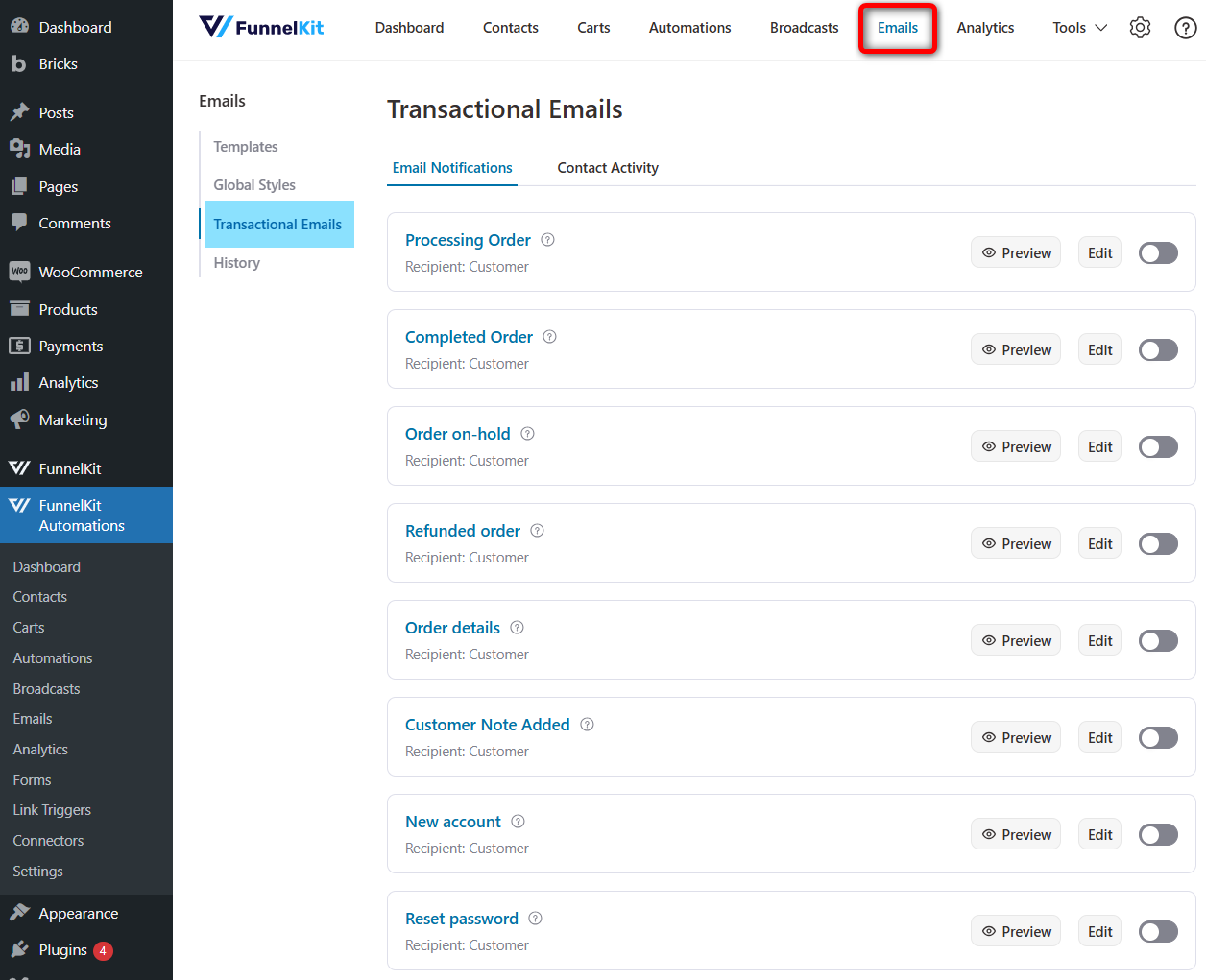
Go to FunnelKit Automations ⇨ Emails and open the Transactional Emails tab. You'll see your WooCommerce order and account emails listed there, with a template ready to customize.
This becomes the main place to manage these emails.
Step 2: Set your global styles first
Add your logo, brand colors, and fonts in the global style settings.
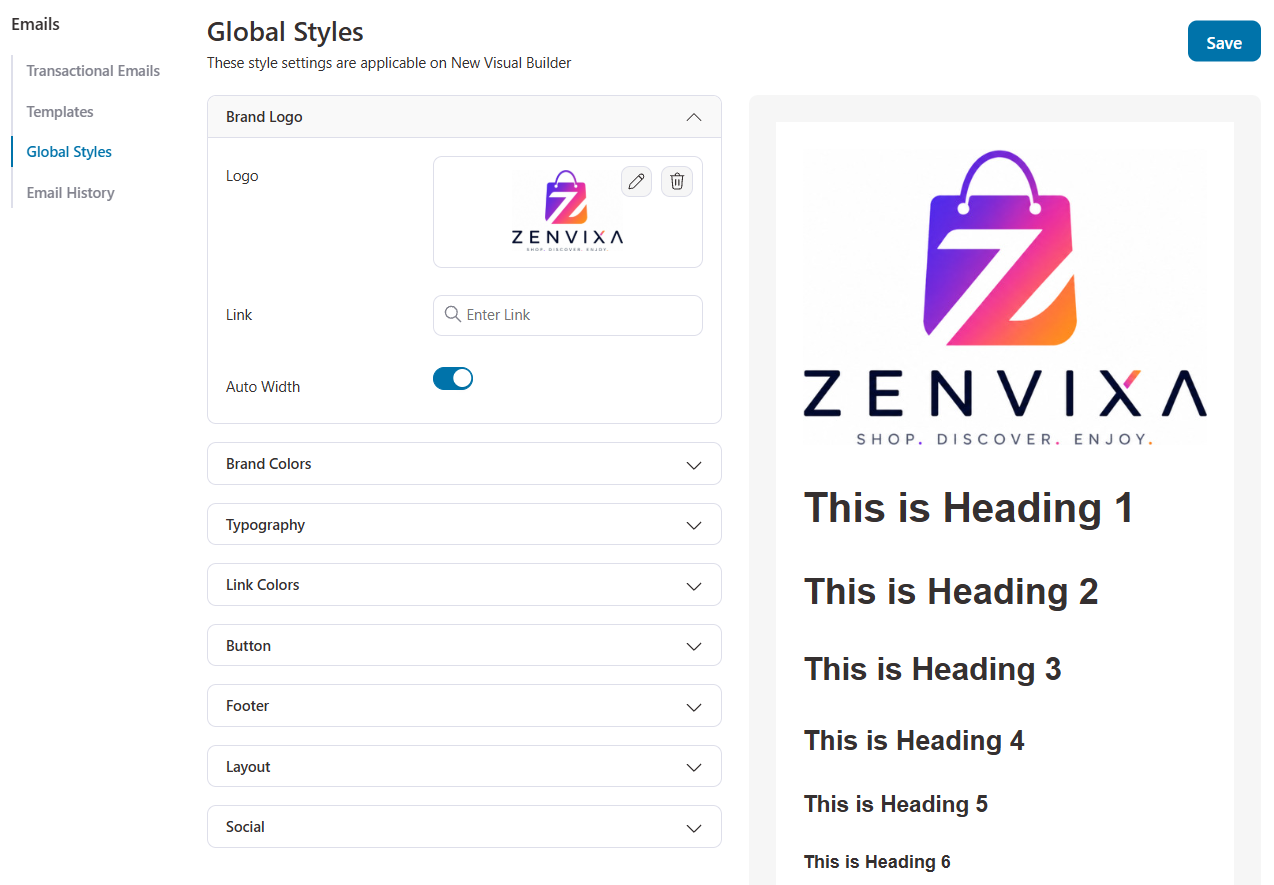
New templates will use these settings automatically, so you don't have to repeat the same branding changes across all emails.
Step 3: Customize the processing order template
This is where you can make the email look and read more like your store.
Enter the from name, from email, and reply-to email address here.
Next, write your subject line and preview text.
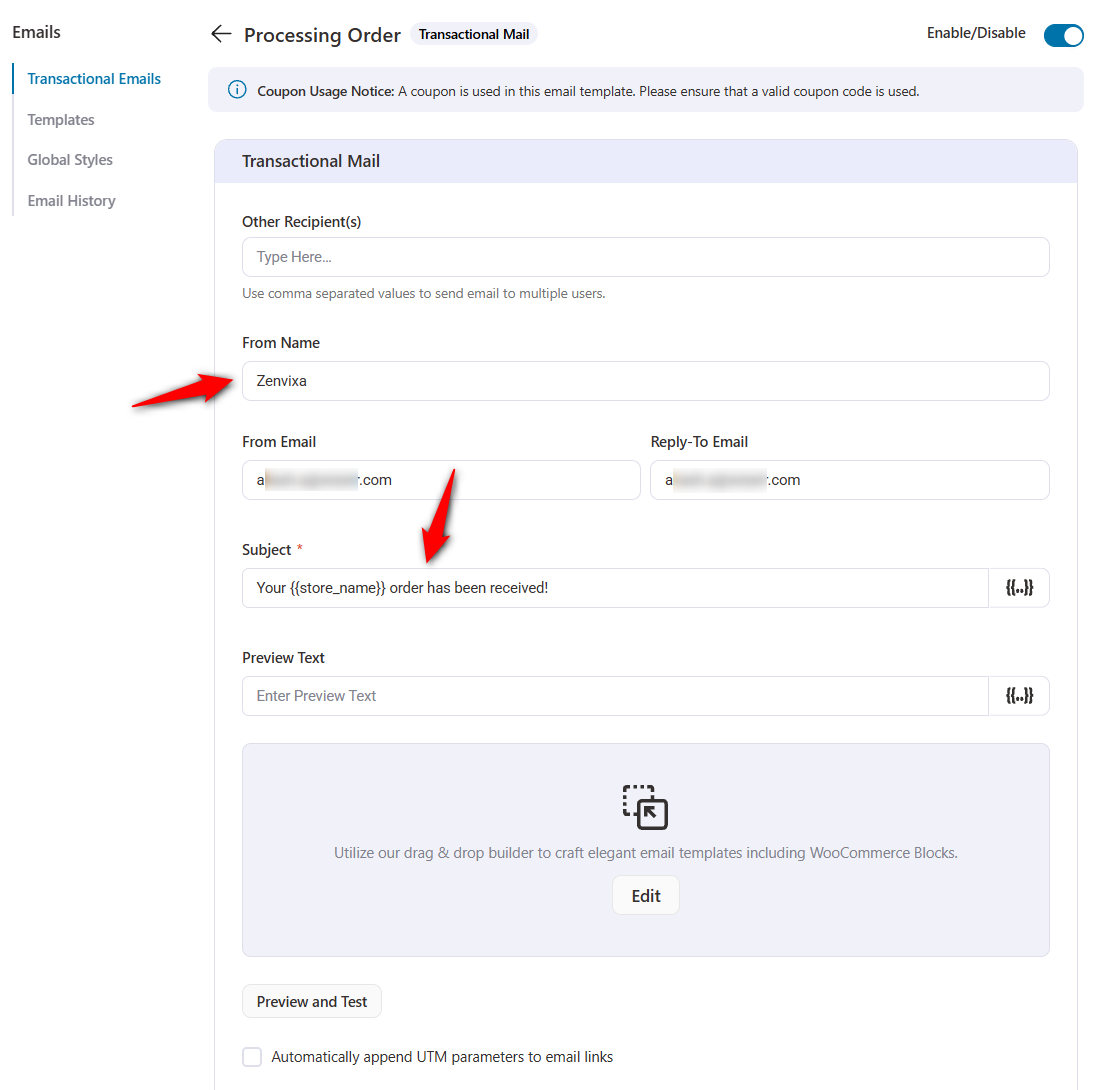
Next, click 'Edit' to open the visual builder, which lets you customize each template and add your brand colors, logos, images, and dynamic content such as the customer name, order summary, and more.
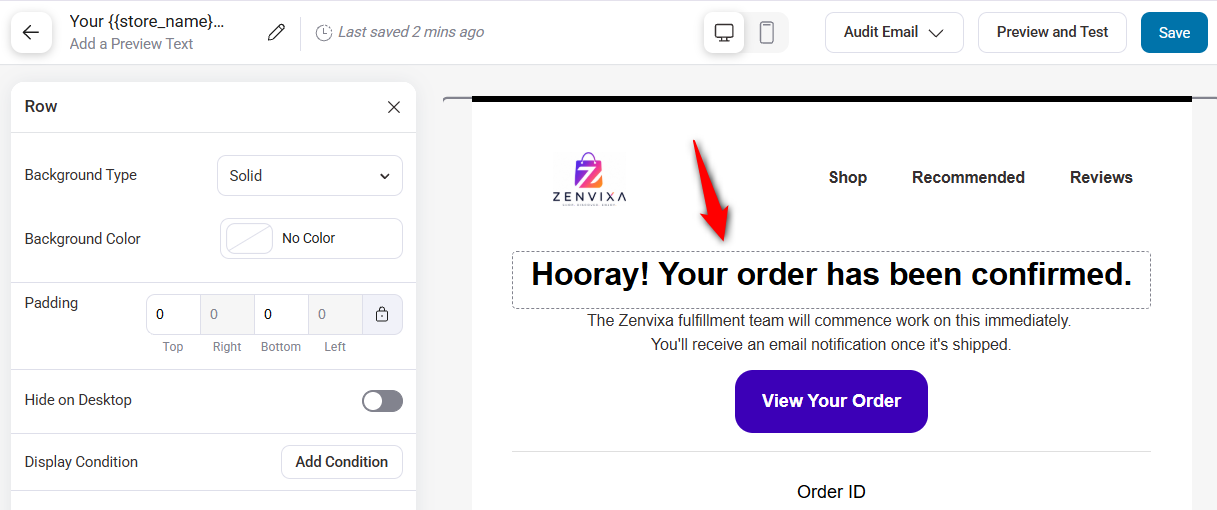
- Add the header section
Select your header to see different customization options on the left.
You can customize the font, alignment, line height, padding, show-on-desktop toggle, or display conditions for this section.
Double-click on the text and edit it.
Furthermore, add the call-to-action button to the header section.
- Edit the order summary
Keep the order summary block so customers can see what they purchased and check the refund against it.
Choose whether to display product images and quantities.
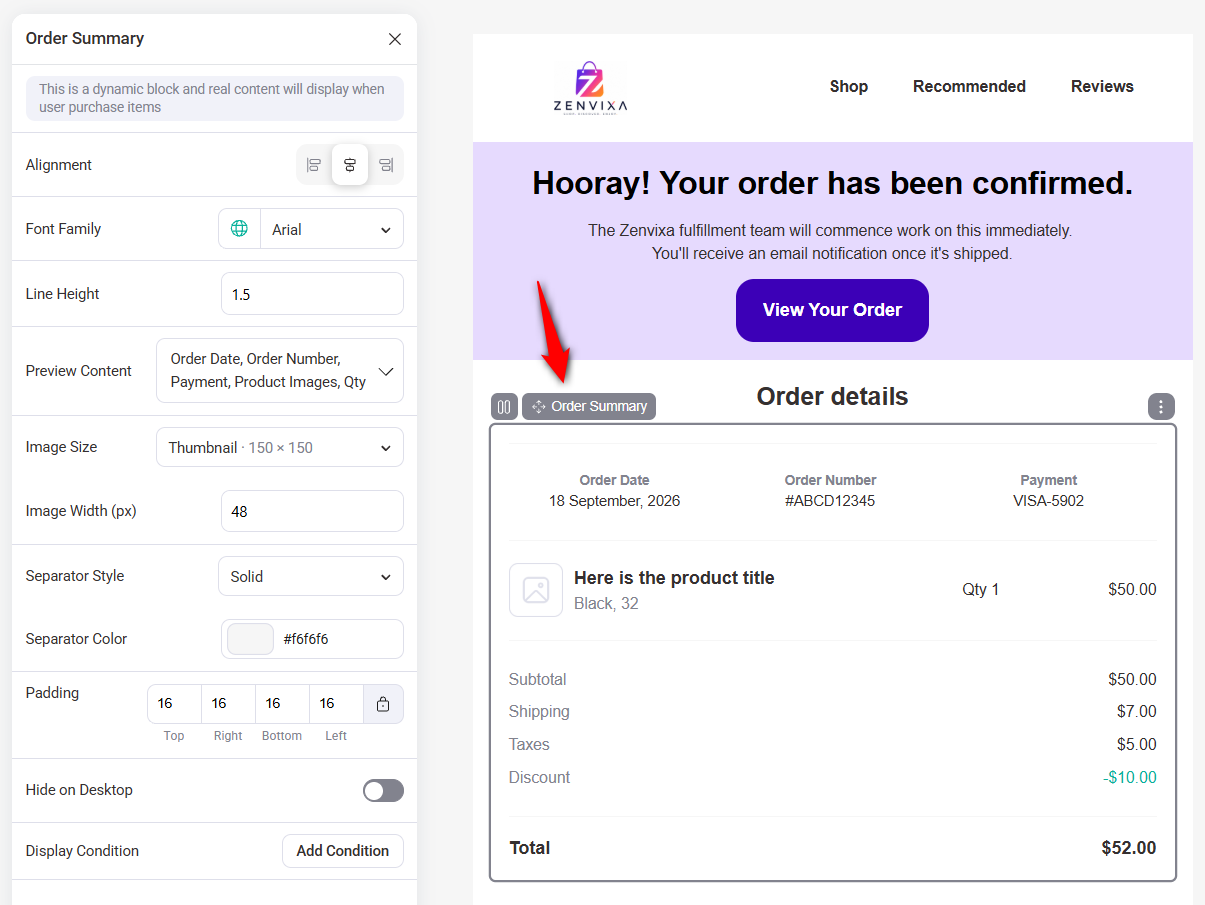
You can even configure the image widths, separator style, separator color, padding, and more.
- Edit the coupons section
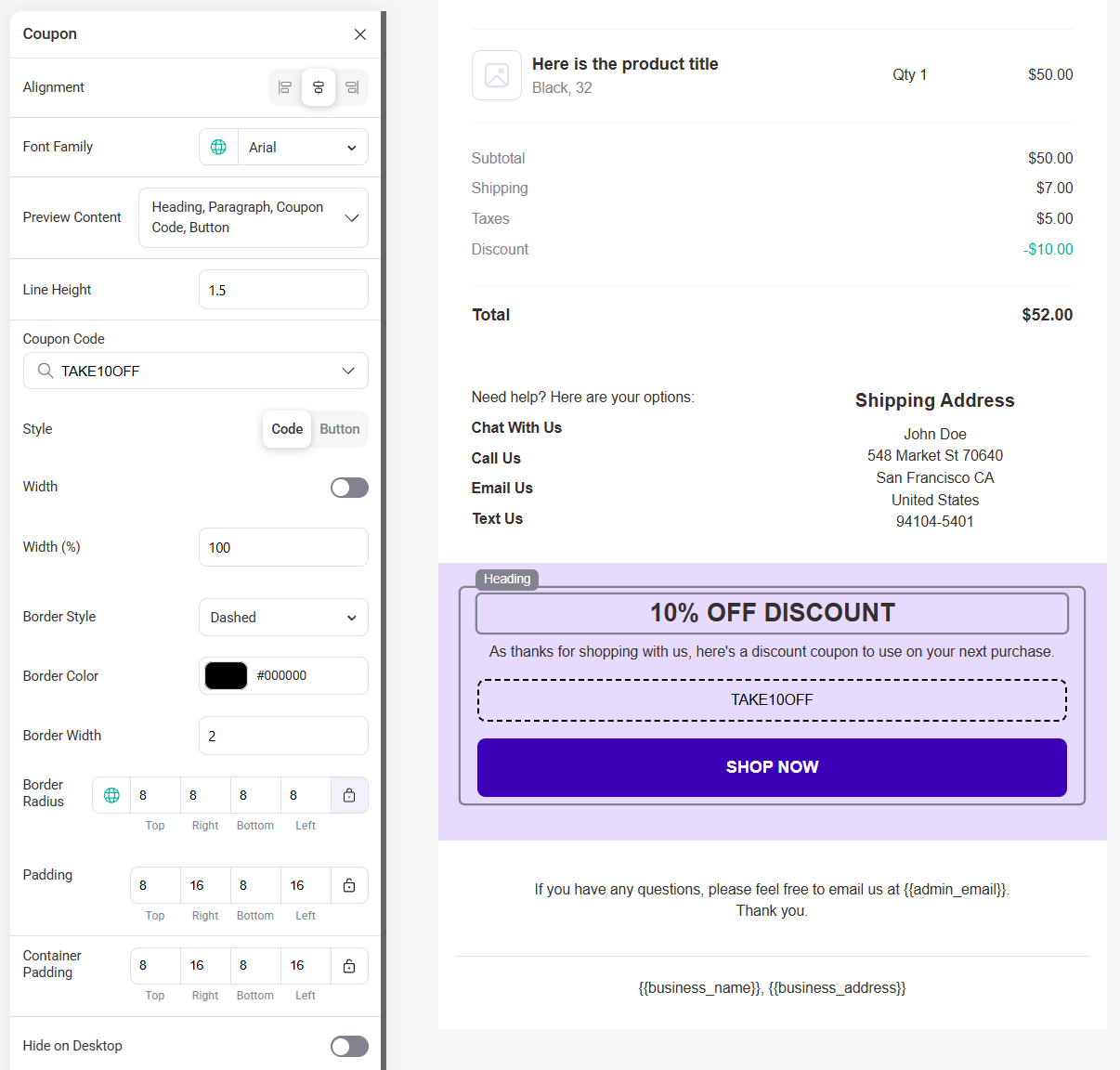
Add a coupon block to offer customers a small incentive on their next purchase.
Enter the coupon code and style the coupon code or button element in your WooCommerce email template.
- Add social media icons
Drag and drop the 'Social' block to your email workspace.
Click on the plus (+) icon and select all the social media icons of your business.
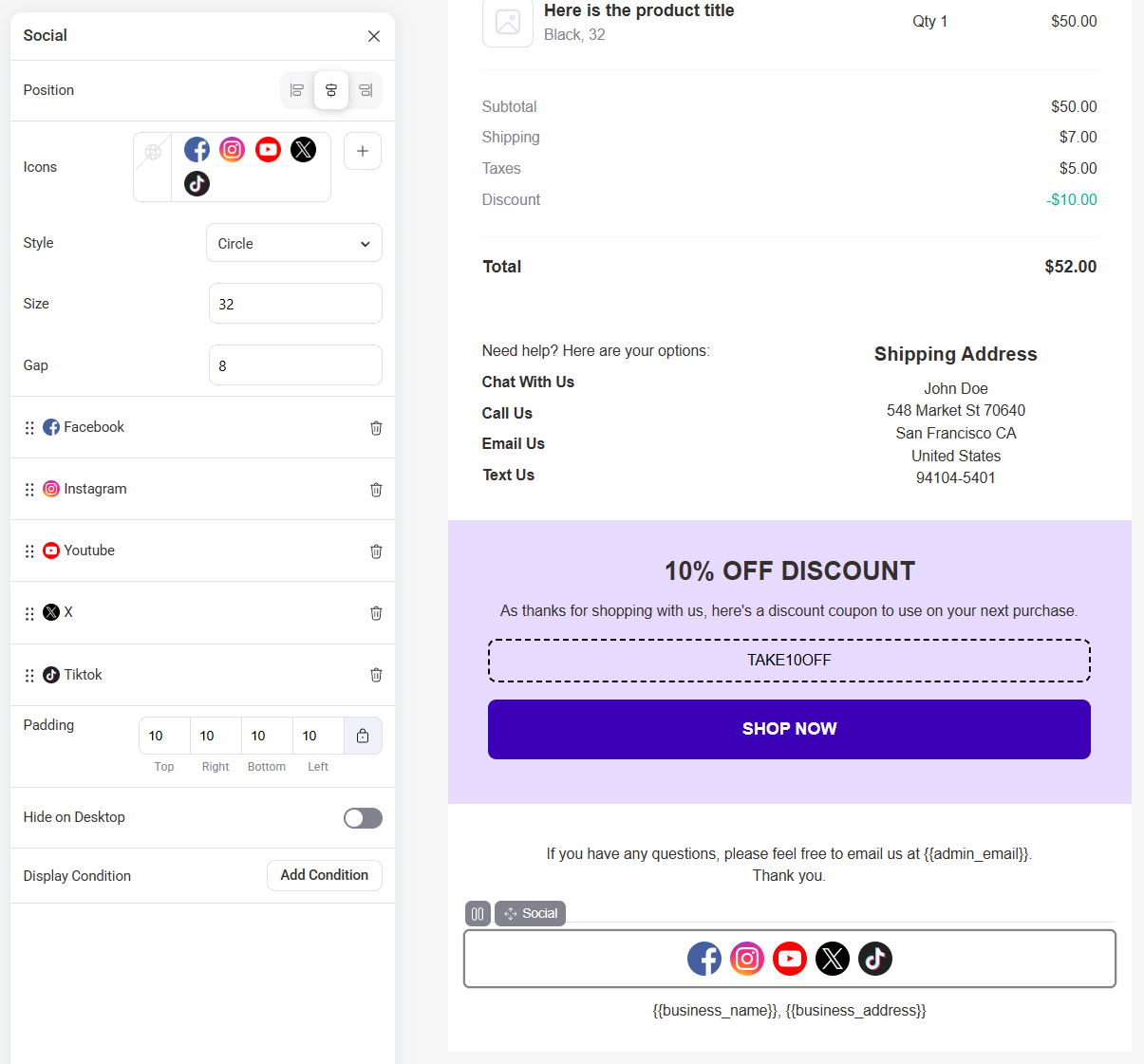
Set the style, size, and gap of your social media icons.
Hit the 'Save' button when done.
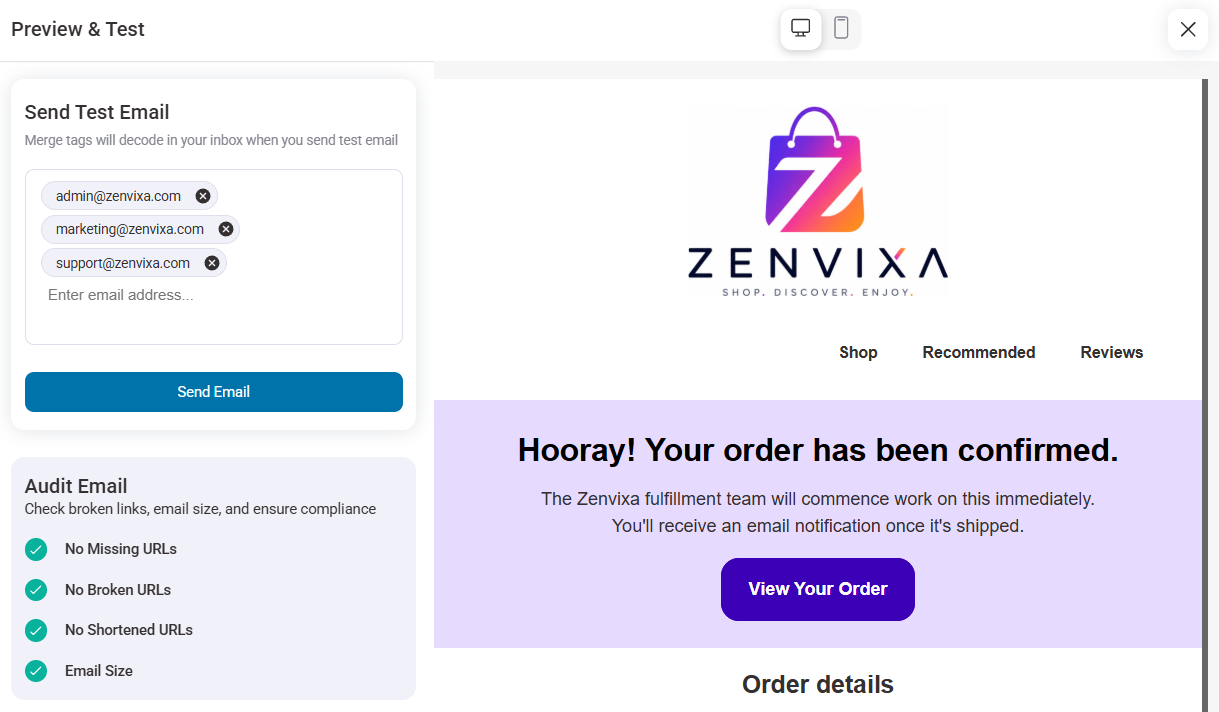
Step 4: Preview, check, and send a test
Use the desktop and mobile previews to check both versions.
Then run the built-in email audit to catch issues such as broken links or an email that's too large.
Send a test to yourself and open it in at least two email apps to make sure everything looks right.
Step 5: Turn it on and test it
Enable the Processing order toggle so FunnelKit Automations sends this version instead of WooCommerce's default email.
Then test the complete flow:
- Place an order by completing the checkout for an item.
- Check your new confirmation email template.
Once you’re happy with it, repeat Steps 3 to 5 for your other emails.
If you manage multiple stores, you can also export completed templates as JSON files.
Prefer to watch the process? This video walks through the same setup:
Creating custom email templates and using them in automations or broadcast emails
To do that, go to the Emails section and click on the 'Create Template' button.
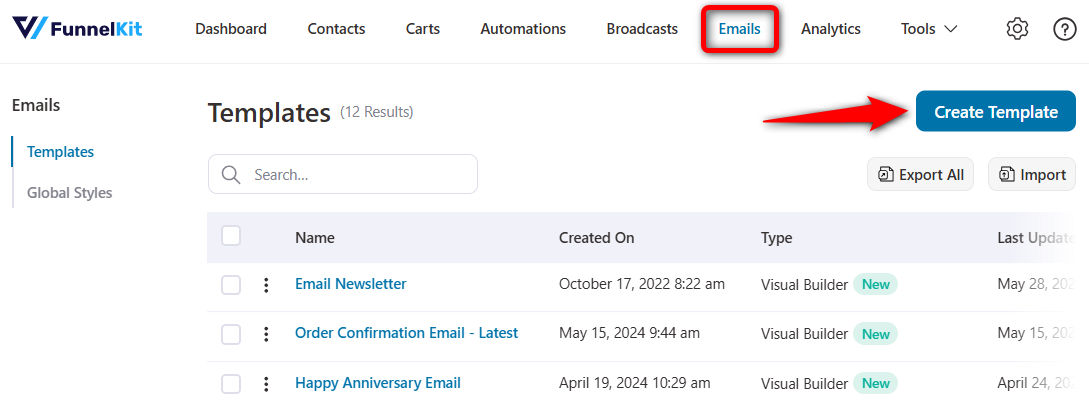
Enter your template name and create it.
Design it with your visual builder as you did above.
Next, use this email template when creating your broadcasts or setting up automated sequences in FunnelKit Automations.
When creating emails, click on the 'Templates' button.
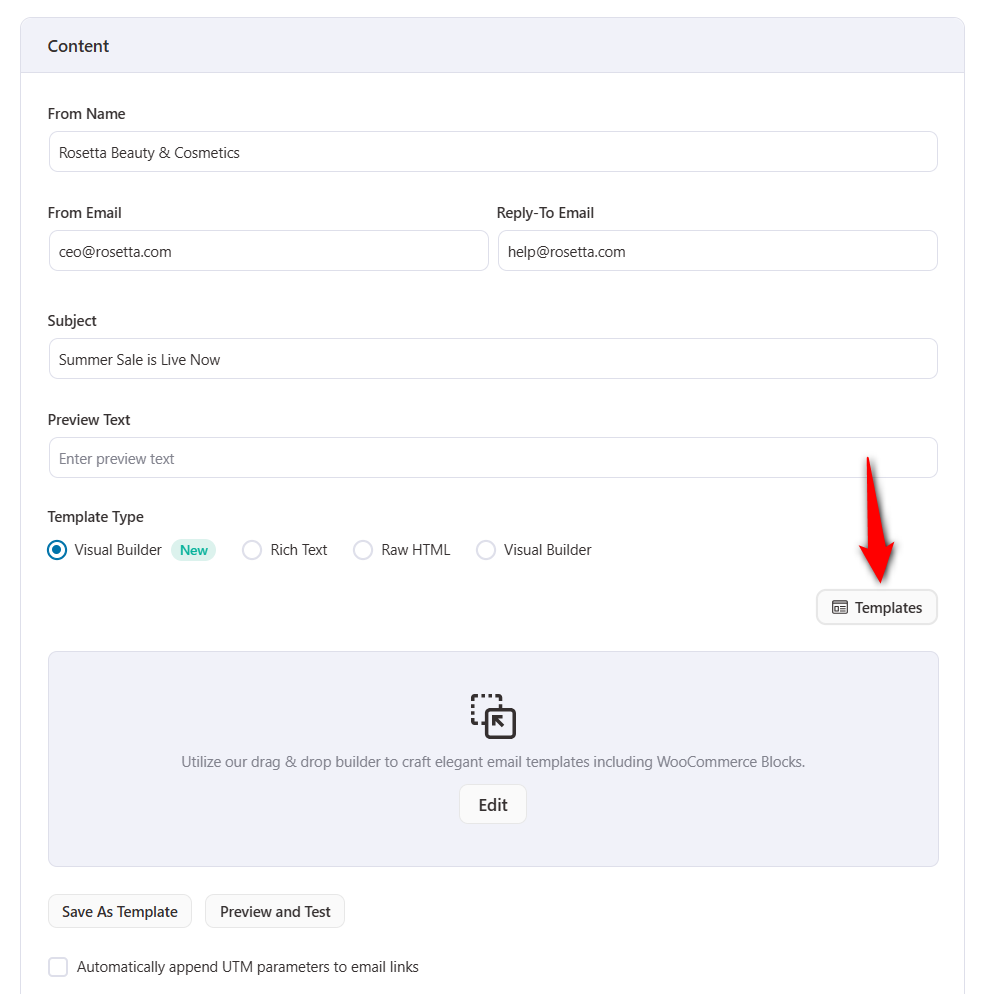
Select a custom template you've created and click 'Apply'. That template will be imported to your automation or broadcast screen.
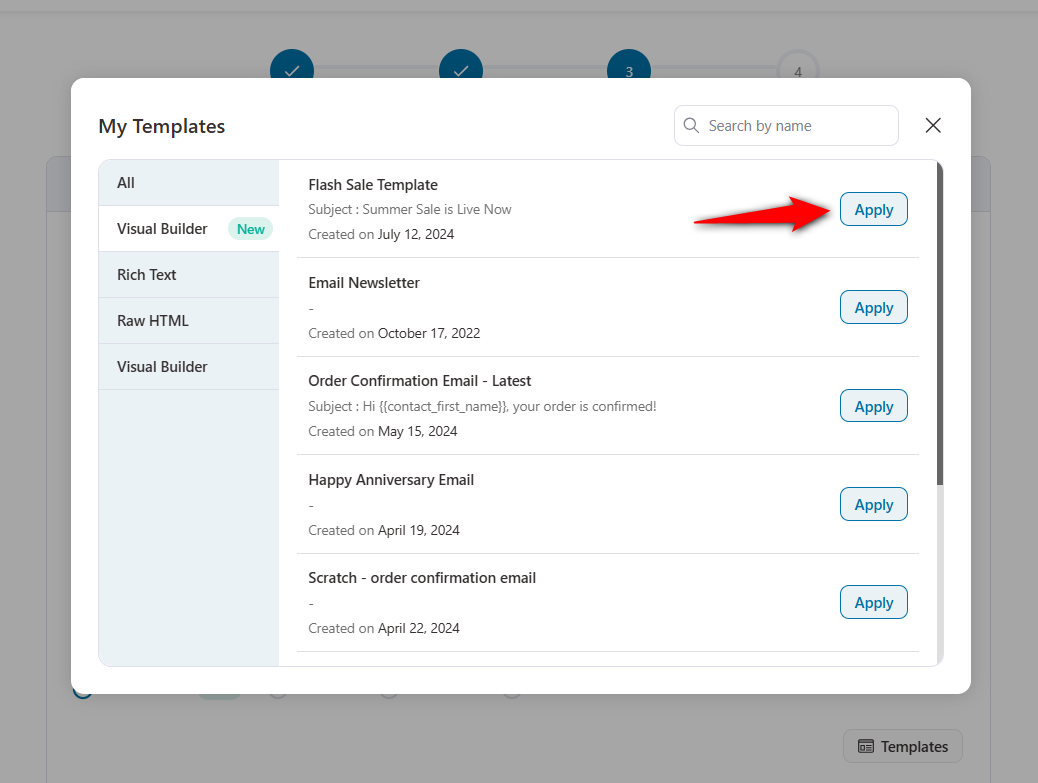
Now, you can activate that automation or send the broadcast.
Method 3: Override the Template File in Your Child Theme

This method gives developers full control over the email's HTML and markup. It works with WooCommerce's classic email templates only.
If your store uses the block email editor, make those changes in the editor instead.
Step 1: Copy the refund template into your child theme
Let's say you want to edit the refunded order email template. For that, go to WooCommerce ⇨ Settings ⇨ Emails, click 'Manage' next to Refunded order, and use the Copy file to theme button.
You can also copy customer-refunded-order.php manually into:
your-child-theme/woocommerce/emails/Step 2: Edit the markup
Open the copied file and change the HTML around the order details. Leave WooCommerce's action hooks, such as woocommerce_email_order_details, in place.
Payment gateways and other plugins can use these hooks to add their own content to the email.
Step 3: Restyle all your emails from one place
Add this snippet to your child theme's functions.php file.
WooCommerce converts these styles to inline CSS before sending the email, which helps them work across different email clients.
add_filter( 'woocommerce_email_styles', 'fk_custom_email_styles', 10, 2 );
function fk_custom_email_styles( $css, $email ) {
    $css .= '
        #body_content { background-color: #ffffff; }
        h1 { color: #131144; }
        a { color: #0a66c2; }
    ';
    return $css;
}
Step 4: Add the customer's name to the refund subject line
WooCommerce's built-in placeholders don't include the customer's name. You can add it with a filter instead.
The refund email also exposes whether the refund is partial, so one filter can handle both subject lines:
add_filter( 'woocommerce_email_subject_customer_refunded_order', 'fk_refund_subject', 10, 3 );
function fk_refund_subject( $subject, $order, $email ) {
    if ( ! $order ) {
        return $subject;
    }
    $name   = $order->get_billing_first_name();
    $number = $order->get_order_number();

    if ( ! empty( $email->partial_refund ) ) {
        return sprintf( '%s, we have refunded part of order #%s', $name, $number );
    }
    return sprintf( '%s, your refund for order #%s is on its way', $name, $number );
}
You can use the same approach with another email by replacing customer_refunded_order with the relevant email ID from the table earlier in this guide.
After a major WooCommerce update, check WooCommerce ⇨ Status ⇨ Templates for outdated overrides.
If one of your copied templates is behind the current WooCommerce version, review it before continuing to use it.
For the complete list of available actions and filters, see our guide to WooCommerce email hooks.
Where to Get Free WooCommerce Email Templates (and When to Pay)
You can get started with WooCommerce's built-in settings, move to a free visual customizer, or pay for a more advanced template builder.
The main difference is how much control you get over individual emails.
| Option | Cost | What it does | Marketing emails? | Good fit for |
|---|---|---|---|---|
| WooCommerce built-in settings | Free | Sets your logo, fonts, and colors for all emails with a live preview, plus editable text for each one | No | Quick branding without another plugin |
| FunnelKit Automations | Free and Pro | Drag-and-drop builder with ready-made order and marketing templates (builder and templates in Pro) | Yes | Order and marketing emails in one builder |
| Kadence WooCommerce Email Designer | Free | Restyles the default emails in a visual editor, with color, font, and background controls and ready-made layouts | No | A free visual refresh |
| Decorator (WebToffee) | Free | Restyles your emails inside the WordPress Customizer with a live preview | No | People who already know the Customizer |
| Mailonix Email Template Customizer (VillaTheme) | Free and Pro | Drag-and-drop builder with WooCommerce elements, rules for which template applies, and import and export | No | Different designs for different order types |
| YayMail | Free and Pro | Drag-and-drop builder for the default emails, with paid add-ons for other plugins’ emails | No | Stores with lots of WooCommerce extensions |
| YITH WooCommerce Email Templates | Paid | Pre-designed layouts you assign to each email | No | Stores already using YITH plugins |
| ThemesEmail pack (ThemeForest) | Paid, one-time | A downloadable pack of responsive email styles | No | A finished design without building one |
A few details can help narrow down the options:
- YayMail: The free version covers the 11 standard WooCommerce emails. Paid add-ons extend the designer to emails from 80+ other plugins.
- YITH: You can assign different templates to individual email types, including WordPress account emails and emails generated by other plugins.
- ThemeForest: The pack includes 20 styles, product thumbnails, and multilingual support.
- Mailonix: It includes desktop and mobile previews and lets you export templates and move them between sites.
In WooCommerce community discussions, a common suggestion is to use a customizer plugin instead of editing PHP directly.
This gives store owners a visual editor and makes routine design changes less dependent on a developer. Kadence, VillaTheme, and YayMail are among the most common options.
Most of these plugins focus on changing the appearance of WooCommerce's transactional emails.
FunnelKit Automations also lets you build emails for abandoned carts, welcome sequences, review requests, and win-back campaigns in the same builder.
That means your transactional and marketing emails can follow the same design.
You can also export templates as JSON files and use WPML, Polylang, or TranslatePress for multilingual emails.
We tested these options side by side in our roundup of the best WooCommerce email customizer plugins.
Marketing Emails Your Store Needs Beyond Order Updates
WooCommerce handles transactional emails triggered by orders and account activity. For marketing emails such as abandoned cart reminders, review requests, and win-back campaigns, you'll need an email automation plugin.
Here are a few useful marketing emails to add beyond the standard WooCommerce notifications:
| Abandoned cart reminder | A shopper leaves items in their cart | Cart abandonment recovery |
| Welcome email | Someone subscribes or creates an account | WooCommerce welcome email |
| Review request | A few days after an order is delivered | Product review reminder |
| Win-back email | A customer hasn't ordered in a while | Win-back campaigns |
| Product recommendation | After a purchase, based on what was bought | Product recommendations |
5 Must-Have WooCommerce Email Templates to Have in Your Store
We have listed some brilliant ideas for creating WordPress email templates below:
1. Order confirmation email template
Many marketers don’t focus much on order confirmation emails. They consider these emails to be often sent out of necessity after the purchase is made.
However, order confirmation emails enhance conversions and improve retention rates.
So, focus on setting up a branded order confirmation email template on your WordPress site.
FunnelKit offers 2 pre-designed order thank-you email templates. Here is a widely used FunnelKit template for WooCommerce order notification emails:
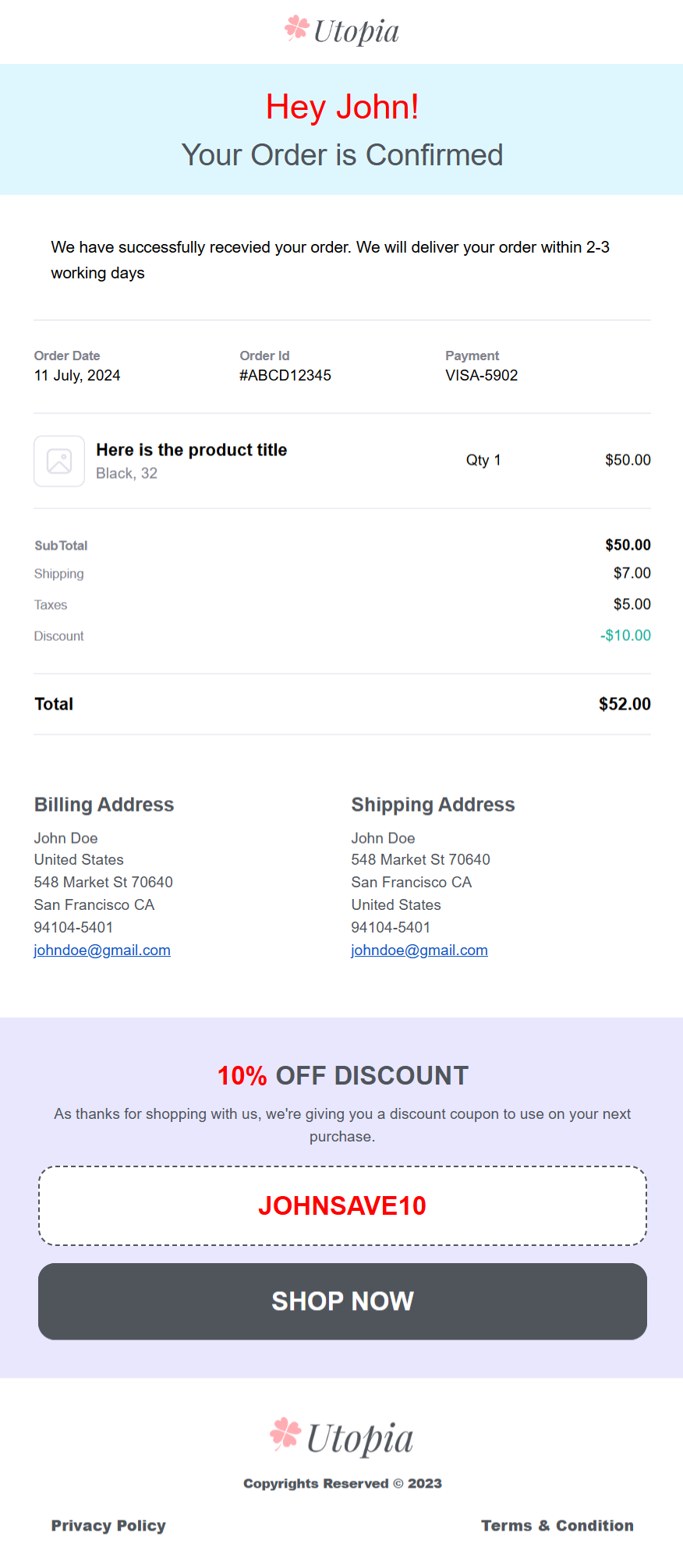
You can even send separate emails for each product in an order and design them elegantly with FunnelKit Automations.
You can also customize transactional email templates, such as shipment tracking, subscription, order cancellation, refunds, and more.
2. Product education email
Some products require customer education so they can use them effectively and to their full potential.
Clear instructions help customers understand the product’s features, benefits, and best practices.
This enhances the customer experience, reduces support inquiries, and increases customer satisfaction.
See one of the most-used product education email templates of FunnelKit - feel free to customize this template at any time.
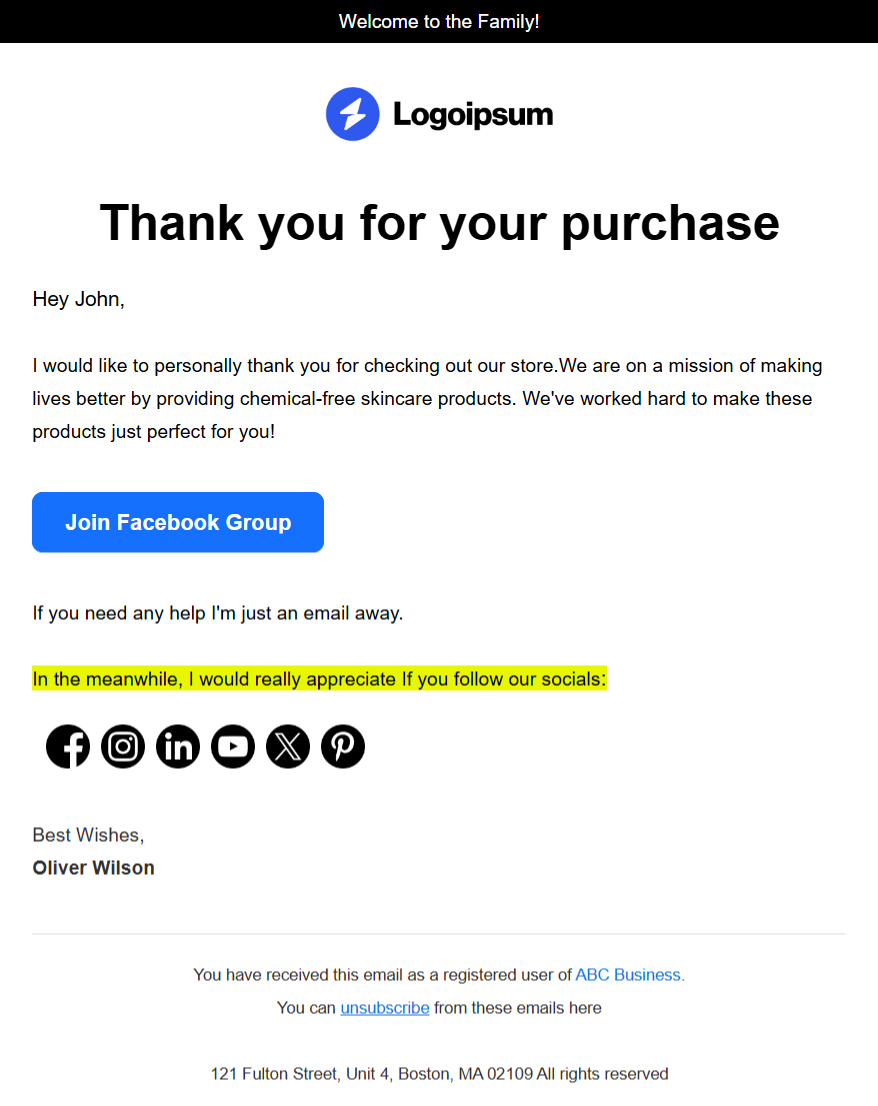
So, setting up the right product education email templates is the best way to proceed.
3. Upsell or product recommendation email template
Offering upsells or product recommendations in your emails is a strategic way to leverage high engagement and build stronger customer relationships.
By suggesting relevant products, you can increase the potential for additional sales and enhance customers' overall experience with your brand.
Here’s a popular product recommendation email template offered by FunnelKit:
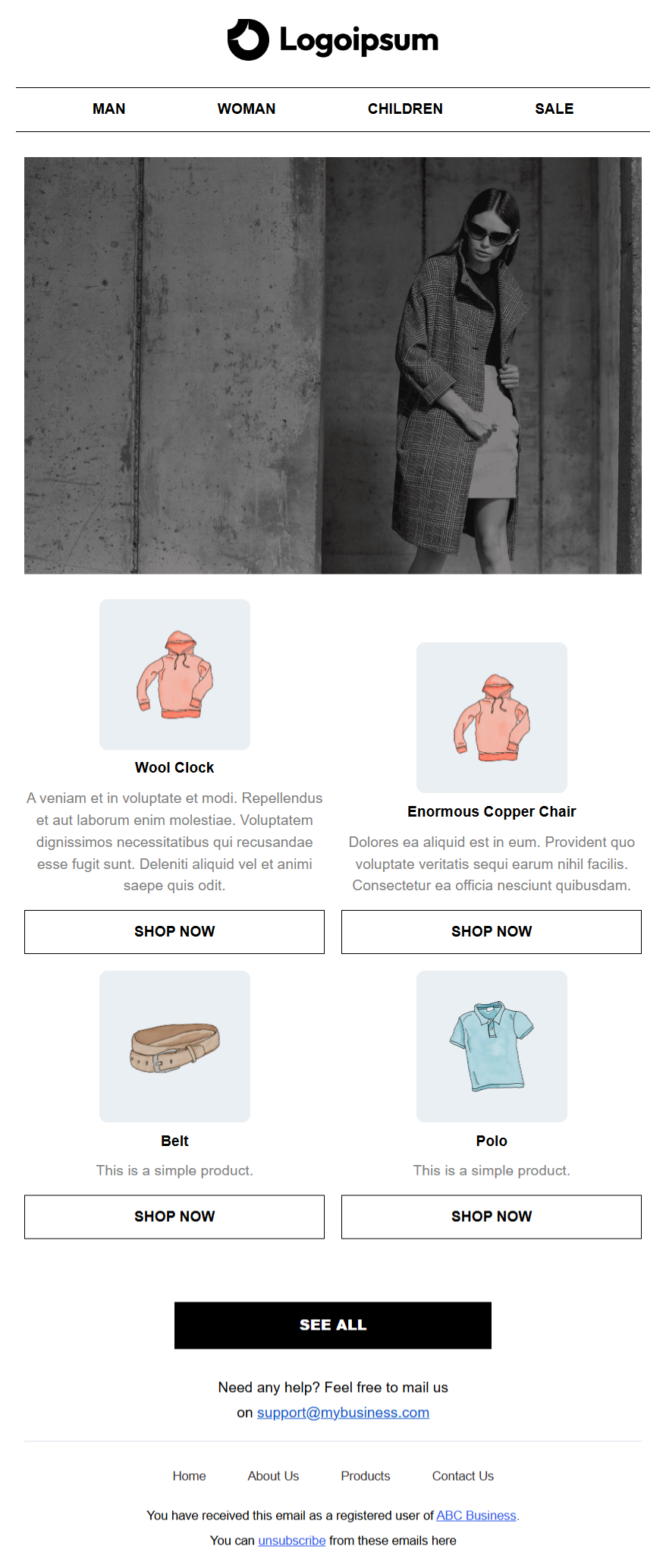
This will help you benefit from the high engagement these emails drive, building rapport along the way.
4. Newsletter email template
81% of B2B marketers prefer email newsletters as the most effective form of content marketing.
Email newsletters offer incredible opportunities to connect with the people that matter most to your business.
See the newsletter email template in WooCommerce:
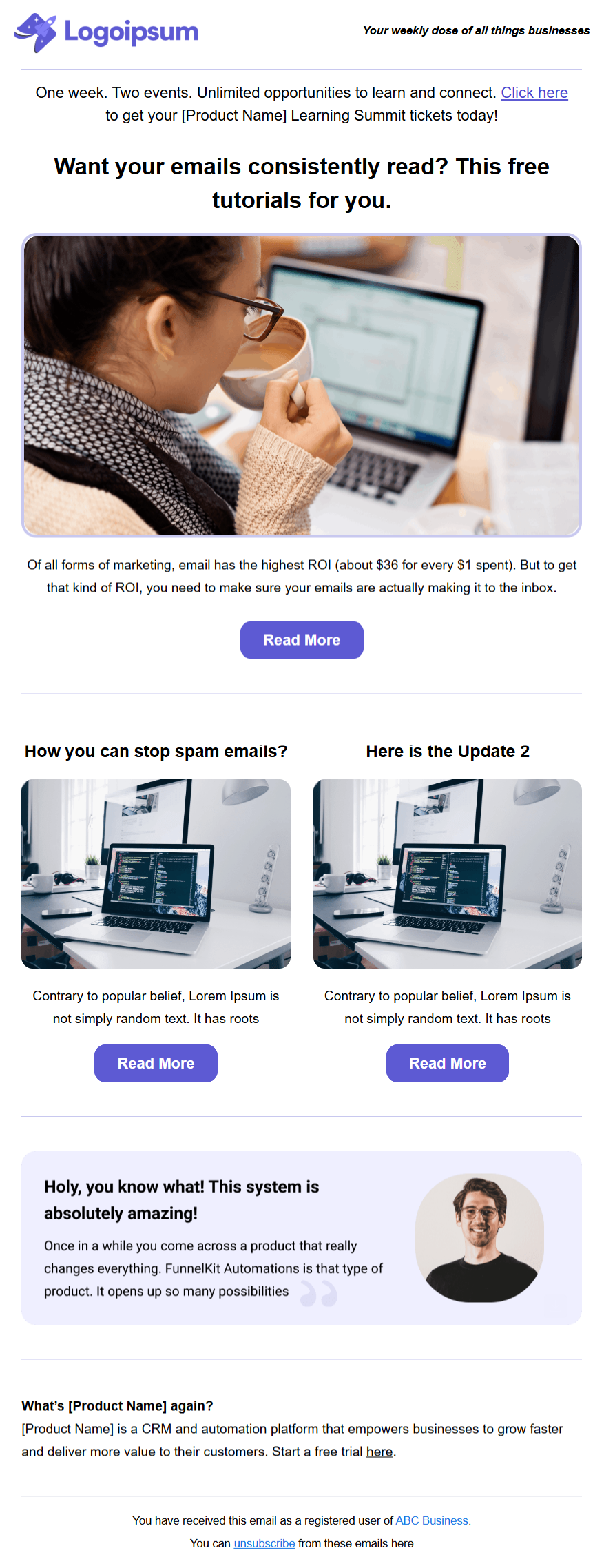
Therefore, having a great WooCommerce email newsletter template at your disposal helps deliver the right message to the right people quickly.
5. Flash sale template
Many eCommerce store owners consider flash sales a foolproof selling strategy because they increase click-to-open rates by 74%.
Flash sales create urgency, encouraging shoppers to explore your store, research products, and buy.
Here is the flash sale template in WooCommerce:
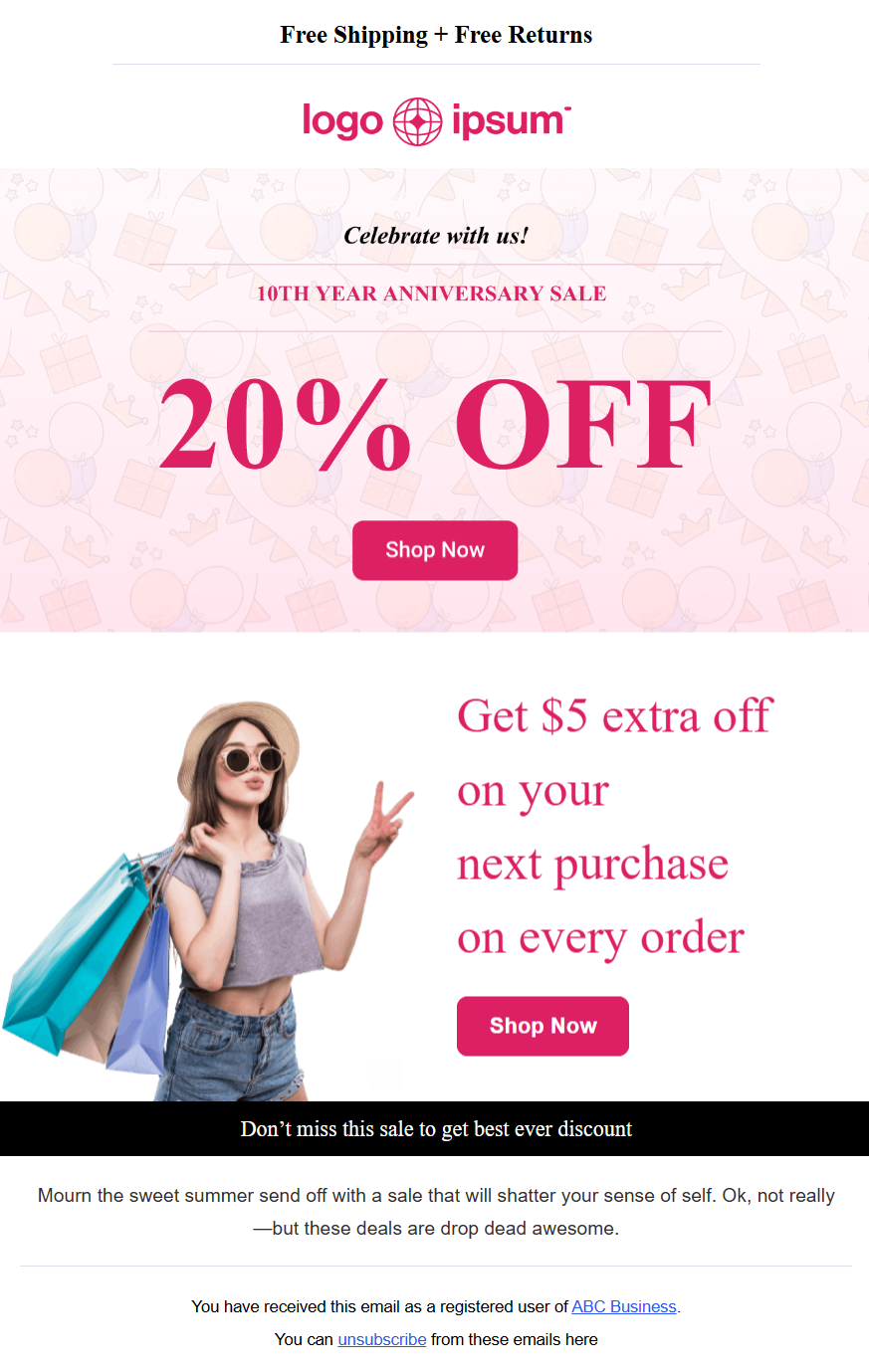
Flash sale templates let you inform your contacts about the sales running in your store.
Email HTML and CSS: What Actually Shows Up in the Inbox
An email can look perfect in the WooCommerce preview and still look different once it lands in an inbox.
Email clients support much less HTML and CSS than modern web browsers, so you need to design for their limitations.
According to Litmus, Apple Mail and Gmail account for nearly 90% of email opens, making them useful starting points for testing your WooCommerce email templates.
Follow the rules below to keep your layouts intact.
- Use tables for layouts: Many email clients still have limited support for flexbox and grid. That’s why WooCommerce's classic email templates rely on tables.
- Let WooCommerce inline your CSS: Add custom styles through email-styles.php or the filter shown in Method 3. CSS inside a separate <style> tag can be stripped out by some email clients.
- Keep the width around 600 pixels: WooCommerce uses a 600px container by default, which works well across most desktop and mobile screens.
- Use a PNG or JPG logo with a full URL: Gmail doesn't support SVG images, and relative image paths can break when the email is opened outside your site. Host your logo on your own domain and serve it over HTTPS.
- Account for dark mode: Some email clients automatically switch to dark mode. A logo with a transparent background can become hard to see, so a light outline or solid background can help.
- Add alt text to every image: Email clients often block images until the recipient allows them. Descriptive alt text keeps the email understandable while the images are hidden.
- Check CSS support before using a feature: Can I Email is a useful reference for checking which HTML and CSS features different email clients support.
If you're looking for email template HTML code to start with, WooCommerce's classic templates are PHP files that output the HTML.
The simplest starting point is to copy the default template file using the process in Method 3.
7 Best Practices to Make Your WooCommerce Emails Convert
Customizing email templates enhances customer experience and reinforces your brand identity.
Here are some best practices to follow when customizing your WooCommerce email templates:
1. Keep your email design consistent across all emails
Ensure your email design reflects your brand’s color theme and font typography. Place your logo at the top of every email.
Set up global email styles to configure your brand logo and other design elements that automatically insert into your emails.
Use a tone and style that replicates your brand's personality.
2. Keep emails simple and clear
Keep the content of your emails concise and to the point. There is no need to elaborate. Share your support email ID or a URL so they can visit to clear their queries.
Use a clean and simple layout that makes your emails easy to read and navigate.
Make your call to action (CTA) buttons or links clear and prominently visible.
3. Ensure mobile responsiveness
Over 1.7 billion people access email on mobile devices. Therefore, make sure your emails look good on all devices, especially mobile phones.
FunnelKit Automations lets you switch between desktop and mobile view when customizing your WooCommerce email templates.
This allows you to test your emails on various devices and screen sizes to ensure their compatibility.
4. Personalize your emails
Address your users by their first names to add a personal touch, and include dynamic content, such as product recommendations based on past purchases.
For this, FunnelKit Automations provides merge tags that use dynamic data to personalize your emails.
Use segmentation to send targeted emails based on customer behavior and preferences.
5. Optimize for email deliverability
Use clear, professional language to avoid triggering spam filters. Ensure your sender name and email address are recognizable to your recipients.
Always use an SMTP plugin when sending emails from WooCommerce.
Follow this guide to fix the WooCommerce not sending emails issue.
6. Use visuals wisely
Use high-resolution images that load quickly and ensure a seamless visual experience.
Maintain a balance between text and images to avoid overwhelming your readers with too much information.
Include alt text for images to improve accessibility and readability if images fail to load.
7. Test and optimize each element in your email
Run A/B tests on elements such as subject lines, CTAs, and layouts to see what works best for you.
Regularly review and update your WooCommerce email templates to keep them fresh and effective.
Monitor metrics like open rates, conversion rates, and click-through rates to measure your email campaigns' effectiveness.
Fixing Common Email Template Problems in WooCommerce
| Problem | Likely cause | How to fix it |
|---|---|---|
| Changes aren't showing up | Another plugin controls that email, or you edited a parent theme file | Check which plugin sends the email and move your overrides into the child theme |
| The override isn’t working | The file is in the wrong folder or in the parent theme | Use Copy file to theme so the file lands in your-child-theme/woocommerce/emails/ |
| The logo won’t show | It uses a relative URL or SVG format, or images are blocked | Upload a PNG or JPG and use its full HTTPS URL |
| Custom CSS gets ignored | The styles sit in a style tag that email apps strip, or the CSS isn't supported | Move the styles into the woocommerce_email_styles filter and check caniemail.com |
| The layout breaks in Outlook | Outlook for Windows renders HTML with Microsoft Word, which ignores a lot of CSS | Stick to table layouts and simple CSS |
| Emails don’t send or land in spam | Your host’s default PHP mail function | Send through an SMTP service, as covered in our guide to fixing WooCommerce not sending emails |
| Customers get duplicate emails | Two plugins, or a plugin and WooCommerce, send the same notification | Turn off the duplicate in WooCommerce settings or in the plugin |
Frequently Asked Questions
Navigate to WooCommerce > Settings > Emails in your WordPress dashboard. Click Manage next to any email template to edit its subject line, heading, and additional content. Below the template list, you will find global design settings for header image, footer text, base color, background color, body background color, and body text color. These settings apply to all email types simultaneously. This is the simplest approach, but it limits you to basic color and text changes.
Yes. WooCommerce generates its email layouts from PHP template files located in the wp-content/plugins/woocommerce/templates/emails/ directory.
For example, the file for the processing order email is customer-processing-order.php. To customize these files safely, copy the template you want to edit into your child theme at wp-content/themes/your-child-theme/woocommerce/emails/ and make your changes there.
This override method ensures your changes survive WooCommerce updates. You don't need FTP access if you can use the WordPress file manager, but many developers prefer FTP or SFTP to edit these files in a code editor.
Yes. Many free WooCommerce plugins let you edit email templates with basic text or HTML customizations.
These include Kadence WooCommerce Email Designer, Decorator, FunnelKit Automations, YayMail, YITH WooCommerce Email Templates, and Email Template Customizer for WooCommerce by VillaTheme, all of which offer free versions with limited template access and basic editing.
For more advanced features like custom content blocks, product recommendations, and automation workflows, you will need a premium plugin.
Customizing your email templates does not directly harm deliverability, but poorly designed emails can trigger spam filters.
Avoid excessively large images, too many links, spam-trigger words, and all-caps subject lines.
If you are experiencing deliverability problems, the issue is more likely related to your email-sending setup than to your template design.
Using an SMTP plugin like WP Mail SMTP or connecting to a dedicated sending service like SendGrid or Amazon SES ensures your WooCommerce emails actually reach the inbox.
Yes, you can create unique email templates for each order event. Your order confirmation can have a warm tone with product recommendations, while your refund email can use an empathetic tone with support links.
WooCommerce email templates are separate from your website theme and page builder. Elementor, Divi, and other page builders do not directly edit WooCommerce emails.
For this, you need a dedicated email customizer plugin to design your emails. FunnelKit Automations, ThemeHigh, and YayMail each have their own built-in email editors that work independently of your page builder.
Your email design should match your website's branding, but the tools used to build each are different.
Redesign Your WooCommerce Emails, Starting With the One Every Customer Opens
Your order emails already reach most of your customers, so they're a natural place to improve the customer experience and create opportunities for another purchase.
You don't have to redesign all twelve at once. Start with the processing order email, then update the partial refund email.
Once those are in place, add a thank-you coupon to the shipping email and track your repeat orders over the next month.
If you want to manage both order emails and marketing emails in one place, FunnelKit Automations gives you a single drag-and-drop builder for both.
You can handle everything from styled order confirmations and shipping notifications to abandoned cart recovery sequences and post-purchase follow-ups.
Take the next step in optimizing your WooCommerce store's email templates by implementing the tips and techniques discussed in this article.
Editorial Team
September 23, 2026The WooCommerce MailerLite integration takes about 10 minutes to set up, but most store owners stop there. They see the subscriber count starts going up, the plugin shows a green...
Editorial Team
September 23, 2026A WooCommerce auto apply coupon adds the discount to the cart before shoppers have to look for a code. Supermarkets have been doing this for years. If there's a "3...

Editorial Team
September 21, 2026WooCommerce customer segmentation is what separates stores that treat every subscriber the same from stores that actually make more from their list. Sending one broadcast to everyone means new customers,...