

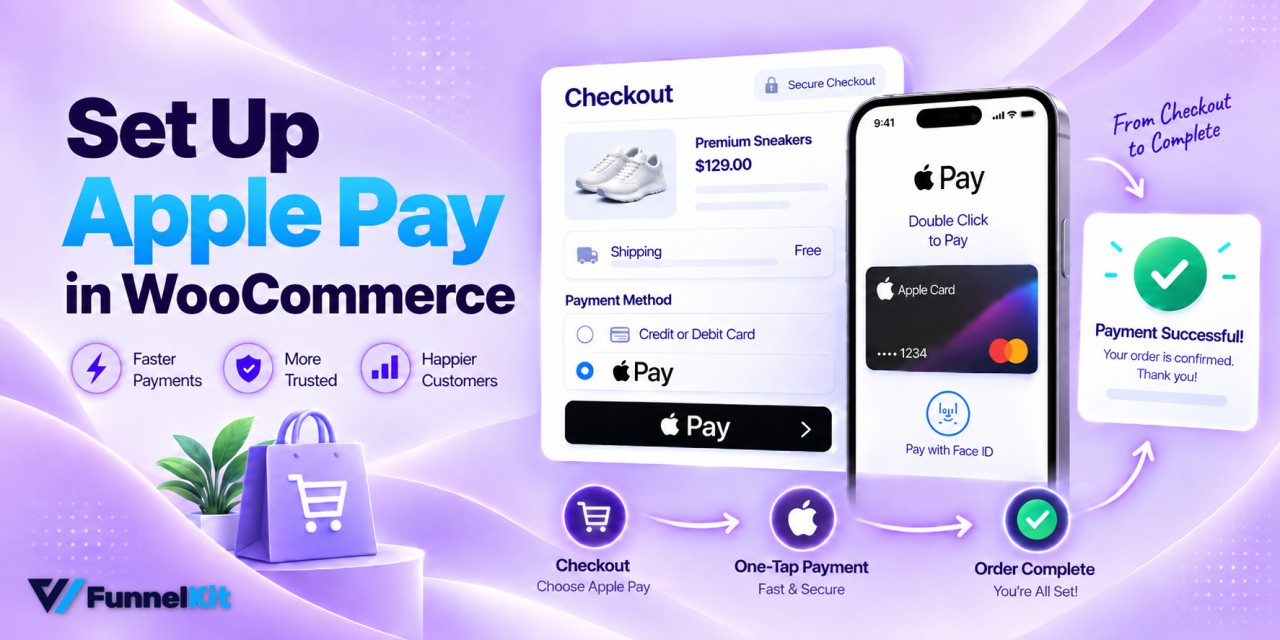
WooCommerce Apple Pay lets shoppers skip most of the checkout form. They tap Apple Pay, double-click the side button, and confirm the payment with a glance at the screen.
Think about someone shopping on a crowded train, holding their phone in one hand and a rail with the other.
Entering a card number and delivery address with one thumb is exactly the kind of friction that can kill an order.
With Apple Pay, their card and shipping details come from Wallet, so they can complete the purchase before they reach the next stop.
If you save just 10 of those orders each month on a store with a $120 average order value, that's $1,200 in sales recovered from shoppers who had already reached checkout.
Apple doesn't charge you an extra fee for using Apple Pay, either. You still pay your payment gateway's standard card processing rate, just as you would with a regular Visa payment.
The setup is where things can get tricky.
WooPayments lets you enable Apple Pay with a single checkbox.
Stripe and Square plugins can register your domain with Apple automatically, but a caching rule can block the verification file and make the Apple Pay button disappear.
In some cases, the button won't appear at all even though everything looks correctly configured.
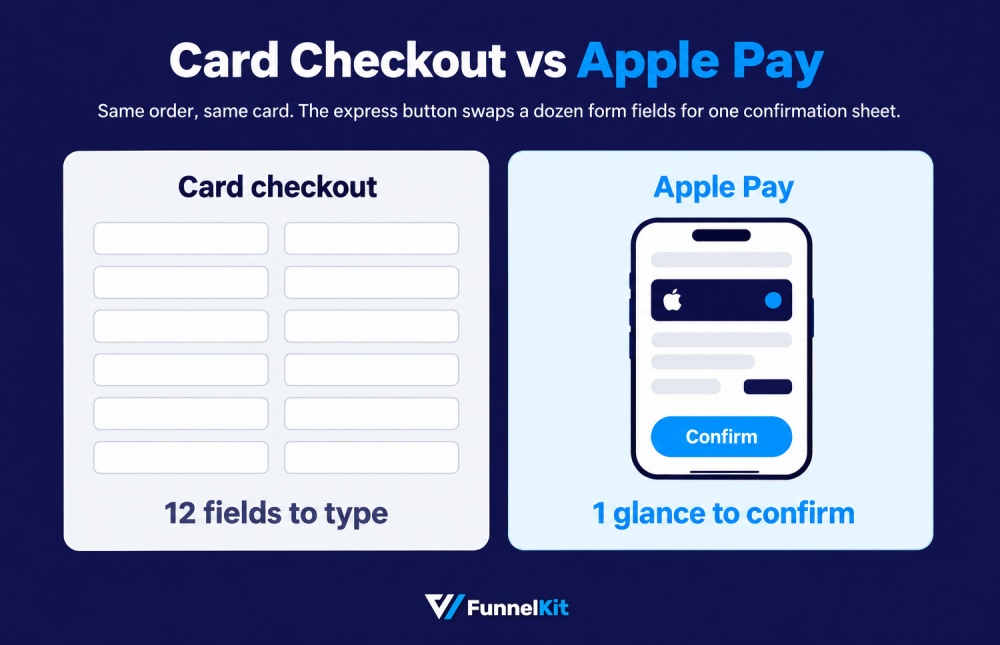
Below, we'll cover how to set up Apple Pay with the major WooCommerce payment gateways, including the full click-by-click process for our free Stripe plugin.
We'll also cover where to place the button, what it costs, and what to check when Apple Pay isn't showing up.
Quick answer: To set up Apple Pay in WooCommerce, you need three things: an HTTPS site, a payment gateway that supports Apple Pay (WooPayments, Stripe, Square, PayPal Payments, or Braintree), and your domain registered with Apple.
In a Stripe or Square plugin, turn on express checkout or digital wallets in the gateway settings, and the plugin handles domain registration.
In WooPayments, go to Payments ⇨ Settings, tick Apple Pay / Google Pay under Express checkouts, and save.
Then test in Safari on an iPhone or Mac with Apple Pay set up.
Don't want to read the content? Here's our quick tutorial video on how to set up Apple Pay express checkout in WooCommerce:
Table of Contents
- 1 How Apple Pay Works in WooCommerce: Express Button vs Inline Method
- 2 Apple Pay Requirements: What You Need Before You Turn It On
- 3 Which Payment Gateways Support Apple Pay in WooCommerce?
- 4 How to Set Up WooCommerce Apple Pay in Your Online Store (Step-by-Step)
- 5 How to Enable Apple Pay in WooPayments
- 6 How to Enable Apple Pay With Square
- 7 Apple Pay On PayPal Payments, Braintree, Clover, and Authorize.Net
- 8 Where to Show the Apple Pay Button: Product, Cart or Checkout Page
- 9 Apple Pay and Custom Checkout Fields
- 10 Apple Pay Fees: What It Costs WooCommerce Merchants
- 11 Apple Pay Button Not Showing? A 10-Point Checklist
- 12 Bonus: Swap WooCommerce Checkout with Modern, Dynamic FunnelKit Checkout
- 13 Frequently Asked Questions (FAQs)
- 14 Ready to Set Up Your WooCommerce Apple Pay Payment Gateway?
- 15
How Apple Pay Works in WooCommerce: Express Button vs Inline Method
Here’s how it works in a WooCommerce store:
1. Shopper selects Apple Pay
When a shopper visits your WooCommerce store and adds a product to their cart, they'll see the Apple Pay button during checkout (depending on the pages you've enabled in your store, it could appear on the product page, cart page, or in the shopping cart).
They'll see the Apple Pay button only if they are using an Apple device with Apple Pay enabled.
Next, they tap on the Apple Pay button.
2. Shopper authorizes the payment
Once the Apple Pay button is clicked, the customer can authorize the payment using one of the following methods:
- Face ID (for iPhone or iPad with Face ID)
- Touch ID (for MacBooks or older iPhones with fingerprint recognition)
- Device passcode (if biometrics are unavailable)
This step keeps payment fast and secure.
3. Payment token is sent to the payment gateway
Apple Pay does not share the customer's actual card details. Instead, it uses tokenization to create an encrypted, unique digital identifier called a payment token.
This token is sent to the payment gateway integrated with your WooCommerce store.
4. The payment gateway processes the transaction
The payment gateway decrypts the token and processes the payment with the customer's bank.
Once approved, the funds are transferred to your merchant account, and the order is processed successfully.
5. Payment confirmation
After a successful transaction, both the customer and store owner receive a confirmation.
The customer is redirected to the thank you page, and you're notified of the new order in WooCommerce.
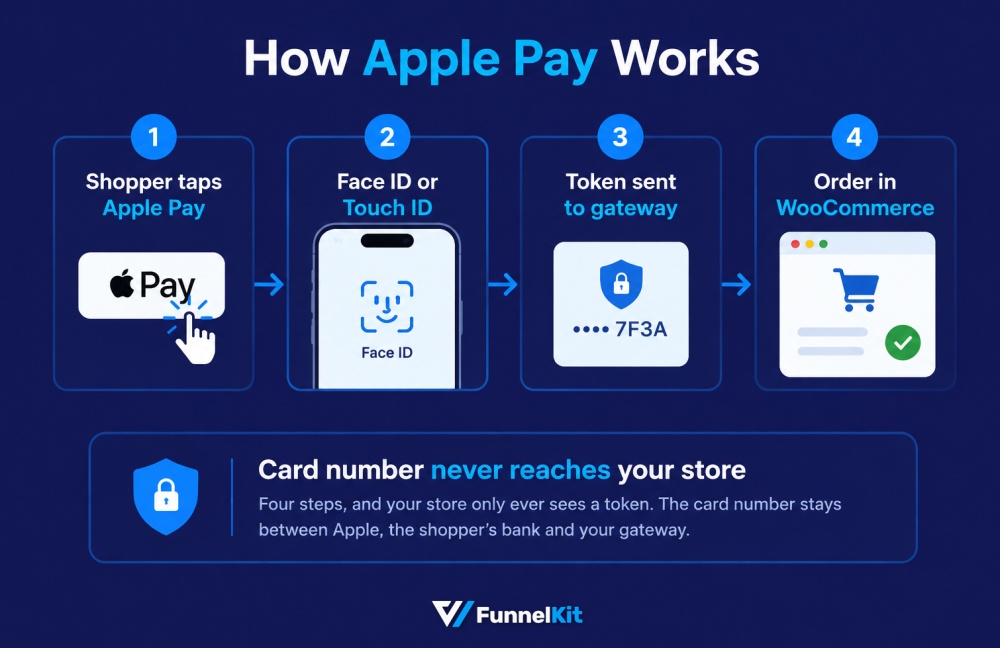
This speeds up checkout, reduces abandonment, and improves the user's shopping experience.
Apple Pay can show up in two ways on your store, and most setup choices come down to which one you pick.
| Parameter | Express button | Inline payment method |
|---|---|---|
| Where it appears | Product page, cart, side cart, top of checkout | In the payment methods list at checkout |
| Checkout form | Skipped. Apple supplies name, email, and address | Filled in first, as usual |
| Custom fields and order bumps | Bypassed | Collected and seen |
| Best for | Quick purchases, repeat buyers | Stores that need extra details at checkout |
The case for offering it comes down to effort. In Baymard Institute's research, 18% of US online shoppers said they'd abandoned an order in the past quarter because checkout was too long or complicated.
An express button removes nearly all of that typing for anyone on an Apple device.
How much it helps depends on your audience. If most of your traffic is on Android, few orders will move to Apple Pay, and Google Pay will do more of the work.
WooPayments and the official Stripe plugin enable both anyway.
Apple Pay Requirements: What You Need Before You Turn It On
Before you enable Apple Pay in WooCommerce, make sure your store meets these requirements:
- HTTPS everywhere
You need a valid SSL certificate and every page served over HTTPS. Your server also needs port 443 open and support for TLS 1.2 or later.
- A gateway that supports Apple Pay
Your merchant account must also be based in a supported country and use a supported currency.
- Your domain registered with Apple
Most plugins handle this for you. They serve a small file at /.well-known/apple-developer-merchantid-domain-association and register the domain through the gateway.
- The exact domain shoppers use
www.yourstore.com and yourstore.com count as two separate domains. Your staging domain counts separately too.
- A permalink structure other than plain
Some plugins need it for domain registration. Clover, for example, recommends the Post name option so its Apple Pay domain registration works.
- A supported device on the shopper's side
The shopper also needs Apple Pay set up in Wallet.

Which devices and browsers show the Apple Pay button
These devices support Apple Pay:
- iPhone: models with Face ID or Touch ID, except iPhone 5s
- iPad: models with Face ID or Touch ID
- Apple Watch: Series 1 and later
- Mac: models with Touch ID; Macs paired with an Apple Pay-enabled iPhone or Apple Watch; Macs with Apple silicon using a Magic Keyboard with Touch ID
- Apple Vision Pro
Apple keeps the current list on its compatible devices page. Browsers are where it gets messy.
| Shopper's setup | Does the button show? |
|---|---|
| iPhone or iPad, Safari | Yes |
| iPhone or iPad, Chrome, Edge or Firefox | Yes on WooPayments. Check your gateway |
| Mac, Safari | Yes |
| Mac or Windows PC, Chrome, Edge or Firefox | Only through Apple's QR-code flow, and only if your gateway supports it |
| Android phone or tablet | No |
| In-app browsers (Instagram, Facebook, email apps) | Often not |
The QR-code flow arrived with iOS 18. On a desktop browser other than Safari, the Apple Pay button can display a code.
The shopper scans it with the Camera app on an iPhone running iOS 18 or later, then completes the payment on the phone.
It only works on websites that have implemented the latest version of Apple Pay, which is why support varies by gateway.
WooPayments, for example, lists Apple Pay on desktop Chrome and Edge for macOS only, and not on desktop Firefox at all.

Supported countries and currencies
Check two lists here. Apple has a list of countries where shoppers can use Apple Pay, while your payment gateway has its own list of countries and currencies where merchants can accept it.
For store owners, the gateway's list usually matters most.
- Stripe: Check Stripe's Apple Pay documentation for the country associated with your account.
- WooPayments: Offers Apple Pay in every country WooPayments supports.
- Square: Digital wallets are available only to stores in the United Kingdom, United States, Canada, Ireland, France, Spain, or Australia, with payments in USD, GBP, CAD, EUR, or AUD.
Which Payment Gateways Support Apple Pay in WooCommerce?
Apple Pay comes through your payment gateway, and the gateway determines how much of the setup you need to handle yourself.
| Gateway | Where you switch it on | Domain registration | Apple Pay for subscriptions | Worth knowing |
|---|---|---|---|---|
| FunnelKit Stripe (Free) | Stripe Gateway ⇨ Express Checkout and Apple Pay tabs | Automatic, with a re-verify button | Yes | Inline Apple Pay option, visibility tester, Admin Only test mode |
| WooPayments | Payments ⇨ Settings ⇨ Express checkouts | Automatic | Yes | Apple Pay and Google Pay share one checkbox |
| WooCommerce Stripe (Official) | Stripe ⇨ Payment Methods ⇨ Express checkouts | Automatic, via Stripe’s payment method domains | Yes | Hides buttons on virtual products taxed by billing address |
| Square (Official or FunnelKit) | Square settings ⇨ Digital wallets or Apple Pay | Automatic | No, one-time payments | Seven countries |
| PayPal Payments | PayPal settings ⇨ Enable Apple Pay button | You register the domain on PayPal’s site | Yes | Button sits under your PayPal buttons |
| PayPal Braintree | Braintree settings | Through Braintree | Yes | Block cart and checkout support since v3.5.0 |
| Clover | Plugin Settings ⇨ Payments | Needs non-Plain permalinks | No | US and Canada, block checkout only |
| Authorize.net / CyberSource | Manual setup | You generate Apple certificates | No | A developer job |
If your current gateway already supports Apple Pay, stay put and enable it. That's the simplest option if you're already using a Stripe plugin or WooPayments.
There's usually little reason to switch payment gateways just to add Apple Pay.
If you're picking a Stripe plugin from scratch, start with your checkout. The WooCommerce Stripe plugin can show Apple Pay as an inline method and an express button, so checkouts with required fields still get it.
It also connects to FunnelKit checkout pages and upsells, if you use them.
If you already use Square for in-person payments, keeping it for your online store can make sense too.
Having online and in-store payments under the same account can be more convenient, even though Square's Apple Pay support is limited to one-time payments.
That means shoppers can still use Apple Pay on checkouts that require additional fields. It also works with FunnelKit checkout pages and upsells if you're already using them.
How to Set Up WooCommerce Apple Pay in Your Online Store (Step-by-Step)
Now that we've covered all the requirements, let's connect your WooCommerce store to Stripe.
Step 1: Install FunnelKit Stripe Gateway for WooCommerce
In your WordPress dashboard, go to Plugins ⇨ Add New Plugin and search for the term "FunnelKit Stripe Gateway for WooCommerce".
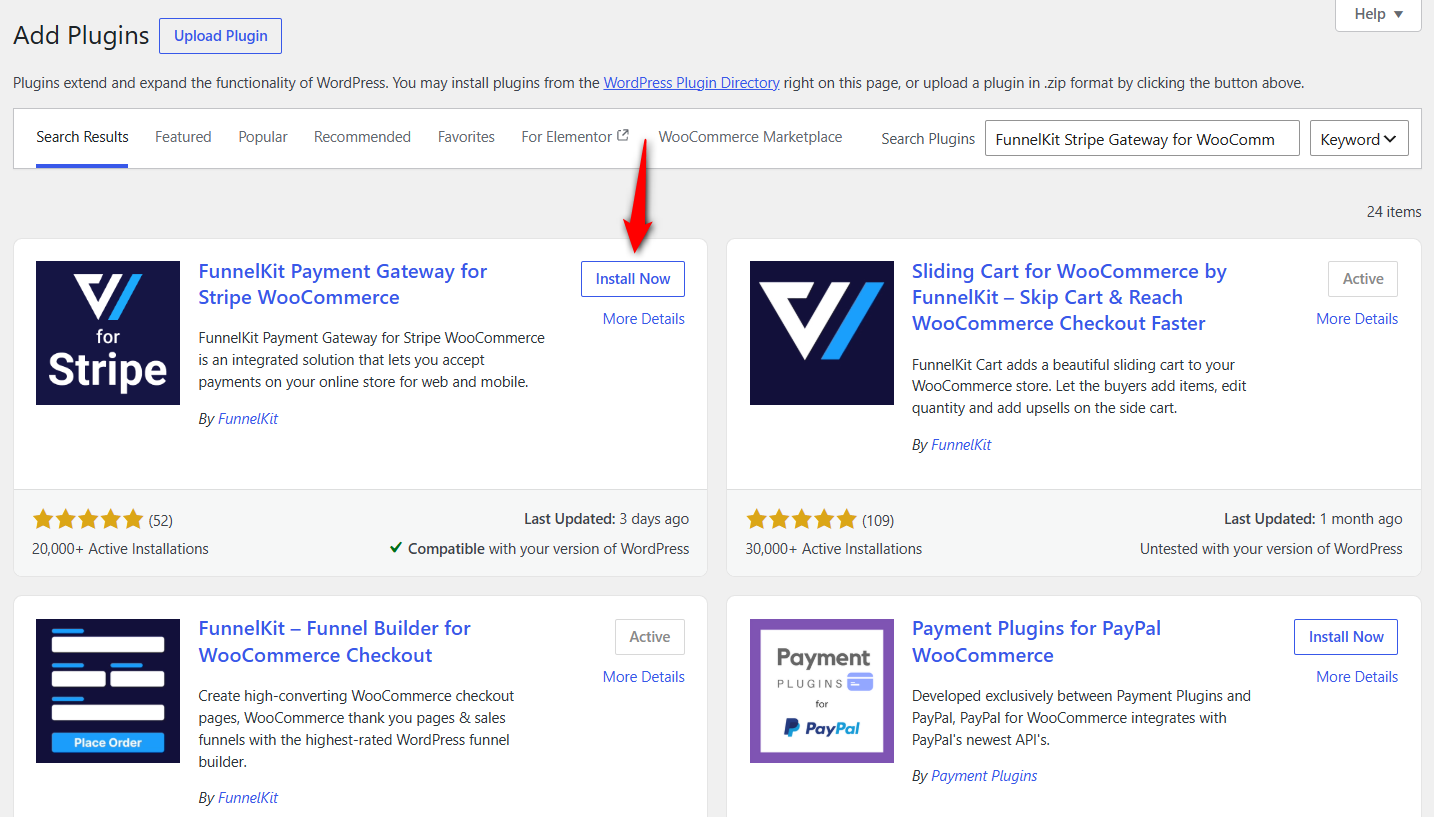
Install and activate FunnelKit Payment Gateway for Stripe WooCommerce. It's free on WordPress.org.
Step 2: Connect your Stripe account
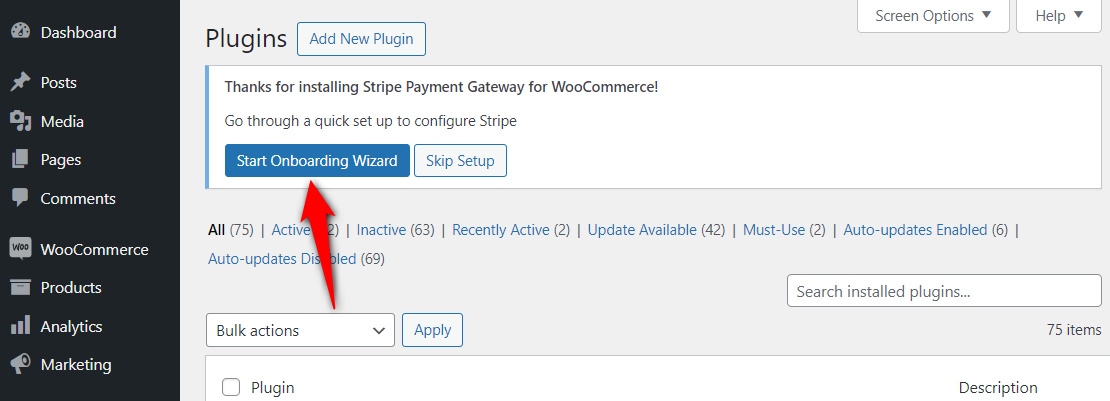
In your Plugins dashboard, you will see a banner that says, "Start Onboarding Wizard".
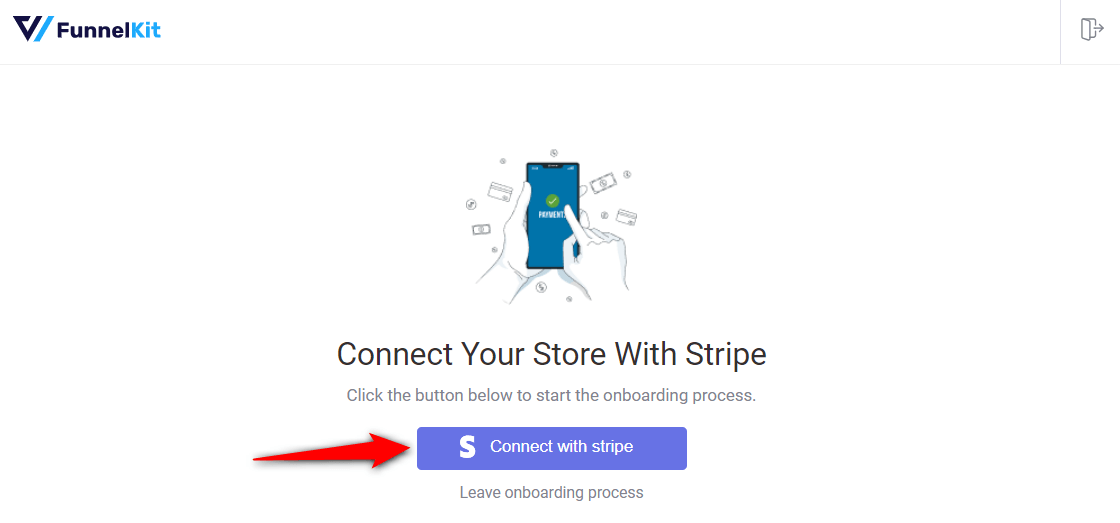
Click on the blue button, and you will be redirected to the Stripe account configuration page.
Click on Connect with Stripe.
You will be redirected to the Stripe account authorization page. Enter your email address and hit Continue.
Enter the password you set when opening your Stripe account. Then hit Log in.
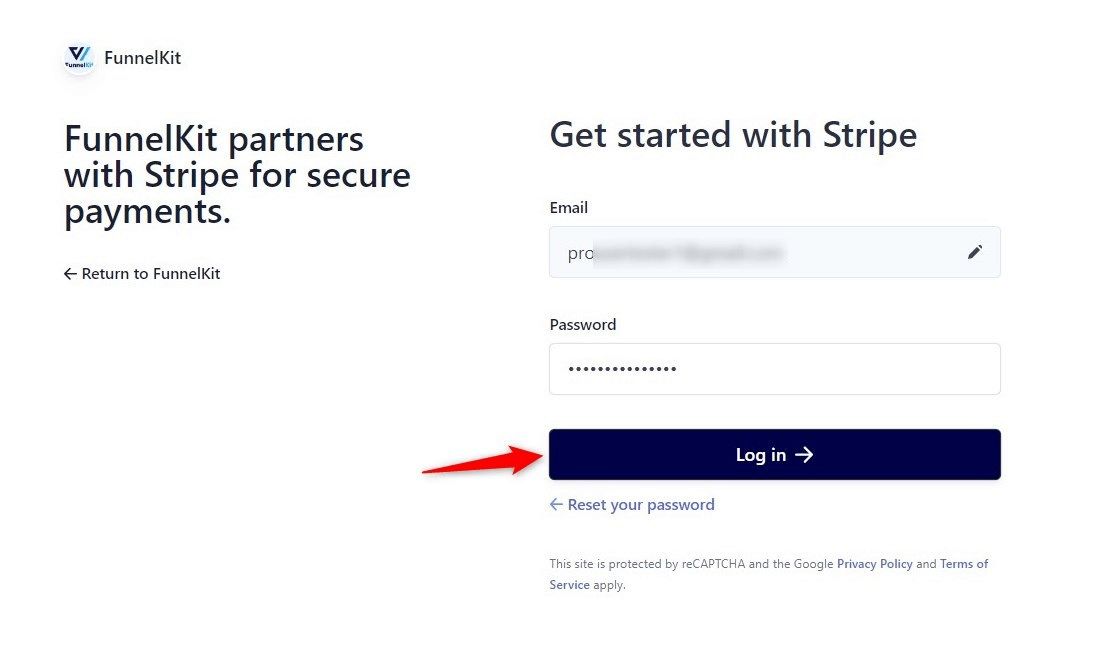
Note: You might be asked to verify your account with a 6-digit OTP sent to your registered email or mobile phone.
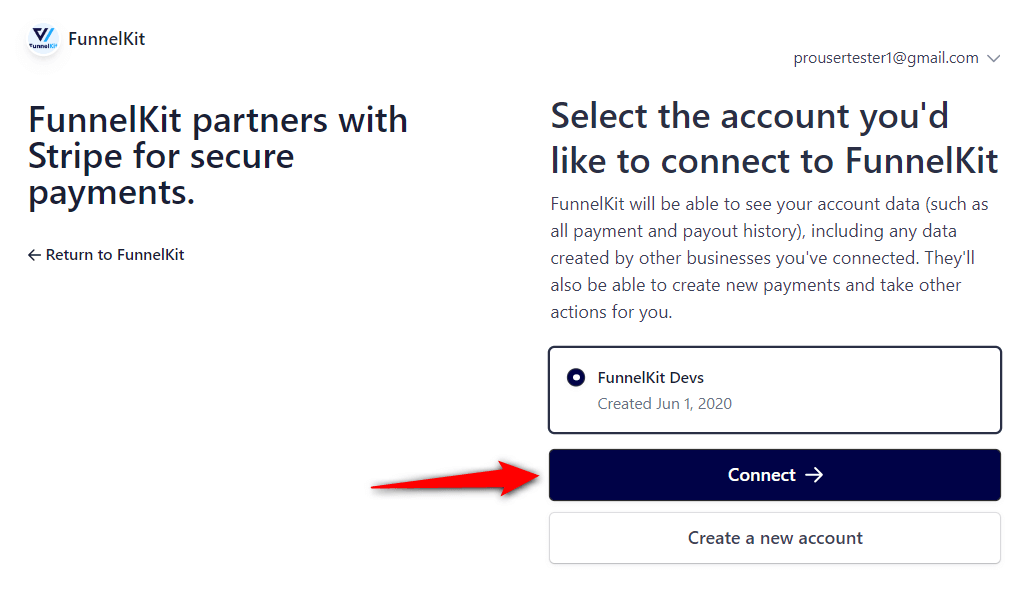
Now, select the Stripe account that you want to use for your WooCommerce Apple Pay integration.
Once selected, click Connect.
Enabling Payment Gateways
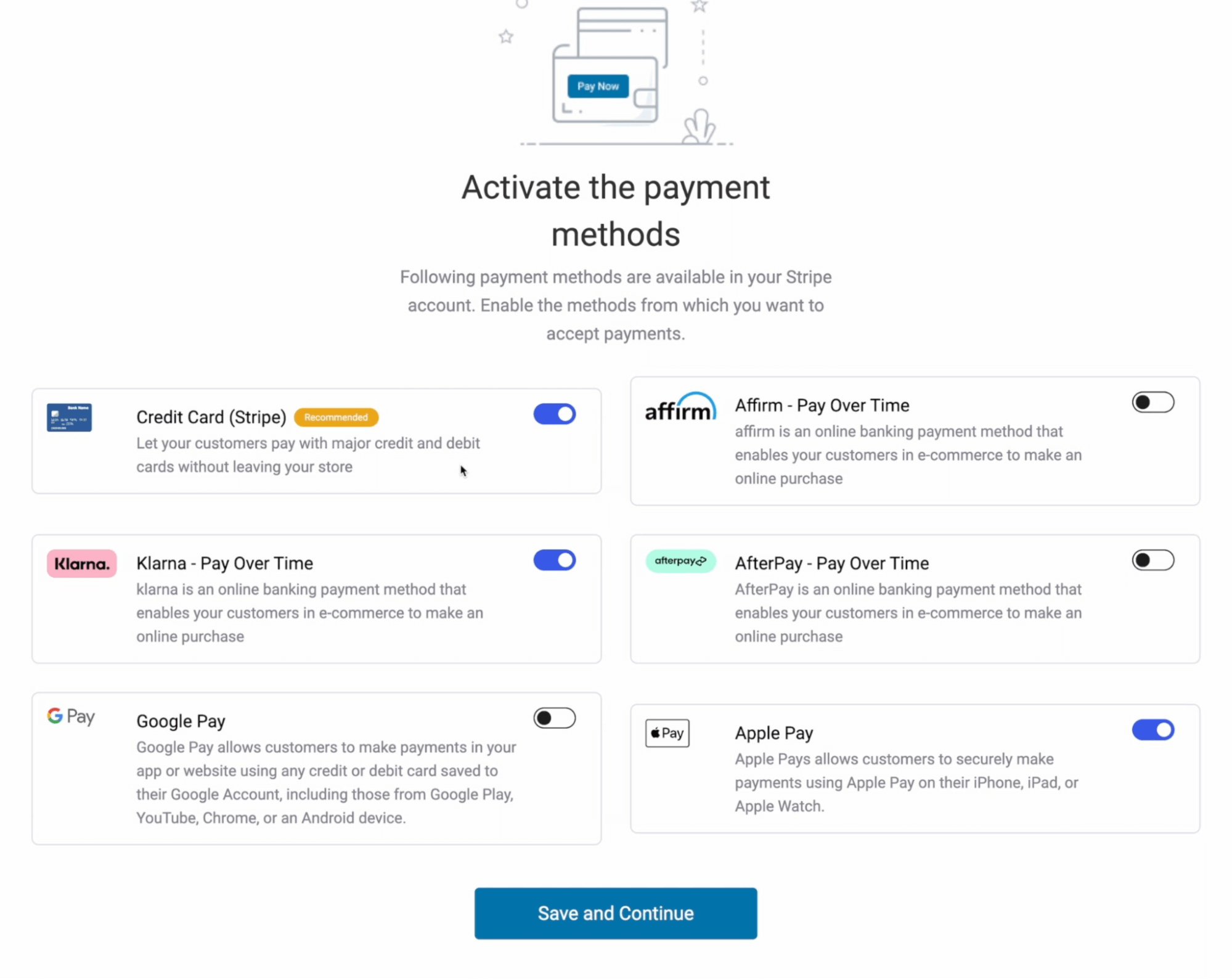
On the next screen, you will see all the available payment gateways. To keep things simple, we'll enable only Credit Cards (Stripe).
However, if you wish to enable local payments or buy now, pay later options, you can do that too.
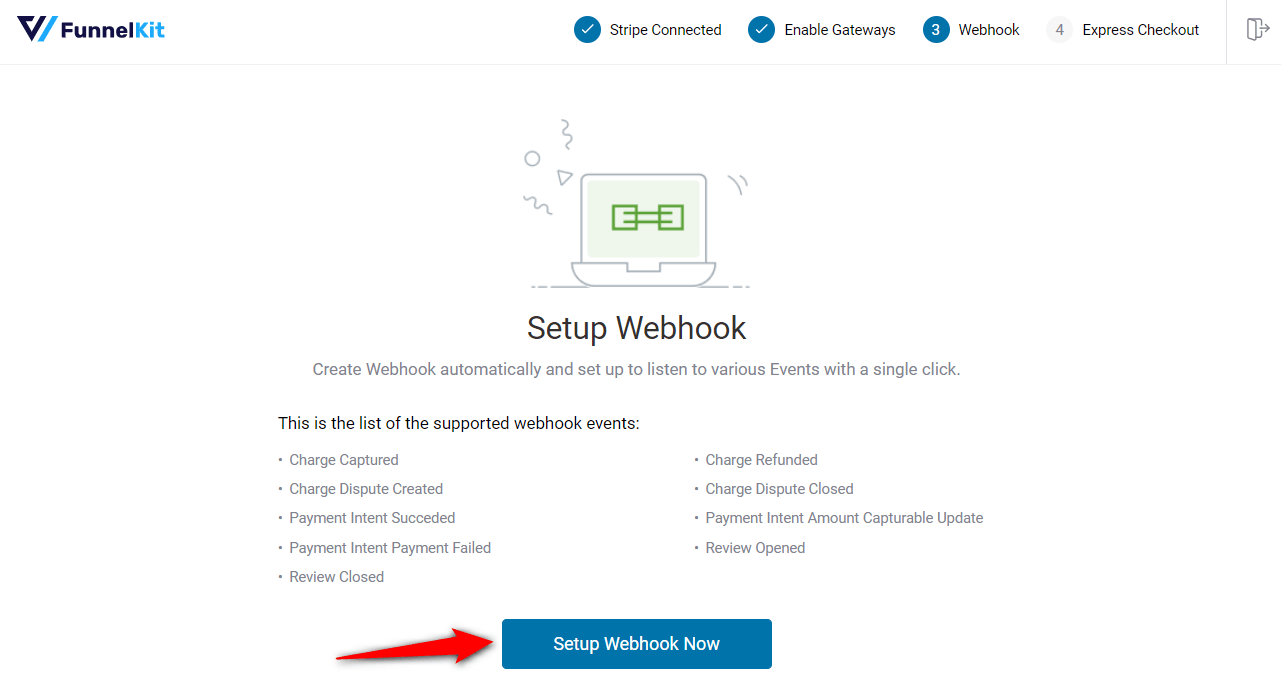
Setting Up Webhook
Stripe will now ask you to set up webhooks. Click the button to go to the next screen.
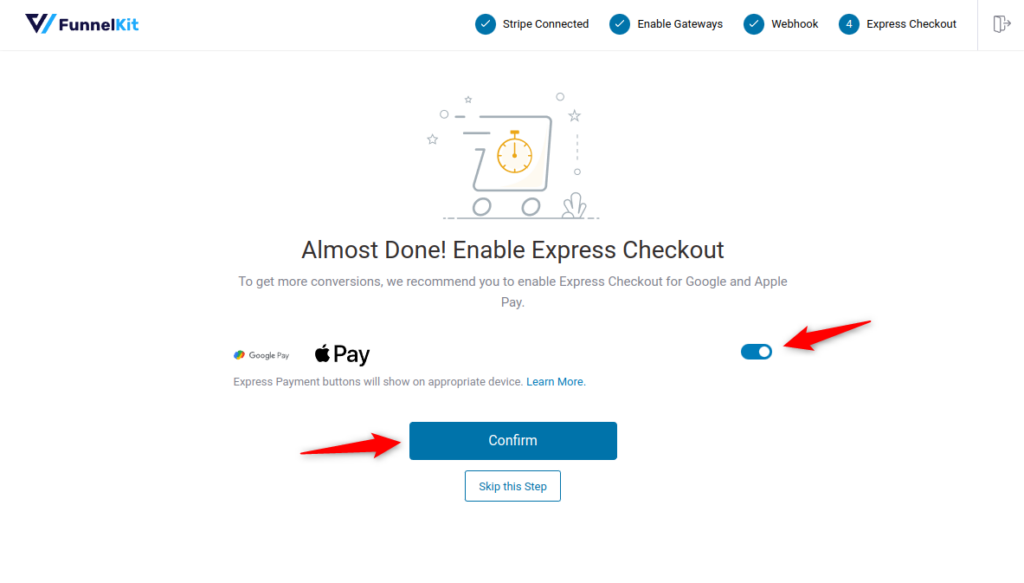
Activating Express Checkouts
On the next screen, you will be asked to enable express checkout.
To set up your WooCommerce Apple Pay integration, you must first enable the express checkout options in Stripe.
You are all set. But first, test whether Stripe successfully processes payments on your WooCommerce store.
Thus, on the last screen, select the mode you want to test: Test, Admin Only Test, or Live.
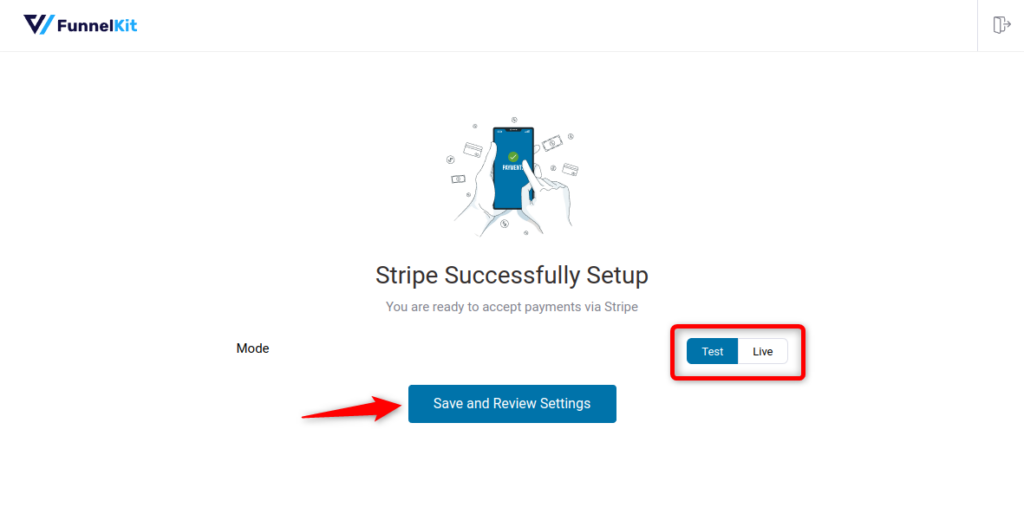
After you select your preferred mode, click Save and Review Settings.
Now that your Stripe account is configured, all the details will be fetched into your WooCommerce store, including:
- Webhook ID
- Webhook URL
- Live and test webhook secret
- Debug log URL
Now, let's enable the WooCommerce Apple Pay integration.
Step 3: Turn on Apple Pay and choose where it shows
Navigate to WooCommerce ⇨ Settings ⇨ Payments.
Under the Payments tab, you will see various payment options. Click on Manage next to Apple Pay.
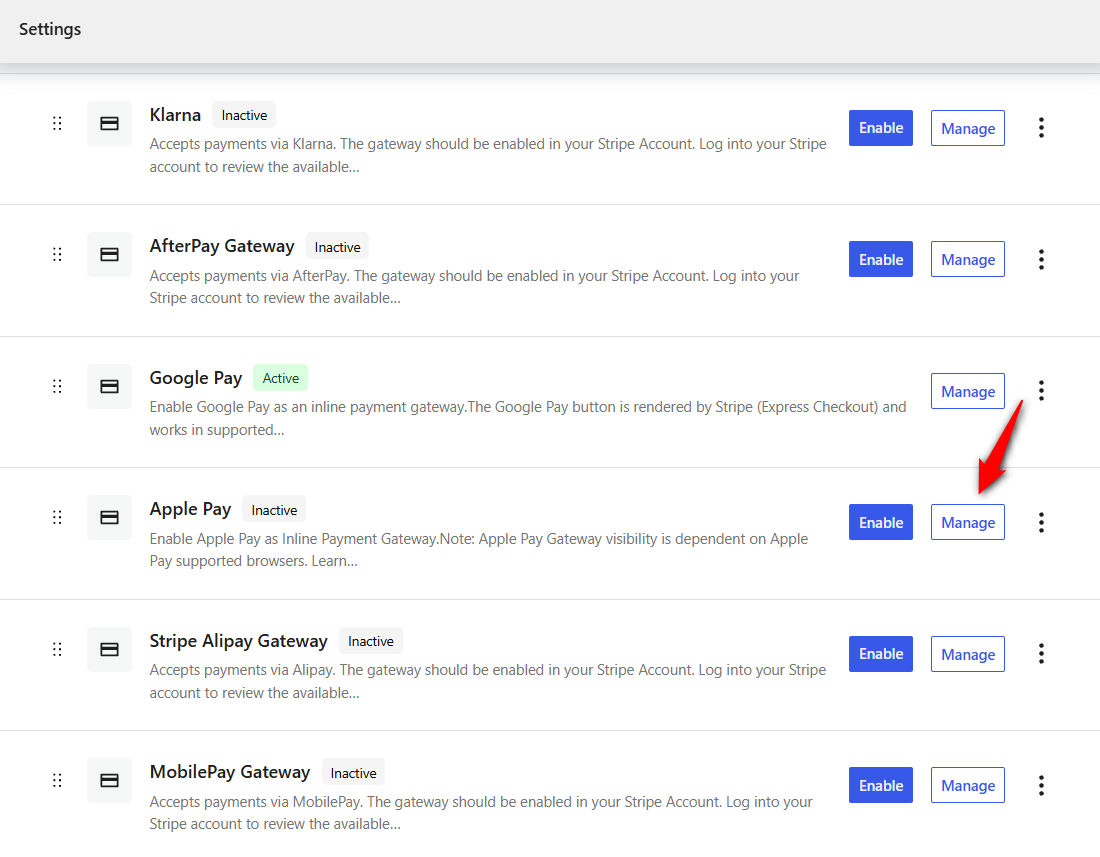
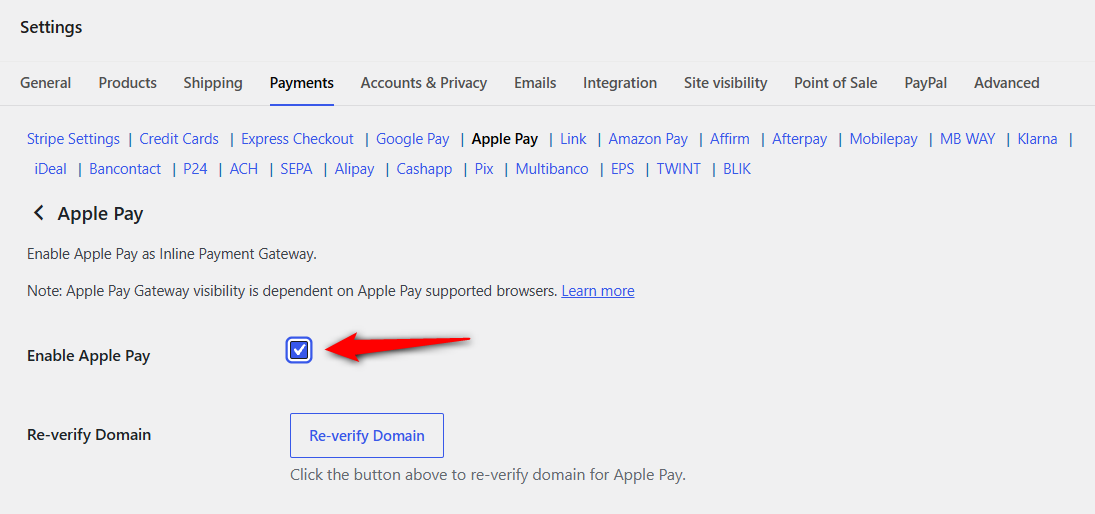
Enable Apple Pay from there.
Next, show which pages you want to display the Apple Pay button on.
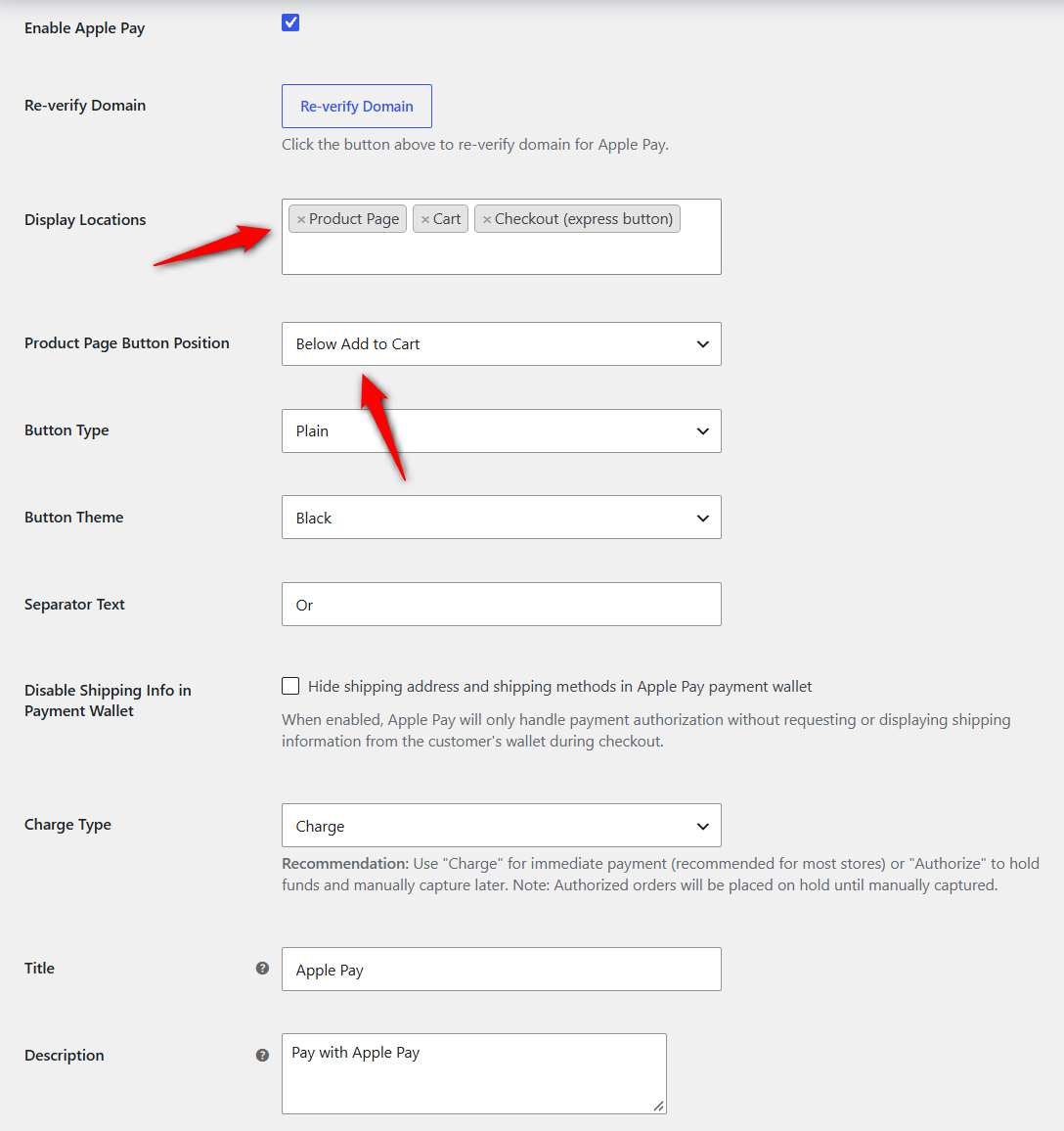
Carefully assess the visibility of your Apple Pay button across different pages of your WooCommerce store.
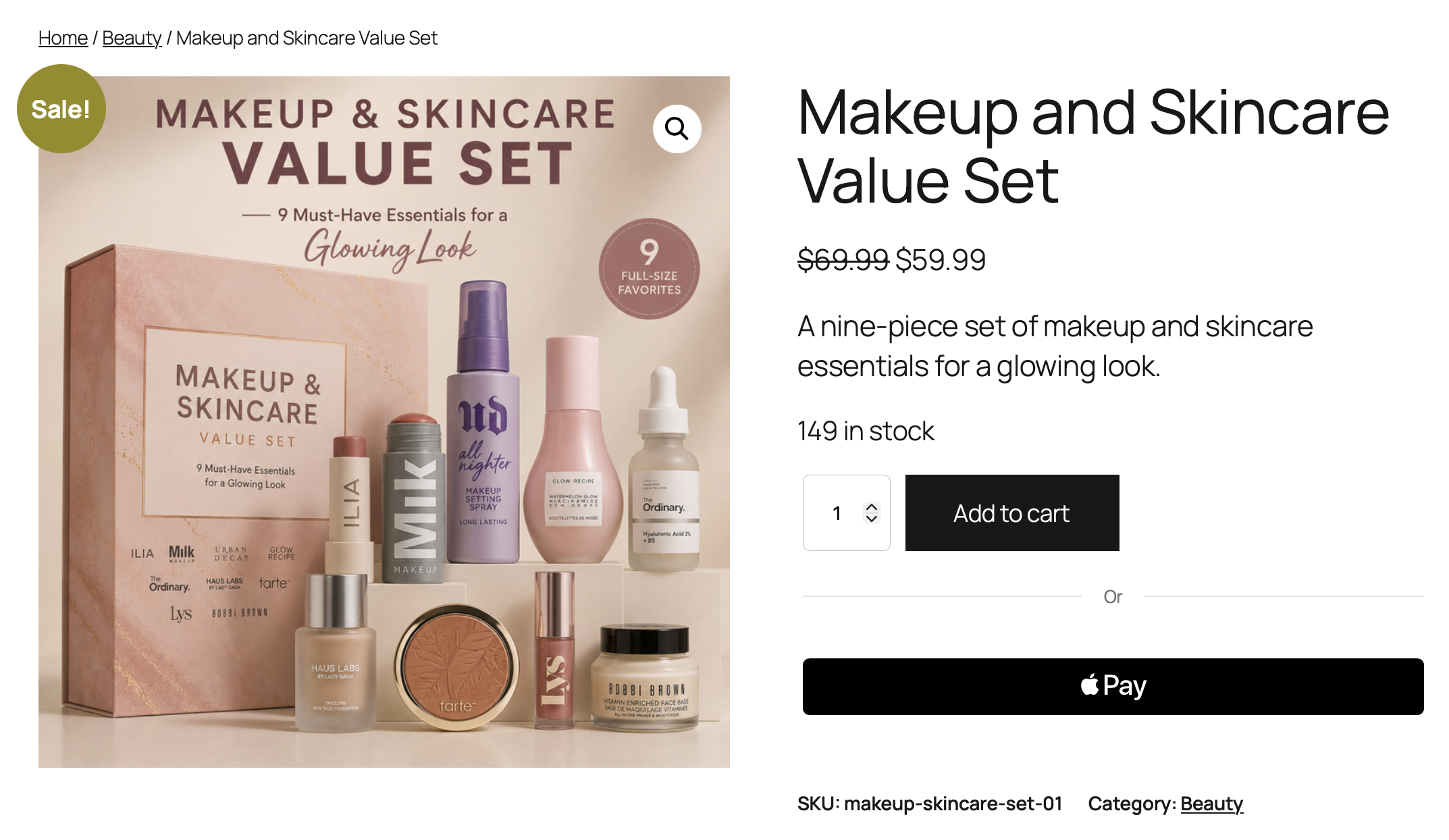
👉 Apple Pay Express Checkout on the Product Page
If a shopper purchases an item using Apple Pay from the product page, only that item will be placed in an order, regardless of what's in their shopping cart.
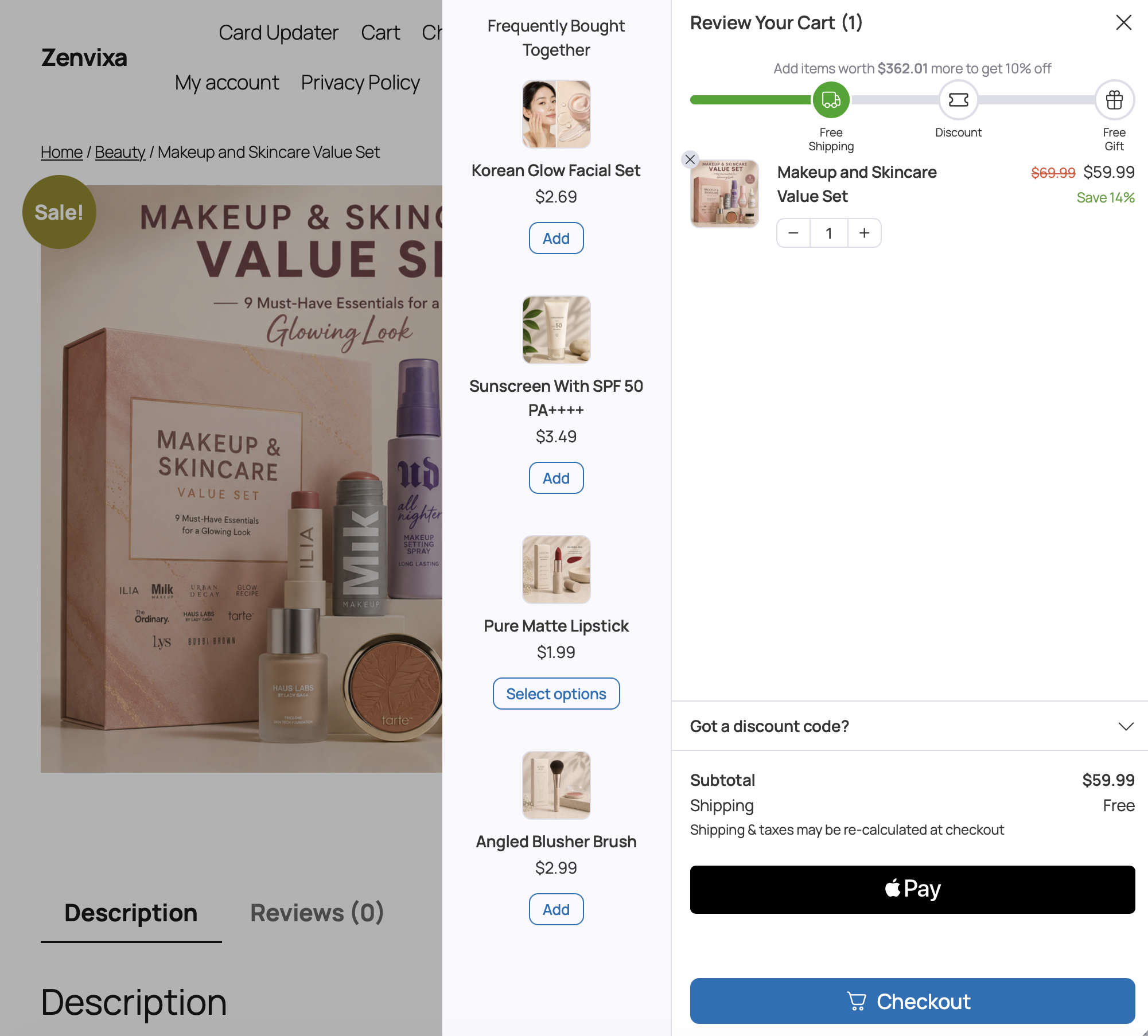
👉 WooCommerce Apple Pay Express Button inside the Shopping Cart
If you use FunnelKit Cart to bring a beautiful, dynamic shopping cart to your store, the Apple Pay button will show up there, too.
It replaces the default WooCommerce cart page, letting users check out directly.
👉 Apple Pay Express Payment on the Checkout Page
The Apple Pay Express Payment button on the checkout page lets shoppers complete transactions without filling out the checkout form.
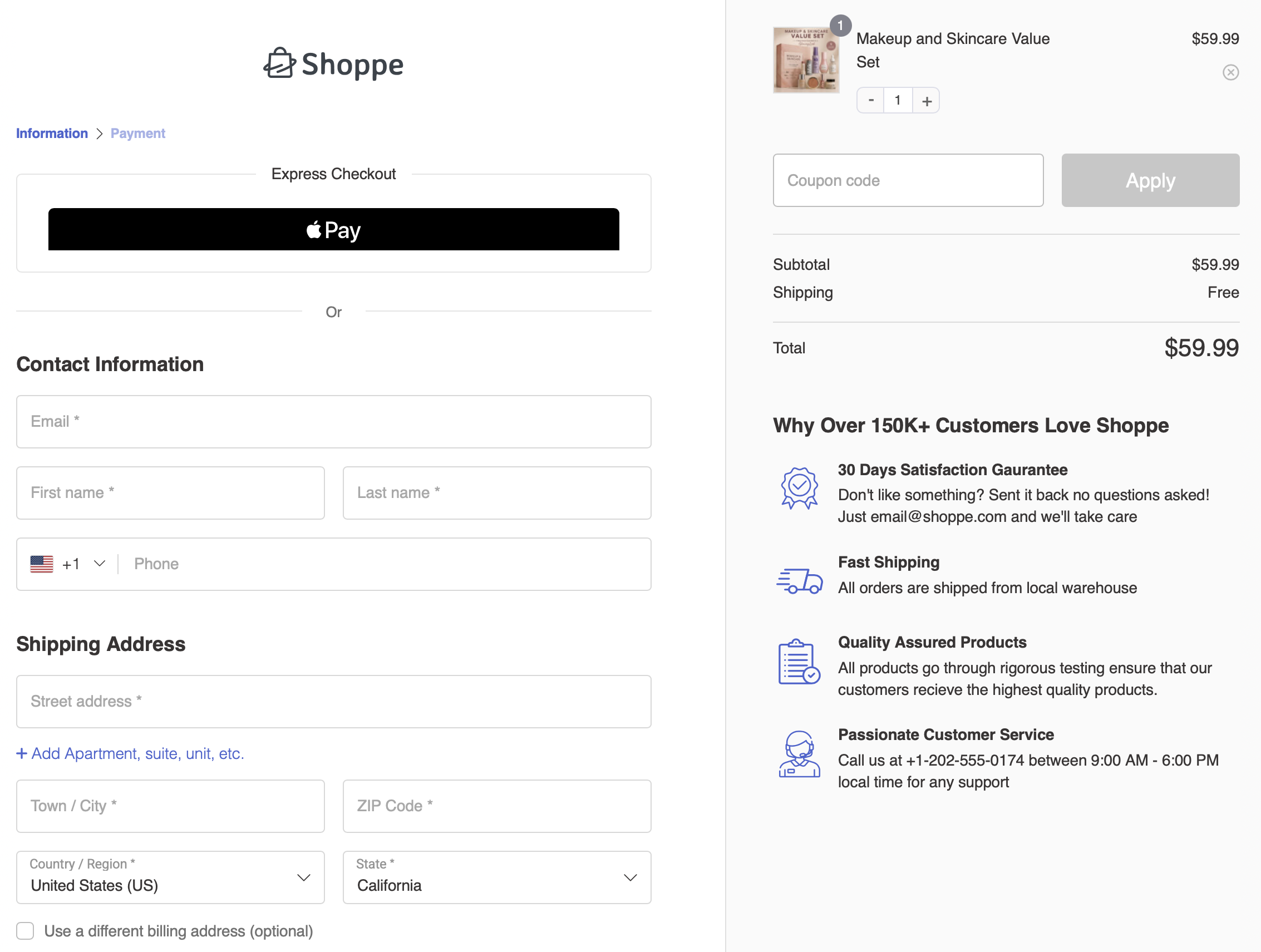
If your checkout page has custom fields, shoppers will likely skip them when paying through Apple Pay Express Payment.
An effective solution is to offer an inline payment method, which we will discuss in the next step.
Customizing the Apple Pay buttons
Type the text that you want to show on the Apple Pay button.
Also, choose the theme for your button.
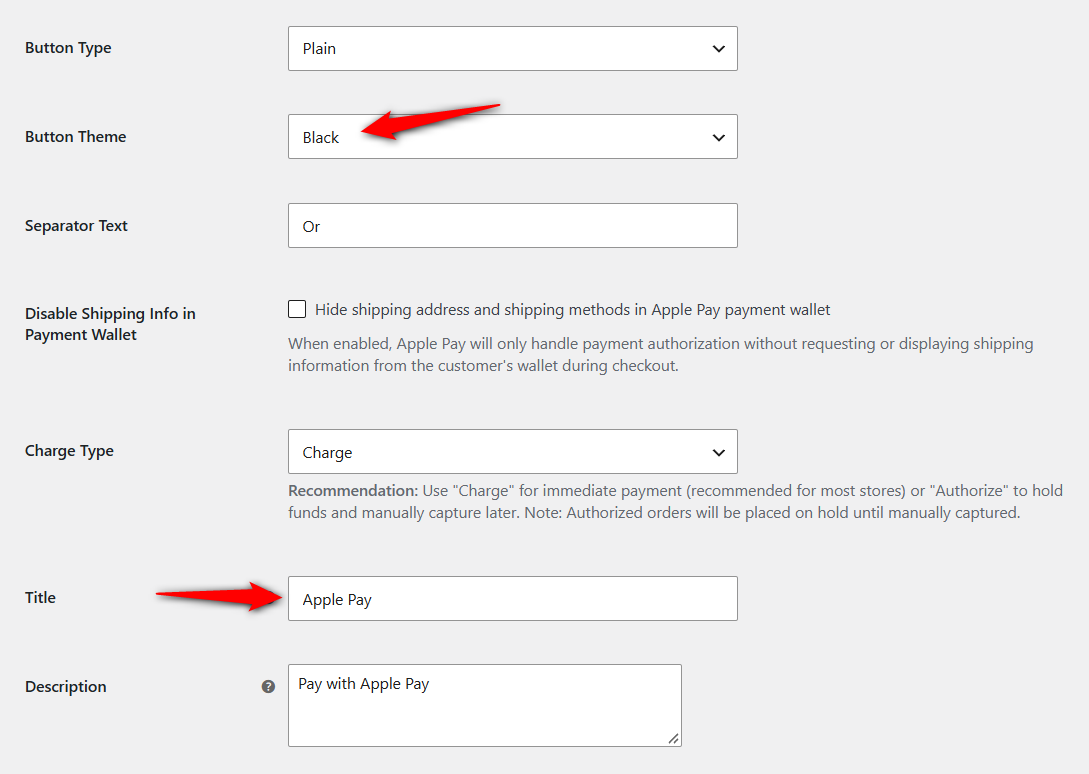
You can customize the Express Apple Pay button on each product page, cart page, and checkout page.
You can set the button position, add separator text, and customize the title, button width, and alignment.
Click on 'Save Changes' when done.
Step 4: Add Apple Pay as an inline payment method
Express buttons are fast, but they skip every field on your checkout form. If a field is required, like a phone number, tax ID, or custom field, some setups throw an error instead.
Inline Apple Pay avoids both problems. The shopper fills in the form, picks Apple Pay from the payment methods, and confirms with a glance.
To enable the inline Apple Pay method, select 'Show as Regular Payment Gateway' under Display Locations.
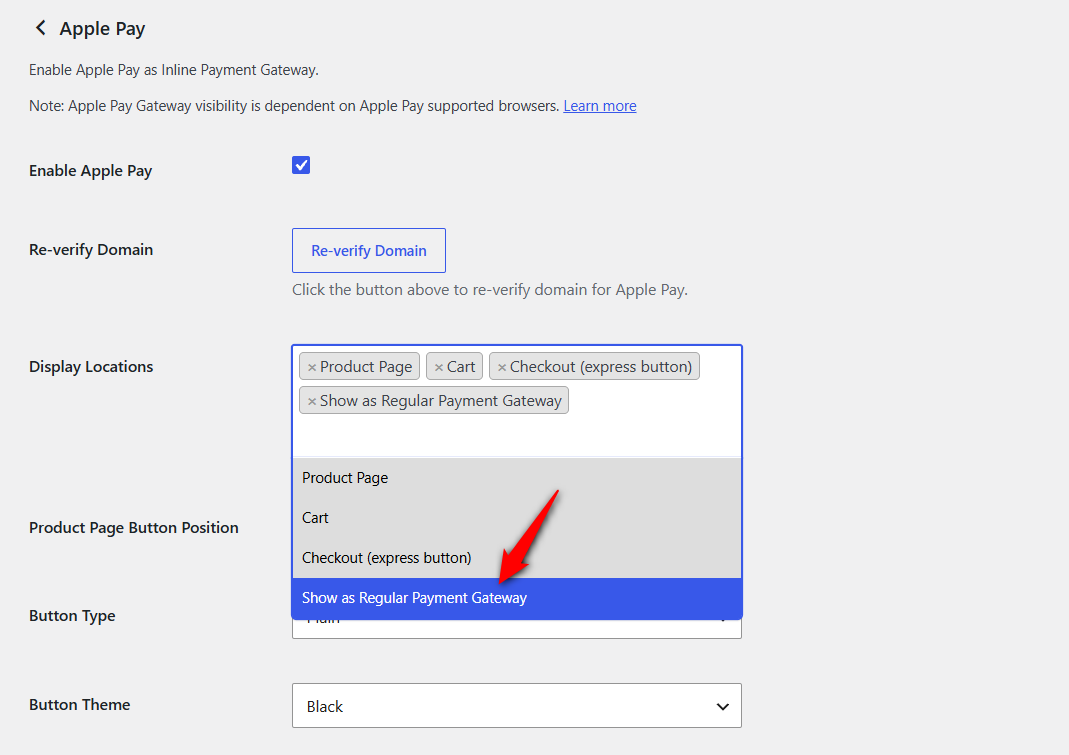
This will enable inline Apple Pay on your WooCommerce checkout page.
Now shoppers can enter delivery instructions or fill custom fields, select Apple Pay from the payment list, and confirm.
Step 5: Test it in admin-only mode
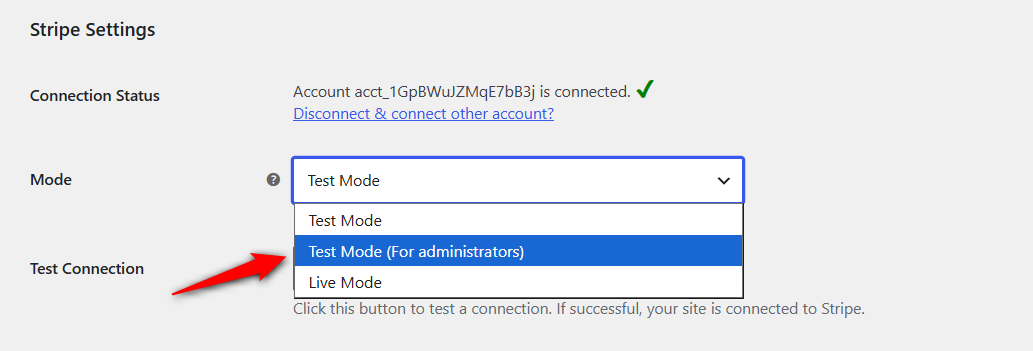
To test the payment button, put the website in Test mode or Admin Only Test mode if it isn't already.
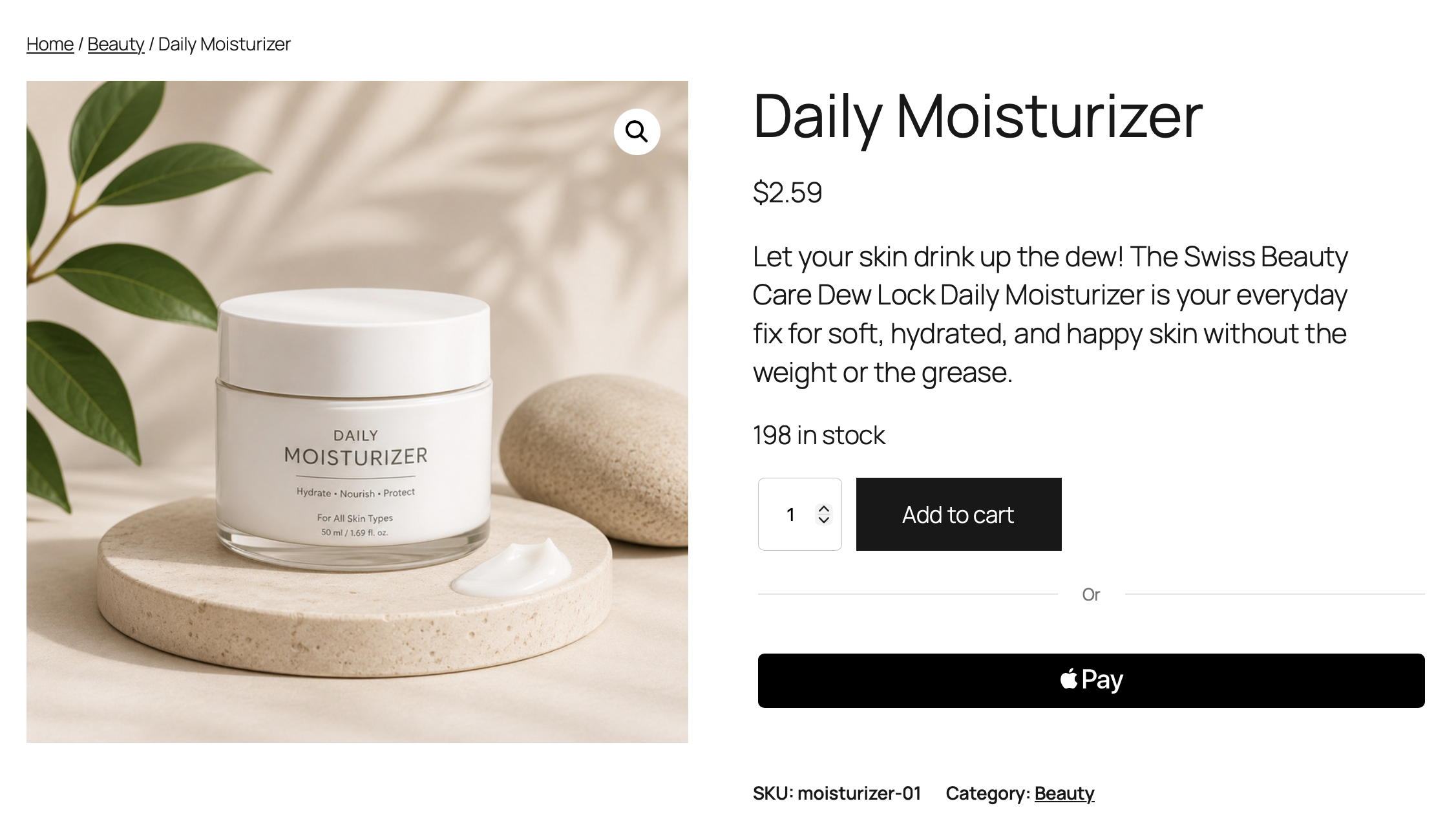
You can see the Apple Pay button on the pages you've set up.
Confirm the payment with Touch ID/Face ID, and the payment will be deducted from the added credit/debit card.
After you confirm, you'll be taken to the thank-you page.
How to Enable Apple Pay in WooPayments
WooPayments is WooCommerce's own payment gateway, and it has one of the simplest Apple Pay setups. There isn't much to configure.
- Go to Payments ⇨ Settings.
- Scroll to the Express Checkouts section.
- Tick the box for Apple Pay / Google Pay.
- Scroll down and click Save Changes.
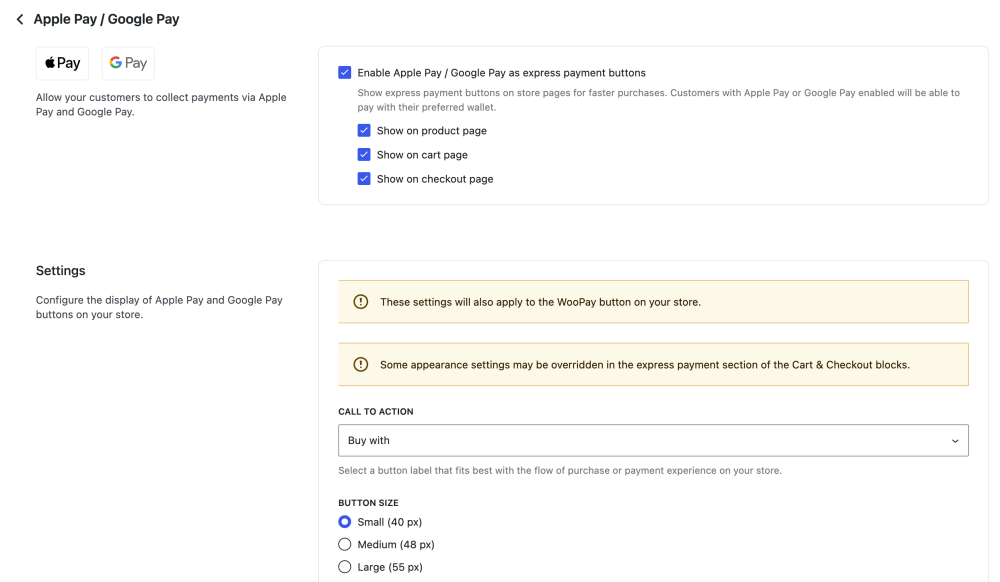
WooPayments generates the certificates and automatically verifies your domain.
Use the Customize link in the same box to choose which pages show the buttons.
If the domain never verifies:
- Untick Apple Pay and Google Pay and save.
- Refresh the page.
- Tick them again and save.
- Open WooCommerce ⇨ Status ⇨ Logs and check today's WooPayments log for an entry confirming your domain was verified.
Apple Pay and Google Pay share a single setting here, so you can't offer one without the other.
How to Enable Apple Pay With Square
Square is a good fit for stores that also sell in person because online and in-store payments stay in the same account.
Both of the Square plugins below support Apple Pay.
Official WooCommerce Square plugin
Turn on digital wallets under WooCommerce ⇨ Settings ⇨ Payments ⇨ Square. The styling options are basic:
- Change the text on the Apple Pay button
- Choose its color, such as black, white, or white with outline
- Hide the wallet buttons entirely
The extension automatically creates the domain association file once digital wallets are enabled.
To confirm verification:
- Enable Square logging.
- Visit your Square settings.
- Check the latest Square log under WooCommerce ⇨ Status ⇨ Logs. If something went wrong, look for "Unable to verify domain".
FunnelKit Square
Go to WooCommerce ⇨ Settings ⇨ Square. Open the Apple Pay section, where you can:
- Enable Apple Pay.
- Set the title and description.
- Choose the pages, the button theme, and the button text.
- Decide whether Apple Pay appears only as an express button or also in the regular payment method list.
If automatic registration fails, follow our manual domain registration steps for Square.
With the official plugin, Apple Pay is available for one-time payments only.
FunnelKit Square's Apple Pay and Google Pay include one-click upsells and subscriptions on Sublium.
Apple Pay On PayPal Payments, Braintree, Clover, and Authorize.Net
PayPal Payments
The basic setup is easy:
- Check the 'Enable Apple Pay' option and save.
- The button then appears below the PayPal button in every enabled smart button location.
The extra step is domain registration, which PayPal Payments can't do for you:
- Click Manage Domain Registration.
- Register every domain and subdomain that will show the button, in both your sandbox and live PayPal accounts.
- The plugin serves the verification file itself.
- If Apple Pay isn’t available after connecting, click Check available features.
PayPal Braintree
Braintree supports Apple Pay too. Version 3.5.0 added Apple Pay express support to the block-based cart and checkout pages, so update before you troubleshoot a block checkout.
Clover
Clover's plugin is for US and Canadian merchants, and it has a few limits:
- Apple Pay only works on the block checkout.
- The permalink structure must be something other than Plain.
- Only one-time payments are supported.
Authorize.net and CyberSource
These setups usually require developer work. Your environment needs to verify the domain with Apple and handle the payment processing and merchant identity certificates.
Your merchant account provider also need to support tokenization. If Apple Pay is a priority and you aren't tied to Authorize.net, a Stripe-based gateway is a much shorter route.
Where to Show the Apple Pay Button: Product, Cart or Checkout Page
Where you place the Apple Pay button depends on how your customers shop. Each location has its own trade-offs.
| Location | Good for | Watch out for |
|---|---|---|
| Product page | Single-item and impulse purchases | Buys only that product and ignores the cart |
| Cart page | Multi-item orders | Skips checkout fields and checkout order bumps |
| Side cart | The fastest path for returning shoppers | Same trade-offs as the cart page |
| Top of checkout | Shoppers who reached checkout before deciding | Skips every field below it |
| Inline at checkout | Stores that need custom fields or bumps | One more step than an express button |
There's one extra limitation on WooPayments product pages. Composite, Bookings, and Mix and Match products don't show express buttons on the product page.
Bundles only show them when the price is fixed and no configuration is required.
For most stores, we'd start with:
- Express buttons on the cart and side cart
- Inline Apple Pay at checkout
- The product page only if you mainly sell single-item products
If you build your checkout pages with FunnelKit Checkout, you can control where the express buttons appear in each template.
You can also A/B test different placements and compare the results against your conversion data.
Block checkout vs classic checkout
Since WooCommerce 8.3, new stores get the block-based checkout by default. Express buttons appear in an Express Checkout block at the top.
WooCommerce 9.4.0 added an "Apply uniform styles" setting to that block.
When it's on, some of your gateway's button customizations may not apply.
Plugin support also differs between block and classic checkout. Clover's Apple Pay integration requires block checkout, while Checkout Field Editor works only with the classic shortcode checkout.
So check your gateway and checkout plugins before switching between the two.
For a detailed comparison, see our guide to customizing block and classic checkout.
Apple Pay and Custom Checkout Fields
There may be many instances, such as a B2B customer needing to enter a VAT number or someone buying a gift wanting to add a message.
The problem with Apple Pay is that it skips your checkout form, so it won't collect any custom fields you've added.
It happens with all the express payment options, such as Apple Pay, Google Pay, and Amazon Pay, which bypass the standard checkout form.
That means fields added with Checkout Field Editor won't be included when shoppers use an express button.
Choose the approach based on how important the field is.
- Use inline Apple Pay at checkout: The shopper fills in the form, then pays with Apple Pay.
- Keep express buttons off checkout and accept the gap: Orders placed from the cart or product page may arrive without the extra field, so you can follow up with the customer.
- Ask earlier: Use product-level fields when the information is product-specific. Just make sure your gateway still displays the express button on products that require extra input.
- Ask afterward: For express orders that arrive without the details, send a short post-purchase email asking for the missing information, such as delivery instructions.
Apple Pay Fees: What It Costs WooCommerce Merchants
Apple doesn't charge merchants an additional fee for Apple Pay. You simply pay your payment gateway's usual card processing fee.
At Stripe's standard rate of 2.9% + $0.30 for US domestic online card payments, here's what a WooCommerce store would pay on a $1,000 product:
- $1,000 × 2.9% = $29.00
- Plus the $0.30 fixed fee
- $29.30 to Stripe, $0 to Apple
If the shopper's card was issued outside the US, Stripe adds another 1.5%, bringing the total rate to 4.4%. The fee on that $1,000 order would then be $44.30.
The 3% or so that people often associate with Apple Pay is the card processing fee, which you'd also pay if the customer entered their card details manually.
But note that shoppers don't pay an extra fee to use Apple Pay either.
Rates vary by country, payment method, and pricing plan, so check your gateway's current pricing page to see the exact rate for your account.
Apple Pay Button Not Showing? A 10-Point Checklist
Work through these checks in order. The first few rule out device and gateway settings, while the rest focus on your store.
1. Test the device first
Open Apple's Apple Pay demo page. If the button doesn't show there either, the device or browser is the problem, so stop changing store settings.
Alternatively, go to the Stripe Payments Demo URL (if you used Stripe to set up Apple Pay) and cross-check if you're able to see the Apple Pay button there.
2. Check your digital wallet
Make sure a card is set up in Wallet, then retry in Safari.
3. Confirm Apple Pay is on at the gateway
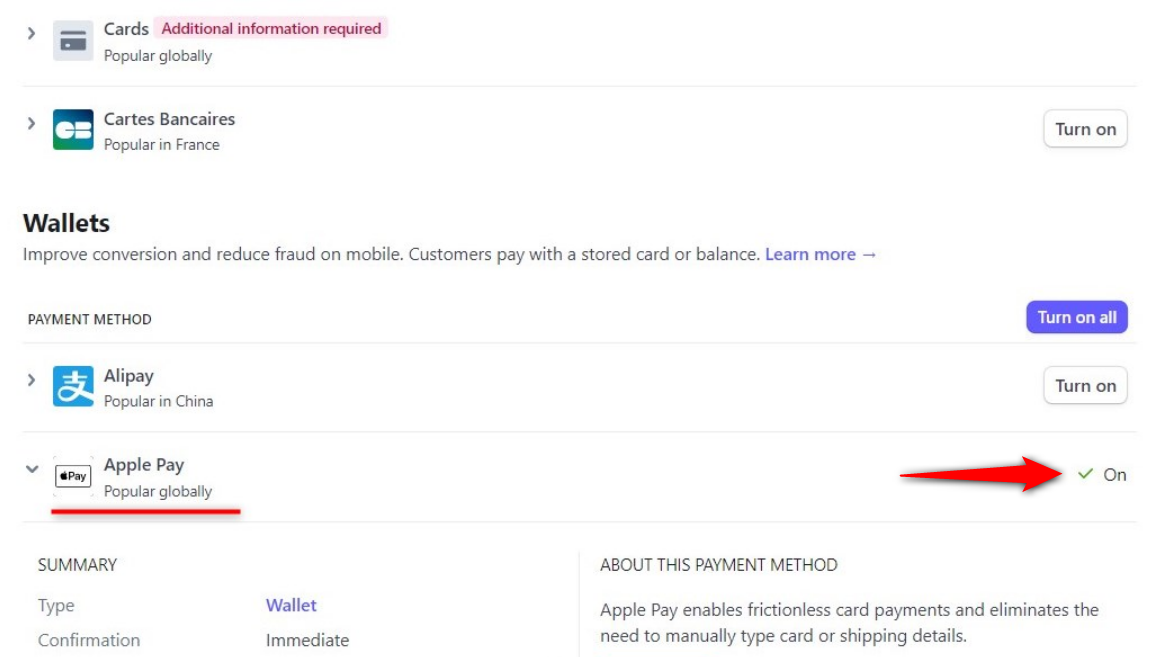
In Stripe, go to Settings ⇨ Payments ⇨ Payment methods and check Apple Pay under Wallets.
4. Re-verify the domain
Make sure the registered domain matches the address bar exactly, www and all.
- In our Stripe plugin, use the re-verify button on the Express Checkout tab.
- On WooPayments, toggle Apple Pay off and on.
- For manual steps, see our guide to verifying your domain manually.
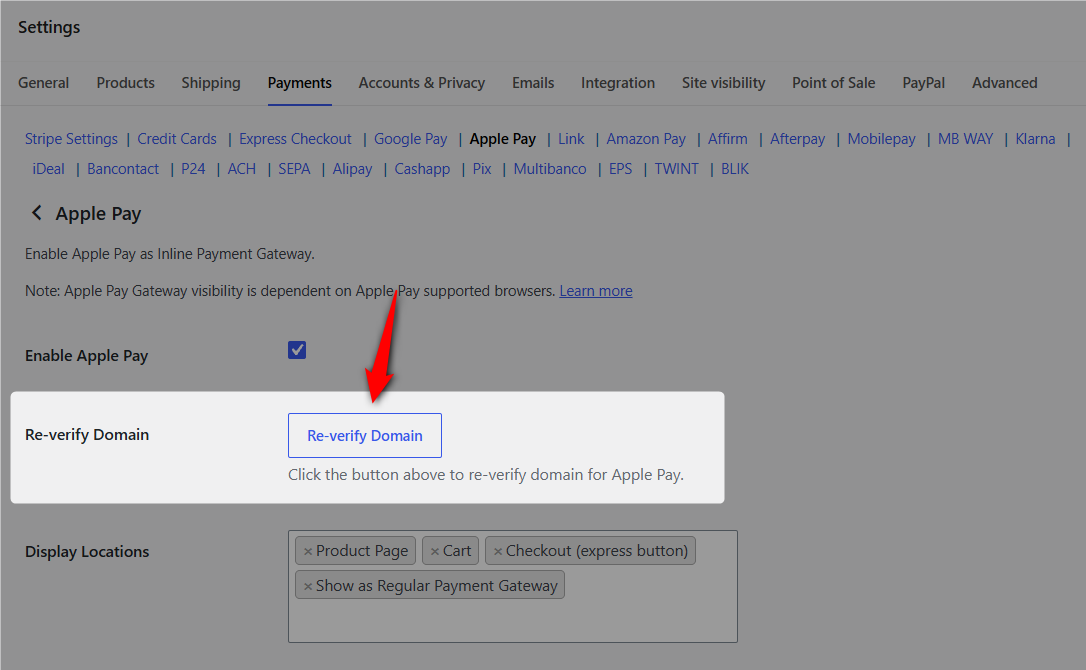
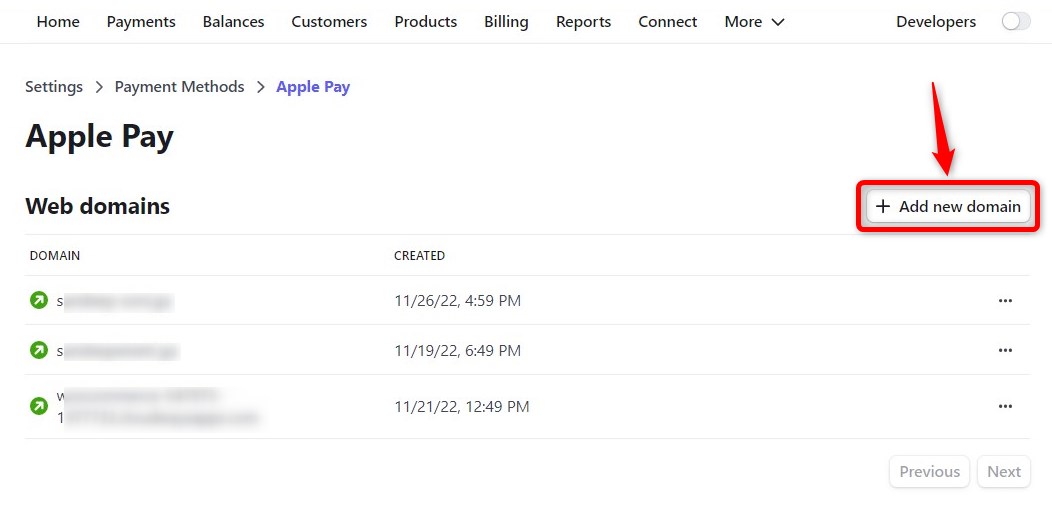
Furthermore, if your domain is not listed in the Stripe Apple Pay dashboard, you can verify your domain by clicking on the button as shown in the image below:
6. Open the verification file
Visit https://yourstore.com/.well-known/apple-developer-merchantid-domain-association.
A 404, 403 or redirect means a cache, CDN, firewall rule or security plugin is in the way, so exclude that path.
7. Check the cart
The Apple Pay button may be hidden by design in cases such as:
- Zero-total orders
- Free trials with no sign-up fee
- Virtual products taxed by billing address
- Out-of-stock products
- Composite or Booking products on the product page
8. Rule out theme and plugin conflicts
Check the browser console for JavaScript errors, and exclude your gateway's scripts from plugins that delay or combine JavaScript.
Then test with a default theme, since a theme missing the standard WooCommerce hooks can keep the button off some pages.
9. Fix HTTPS gaps
Mixed content or an expired SSL certificate can stop Apple Pay from working.
10. Check the logs
Go to WooCommerce ⇨ Status ⇨ Logs. WooPayments may log "Express Checkout Element button disabled" along with the reason.
Square logs "Unable to verify domain" when domain verification fails.
If the button still doesn’t appear, our full guide to fixing a missing Apple Pay button walks through each common cause with screenshots.
Bonus: Swap WooCommerce Checkout with Modern, Dynamic FunnelKit Checkout
The traditional WooCommerce checkout works well for beginners, as it does what it is supposed to do - enable the user to check out.
However, it is not optimized for conversions and is too rigid to customize.
So what if you could get beautiful, pre-built checkout pages you can import with one click?
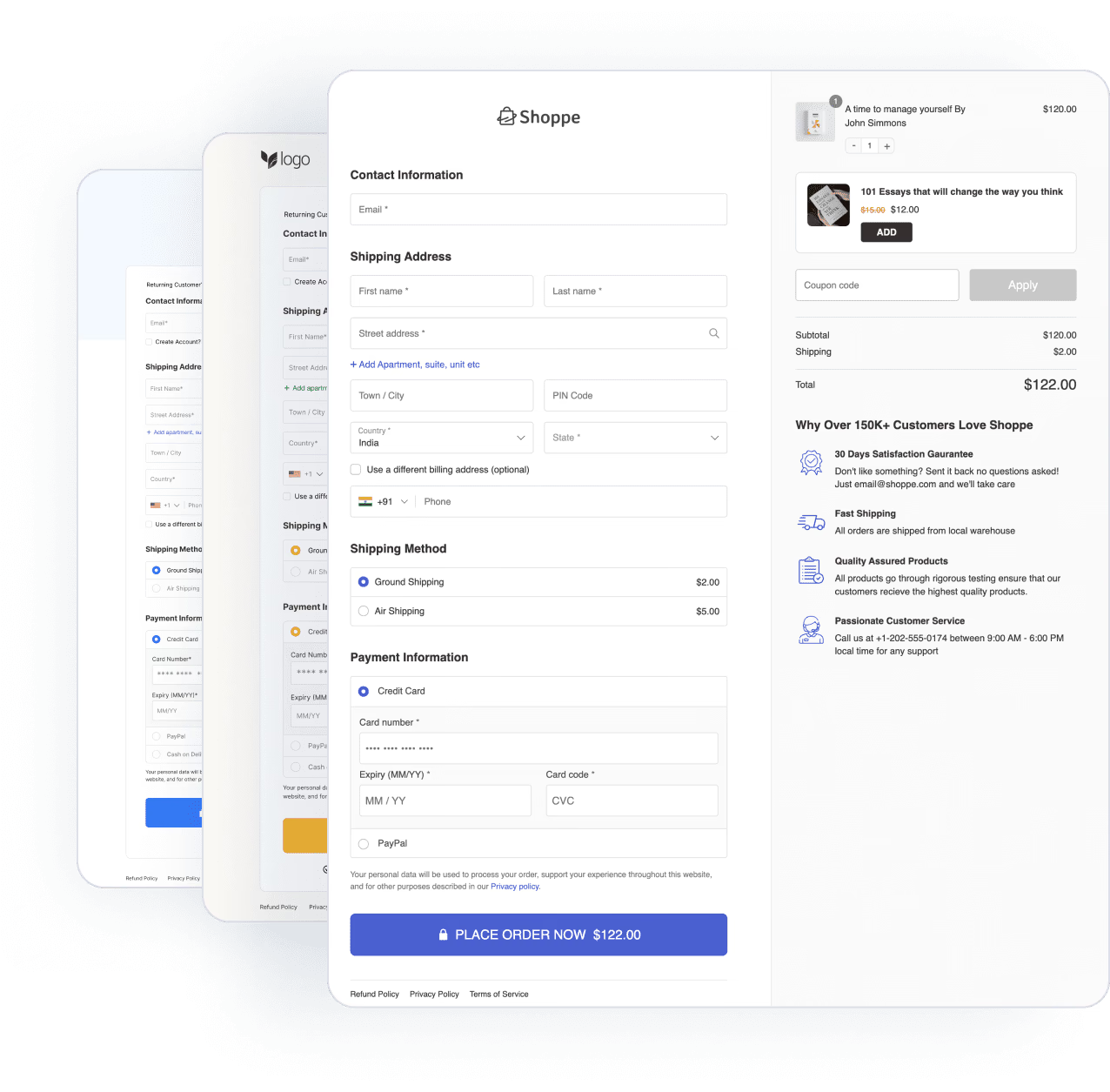
They come with conversion-proven elements like testimonials, trust seals, one-step or multi-step checkout forms, Google Address Autocomplete, embedded forms with customizable fields, and so much more!
Customize them with your favorite page builder - yes, drag and drop, no coding.
We are talking about the modern, dynamic FunnelKit Checkout.
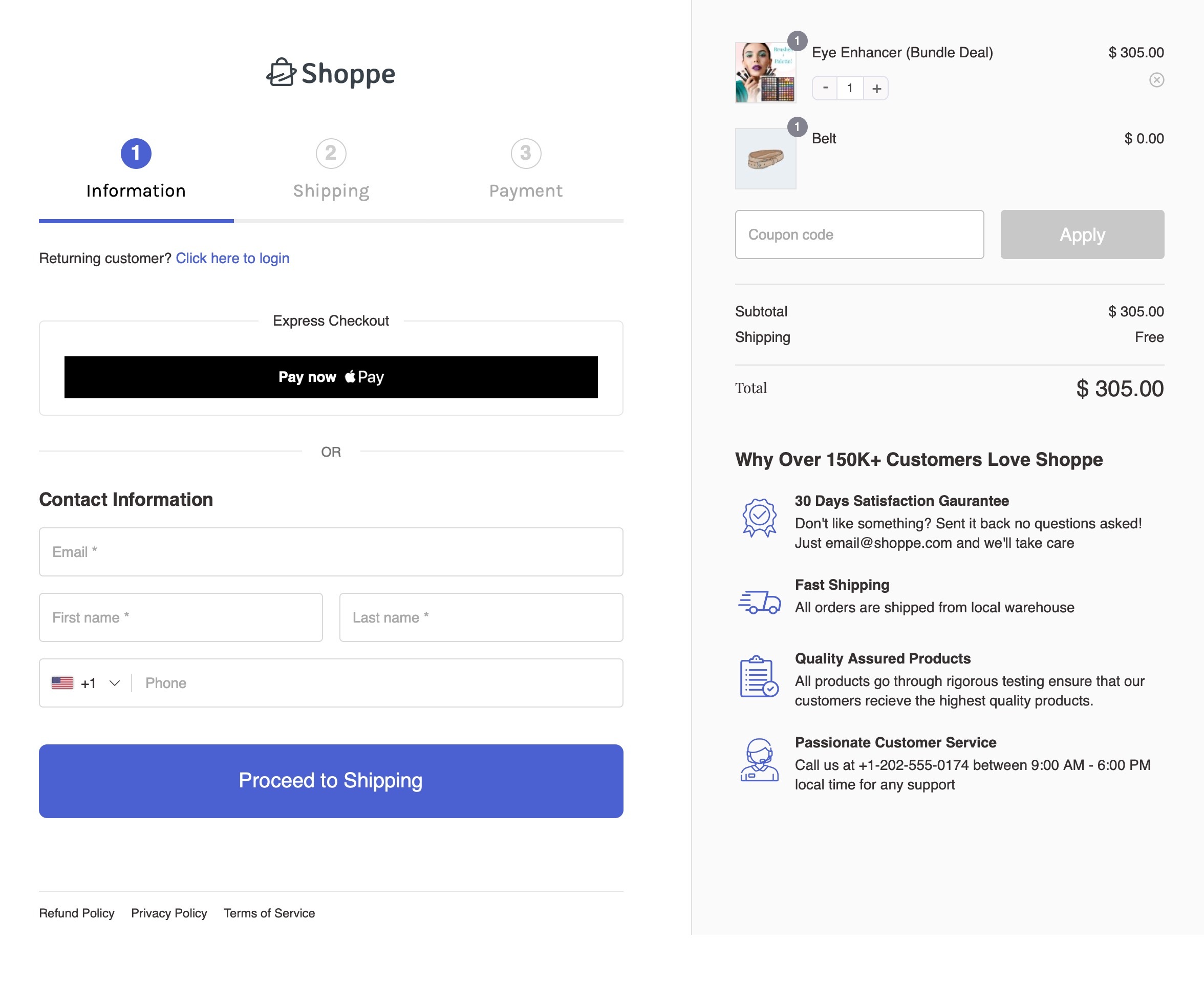
To reduce cart abandonment, you can enable a quicker checkout process with a one-page checkout or create a multi-step Shopify-style checkout.
But that’s not it. You get more.
🛒 Mini Cart Widget: FunnelKit’s checkout templates have a mini-cart widget. This lets users review, delete, adjust item quantities, and more.
📍 Google Address Autocomplete: Wrong addresses can lead to failed deliveries. FunnelKit’s built-in checkout page optimizations like Google Address Autocomplete allow your user to type in their address with just a few keystrokes.
🌟 Rule-based Checkouts: Create rule-based checkout pages for different products and add relevant upsell offers and one-click order bumps.
📄 Advanced Form Fields Editor: With the flexible checkout form builder, add sections and additional fields and rearrange them all right within WordPress.
FunnelKit’s checkout page templates are optimized for mobile and ensure a frictionless checkout experience for your mobile users.
Frequently Asked Questions (FAQs)
Not on its own. WooCommerce ships with offline methods like direct bank transfer, check payments and cash on delivery.
Apple Pay comes through a payment gateway plugin like Stripe, Square, PayPal, Authorize.Net, and WooPayments.
No. Apple charges merchants nothing. The roughly 3% people quote is your gateway's card processing fee, which you'd pay on any card order.
Yes. WooPayments, Square, PayPal Payments, Braintree and Clover all support it, and WooPayments doesn't need a separate Stripe account.
They can. If your checkout relies on an order bump, shoppers who pay from an express button at the top of checkout may never see it, so bump-heavy checkouts do better with inline Apple Pay.
Post-purchase one-click upsells run after payment and aren't affected.
Usually it's one of three things: no card in Wallet on the iPhone, an older iOS version, or an in-app browser (Instagram, Facebook, email apps) where the button often won't render.
Open it in Safari and try again.
On WooPayments and the official Stripe plugin, no. One setting controls both.
However, the FunnelKit Stripe plugin has separate settings for each.
Untick it where you turned it on. In our Stripe plugin, disable express checkout under the Express Checkout tab and untick Enable Apple Pay in the Apple Pay tab.
To hide it on some pages only, untick those pages instead.
Most gateway plugins serve it for you. If you have to do it by hand, download the file from your gateway, create a .well-known folder in your site's root directory, and upload the file there by SFTP or your host's file manager. Then check that it opens in a browser.
Apple's official guide to preparing merchant domains for verification covers all the details.
WooCommerce itself comes with three offline methods: direct bank transfer, check payments and cash on delivery.
Everything else comes from plugins. That includes cards, wallets like Apple Pay and Google Pay, buy now, pay later options, and local methods such as iDEAL or SEPA.
The same as card refunds. Refund from the WooCommerce order screen, and the money goes back to the card behind the shopper's Apple Pay.
Yes. Each payment uses a one-time token and needs Face ID, Touch ID or a passcode, so the card number never reaches your store.
That cuts down the card data you handle, but it doesn't remove your PCI obligations. Your gateway can tell you what applies to your setup.
Apple Pay dominates the digital wallet market with an impressive 92% market share.
In 2022 alone, it processed a staggering $6 trillion in global payments, generating a remarkable $1.9 billion in revenue.
Here’s why Apple Pay is a game changer for your WooCommerce store:
1. Boosts conversions
56% of shoppers expect to see multiple payment options at checkout.
Express payment options like Apple Pay, Google Pay, PayPal, Amazon Pay, and more give your shoppers a convenient way to pay and place their orders quickly.
According to ACI Worldwide, such convenient payment options can boost conversions by 30%!
2. Faster checkouts
If you have a WooCommerce one-page checkout, you are already giving your shoppers a quick checkout.
However, adding express pay options like Apple Pay can give your shoppers a frictionless checkout experience.
The WooCommerce Apple Pay integration can really enhance your store's checkout experience.
With one-tap payments, Apple Pay eliminates the hassle of filling out forms and significantly reduces cart abandonment.
3. Unmatched popularity
With over 500 million active users worldwide, your customers are very likely to already have Apple Pay set up on their devices.
By offering Apple Pay as a payment option, you tap into a massive base of loyal users who prefer using this fast, convenient, and secure method over traditional card payments.
This gives your WooCommerce store a competitive edge and helps ensure you don't miss sales from Apple Pay users.
4. Enhanced security and fraud protection
When a customer purchases with Apple Pay, their credit card details are never shared with your store.
Instead, Apple uses tokenization, which replaces sensitive data with a secure, one-time payment token. This ensures payment details can never be used fraudulently.
Additionally, Apple Pay uses Face ID, Touch ID, or a device passcode to authorize transactions, adding an extra layer of security for every payment.
5. User experience optimization
Repeat customers make up most of your sales. In fact, repeat customers have a 67% higher average order value than new customers.
So, giving repeat customers a convenient express pay option like Apple Pay can improve their shopping experience and encourage them to buy more often.
Ready to Set Up Your WooCommerce Apple Pay Payment Gateway?
The growth of the eCommerce industry and the rising use of express pay options like Apple Pay go hand in hand.
Apple Pay doesn't cost anything beyond your normal card processing fee, and it can remove a lot of friction from mobile checkout.
Getting it working comes down to three things: choose a gateway that supports Apple Pay, make sure Apple can verify your domain, and place the button where it won't skip information your store needs.
If you're using Stripe, our free Stripe plugin registers your domain automatically and supports both express and inline Apple Pay.
It also includes a private test mode so you can test the setup before making it live.
Once you're ready to build the checkout around Apple Pay, including your custom fields, order bumps, and upsells, FunnelKit gives you control over where each element appears.
Couple your WooCommerce Apple Pay with a conversion-boosting checkout page and see sales rolling in!
Editorial Team
September 7, 2026Testing Stripe payments in WooCommerce is quite simple. Turn on test mode in your Stripe plugin, add a product to your cart, and check out using the test card 4242...
Editorial Team
August 27, 2026WooCommerce Google Pay can turn a 90-second checkout into a two-second tap. Think about paying for coffee with your phone. You pull out your phone, tap to pay, and you’re...
Editorial Team
July 6, 2026Stripe is one of the most trusted payment gateways worldwide, powering over 3.5 million websites globally. With 90% of U.S. adults having made a purchase from businesses that use Stripe...