


Most people assume setting up WordPress order forms means setting up a WooCommerce store. But it doesn't.
These order forms have one job, i.e., to give their customers a page where they select the items they want and pay.
A full online store hands you inventory rules, tax engines, shipping zones, and an accounts system you will never open.
The fastest build is three steps. You install a form plugin, connect Stripe, and drop the shortcode on a page.
All this takes is 10 minutes, with no cart and no monthly fee.
In this guide, we cover the setup that requires no store at all, a second setup for stores already running WooCommerce, and how seven different order form plugins compare.
Already running WooCommerce with a real catalog and want customers ordering from a product table? That is a different build.
For the broader playbook, see our guide to WooCommerce checkout optimization.
Table of Contents
- 1 Quick Answer: How to Create an Order Form in WordPress
- 2 What is a WordPress Order Form?
- 3 Which Setup You Need Before You Build Anything
- 4 How to Build a WordPress Order Form (Step by Step)
- 5 Building the Order Form Into Your WooCommerce Checkout
- 5.1 Step 1: Create a sales funnel with an order form
- 5.2 Step 2: Customize the WordPress Order Form
- 5.3 Step 3: Add products to your order form
- 5.4 Step 4: Enable express payment options (optional)
- 5.5 Step 5: Share the WordPress order form link with your audience
- 5.6 Bonus: Adding Custom Fields to Your WordPress Order Form
- 6 7 Order Form Plugins We Tested
- 7 6 Proven Tips to Optimize Order Forms That Move Completion Rates
- 8 Frequently Asked Questions
- 9 Ready to Create Your Own WordPress Order Form?
Quick Answer: How to Create an Order Form in WordPress
- Install a WordPress form plugin that supports payment fields.
- Open an order form template instead of starting from scratch.
- Add your products, prices, quantity fields, and customer details.
- Connect Stripe or PayPal inside the plugin settings.
- Paste the shortcode on any page and place a test order.
Jump to the step-by-step process below
What is a WordPress Order Form?
An online order form is a single page where a customer picks what they want, supplies their details, and pays. No catalog to browse, no cart to review.
You will also see it called a product order form or a simple order page.
It is a completely different tool from a contact form or a full store checkout.
| Components | What it collects | Does it take money | Best for |
|---|---|---|---|
| Contact form | An inquiry you reply to | No | Questions, quotes, lead capture |
| Order form | A confirmed order with payment | Yes | Small catalogs, services, campaigns |
| Full store | Orders against a managed catalog | Yes | Stock, shipping, tax, many SKUs |
The gap between a contact form and an order form is massive.
Only 38% of people who interact with a contact form ever submit it.
Asking someone to enquire costs you more than asking them to buy, because an inquiry requires a second conversation before anyone gets paid.
WordPress ships with no order form feature in core. The plugin you pick dictates whether you can take payments without fees, accept file uploads, or calculate live totals.
Which Setup You Need Before You Build Anything
There are two routes, so make sure to pick the right setup.
Route 1: A form plugin
You add a custom order form with payment fields to any WordPress page using a shortcode.
Orders arrive as form entries in your dashboard, and the money lands in Stripe or PayPal.
This suits small catalogs, services, and campaigns. For most sites, this is the right call.
Route 2: The checkout itself
If WooCommerce is already running, you turn the checkout page into the order form.
Orders behave like real store orders, so stock counts, coupon codes, and tax rules keep working.
This suits stores that already have a catalog and want to skip the cart.
Here is how the seven plugins we tested fall across those two routes:
| Plugin | Best for | Payments on free plan | File uploads | Calculations | Where orders land |
|---|---|---|---|---|---|
| FunnelKit Funnel Builder | WooCommerce stores where the order form is the checkout | Free version has checkout templates | Yes | Totals, tax, and shipping | Real WooCommerce orders |
| WPForms | A first order form with the gentlest learning curve | Stripe and PayPal, one-time and recurring | Paid plan | Paid addon | Form entries, with a payments dashboard |
| Fluent Forms | Lightweight sites that want Pro features for less | No, payments sit in Pro | Paid plan | Paid plan | Form entries |
| Bit Form | Buyers who want a one-time license, not a renewal | No, payments sit in Pro | Yes | Yes | Form entries |
| Formidable Forms | Quote forms, configurators, anything math-heavy | Stripe only, fixed amount | Paid plan | Strongest engine tested | Form entries, plus front-end views |
| JetFormBuilder | Block editor sites wanting a free order-and-pay form | PayPal, in the free core | Yes | Yes, in the free core | Form entries |
| Gravity Forms | Agencies and complex, data-heavy order workflows | No free version | Yes | Yes | Form entries |
Disclosure: FunnelKit Funnel Builder is our own product. It is in this comparison because it solves one specific version of this problem, and its limitations are listed alongside everyone else's.
We review all seven further down. First, the build.
How to Build a WordPress Order Form (Step by Step)
Here we will build one form all the way through: a bakery taking pre-orders for three cake sizes, with a collection date, an optional message on the cake, and payment on the same page.
We are using WPForms Lite for the walkthrough because it handles both one-time and recurring payments on the free tier, but the steps are nearly identical in Fluent Forms or Bit Form.
Step 1: Open an order form template
Install your form plugin and create a new form. Start from an order template.
Most form plugins ship with a billing template that already sequences the name, email, product selection, and total in a logical order.
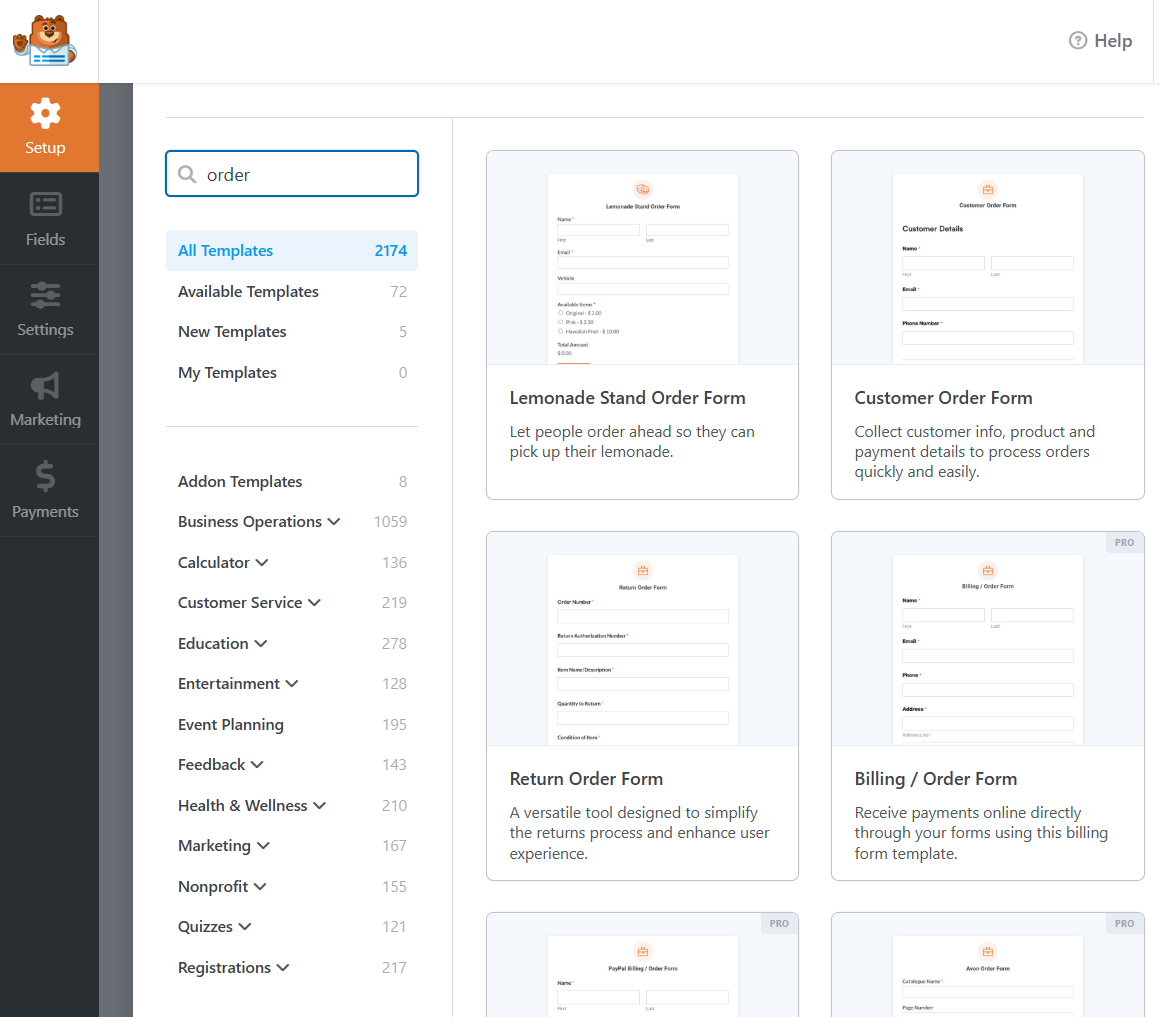
The field sequence takes the longest to get right, so do not start from a blank canvas.
Step 2: Add products, prices, and quantity fields
Add your items using the product or payment field type. Each needs a name and a price.
Ordinary text and dropdown fields will not add to a total, which is where most builds stall.
For the bakery, we use a multiple-items field with a quantity box, so someone can order two small cakes and one large.
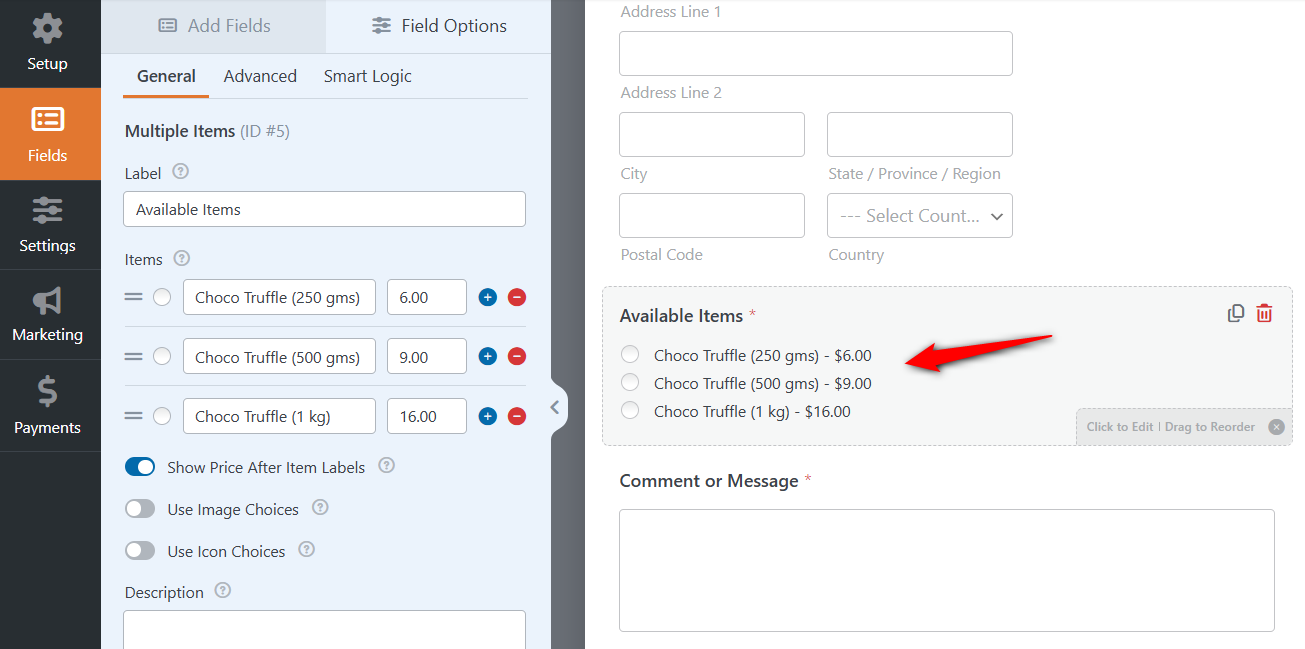
Add a total field at the bottom so the number updates live.
A customer who cannot see what they owe before the payment step hesitates, and hesitation on a long form is abandonment.
Step 3: Connect Stripe or PayPal
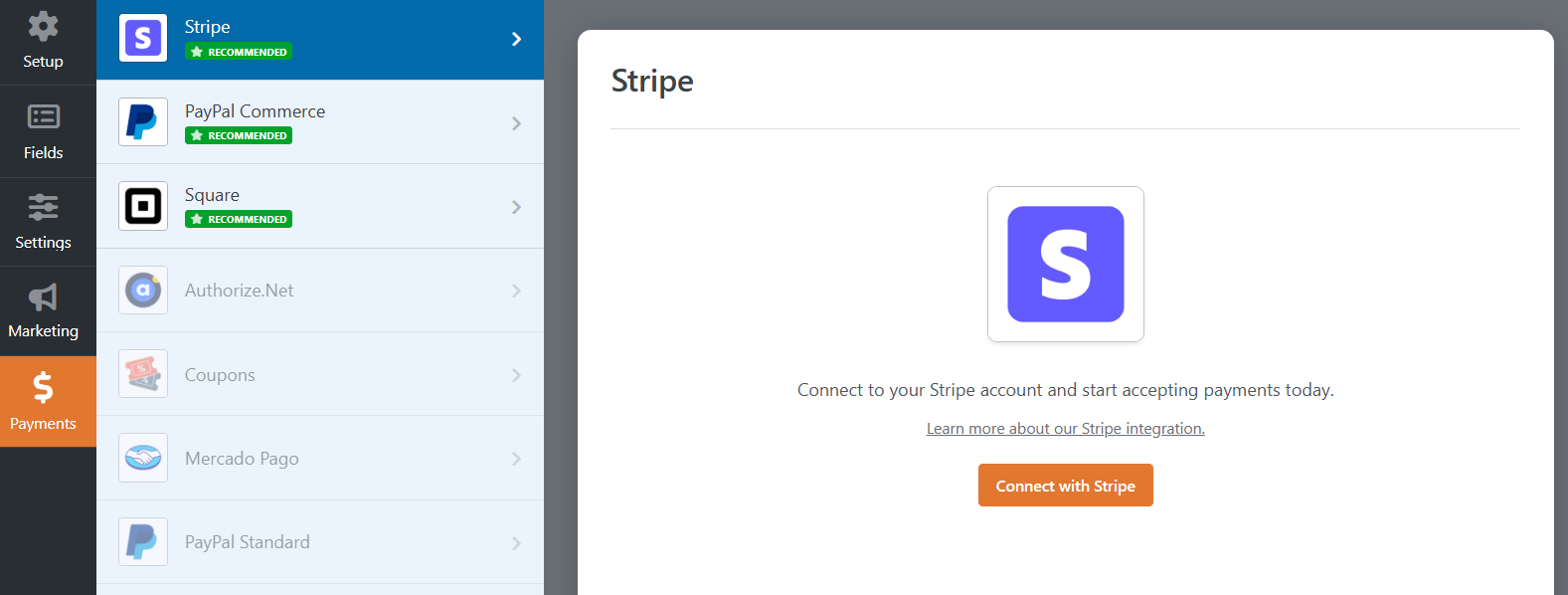
Open payment settings and connect your gateway. Stripe brings cards, Google Pay, and Apple Pay with it.
Check the fee before committing.
Several plugins let you take payments on the free plan but add their own percentage fee on top of the gateway fee.
For a bakery selling $40 cakes, a 3% platform fee passes the cost of a paid plugin license around the eightieth cake.
Enable the payment field in the form itself.
Connecting the gateway and adding the field are two separate actions.
Skipping the second is why a form submits without charging anyone.
For the broader playbook on gateways and their trade-offs, see our guide to Stripe payment plugins for WordPress.
Step 4: Customize the fields and add conditional logic
Delete anything you will not use. Every field is friction, and the average checkout shows 23.48 form elements by default. Keep yours under 14.
Ask for the email address near the top. If someone abandons halfway down, that early capture is your only way to follow up.
Then add conditional logic. The bakery’s custom message box appears only when someone ticks the personalize option.
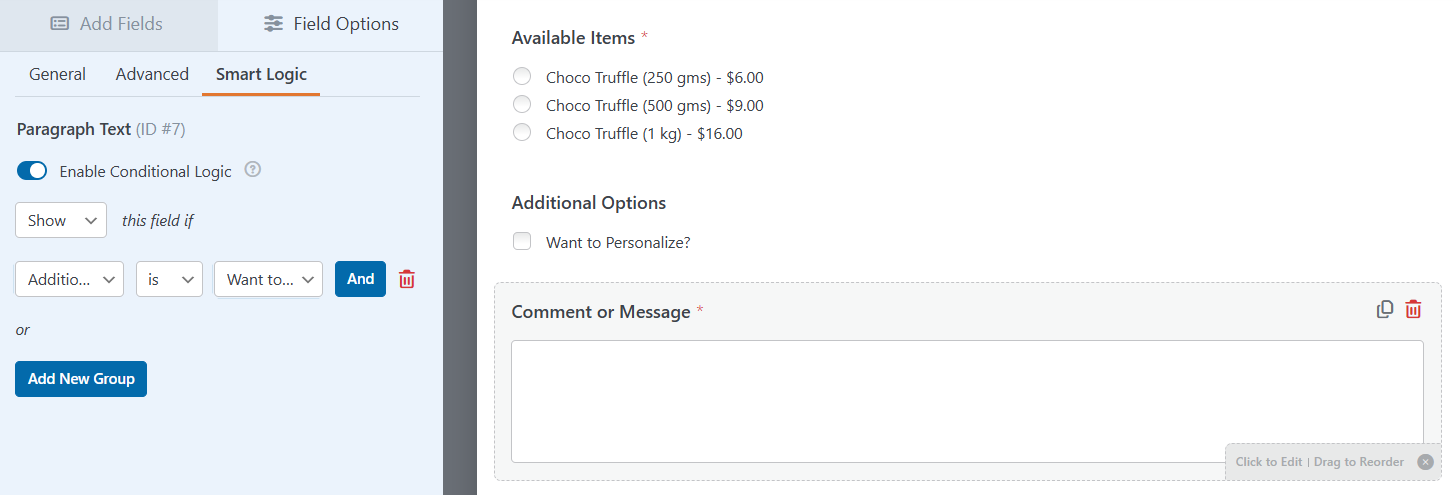
A delivery address appears only when they choose delivery over collection.
Step 5: Place a test order
Paste the form's shortcode onto a new page. Give it a clean URL like /order.
Put the gateway in test mode, select two sizes, tick the personalize box to fire the conditional field, and pay.
Then do the whole thing again on a phone.
Forms that behave on a laptop routinely stumble on a phone, and since desktop forms complete at 54.48% against 47.53% on mobile, a broken mobile layout costs you half your traffic.
Building the Order Form Into Your WooCommerce Checkout
If WooCommerce is already running, a standalone form plugin is the wrong tool.
Instead, turn the checkout page itself into a one-page order form. Product selection and payment sit together, and every order registers correctly in WooCommerce.
FunnelKit Funnel Builder handles this directly. Import a checkout template, enable multiple product selection, and drag the products field into the form.
Because the result is a true checkout, you can attach an order bump before payment and a one-click upsell immediately after it.
Standalone form plugins have no mechanism for this.
Before moving to the main process, make sure you install and activate FunnelKit Funnel Builder (free and pro).
Step 1: Create a sales funnel with an order form
Navigate to Funnelkit ⇒ Funnels and click on the "Create New Funnel" button.
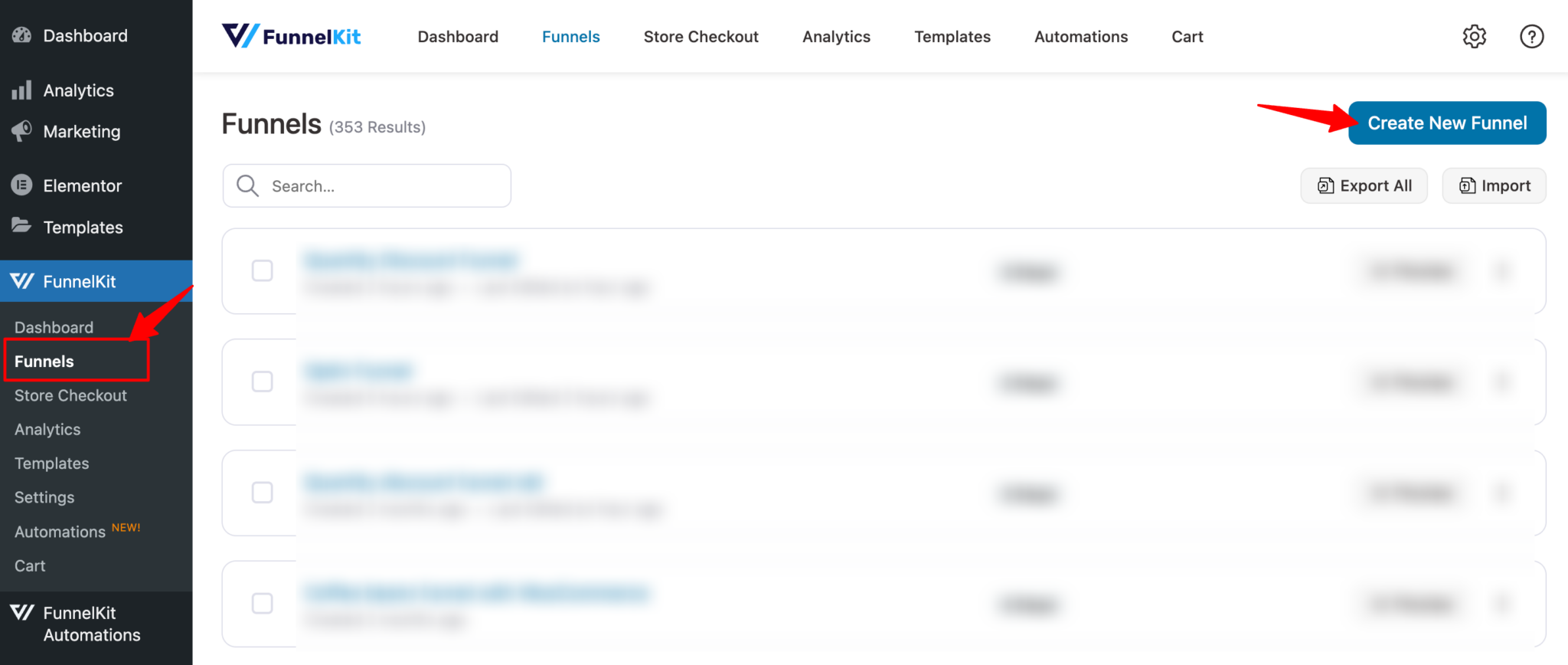
You will see premium sales funnel templates to choose from. Choose your favorite page builder and hover over the template you like. If you want to import the template, click on Preview.

Now, choose whether you want a single-page or multi-page checkout. I am using two steps.
After that, click on “Import This Funnel,” provide a name, and click on "Done" to import this sales funnel.
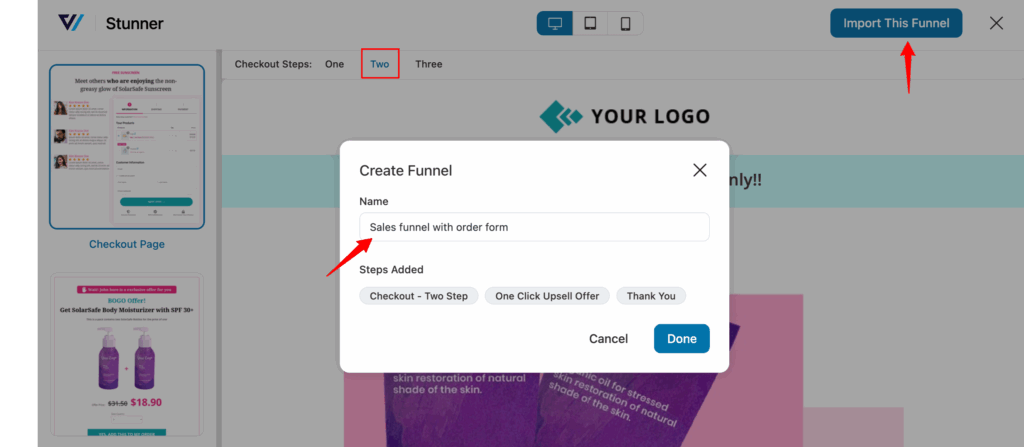
This will import a sales funnel with a two-step order form (checkout), one-click upsell, and a thank you template.
Step 2: Customize the WordPress Order Form
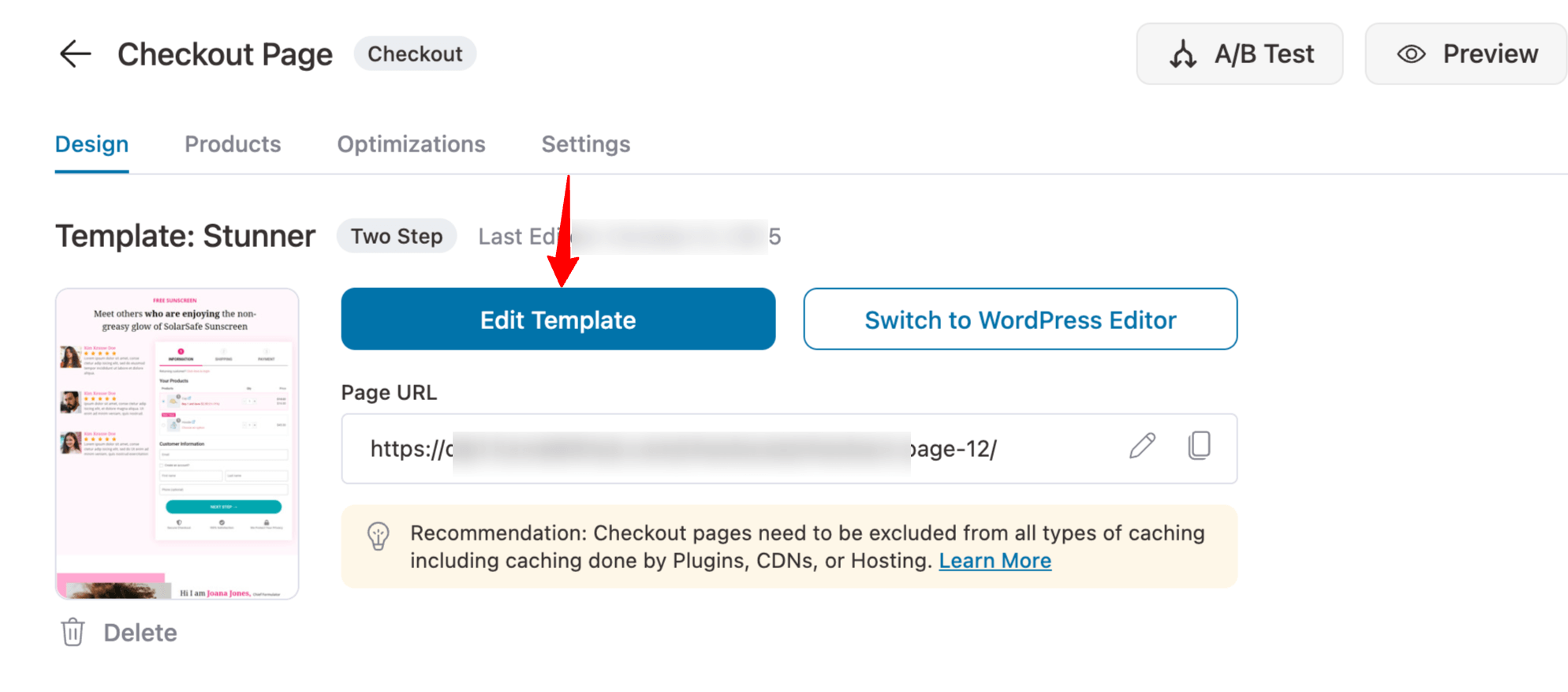
Now, let’s customize the order form with Elementor to make it look appealing. First, click on the checkout step.
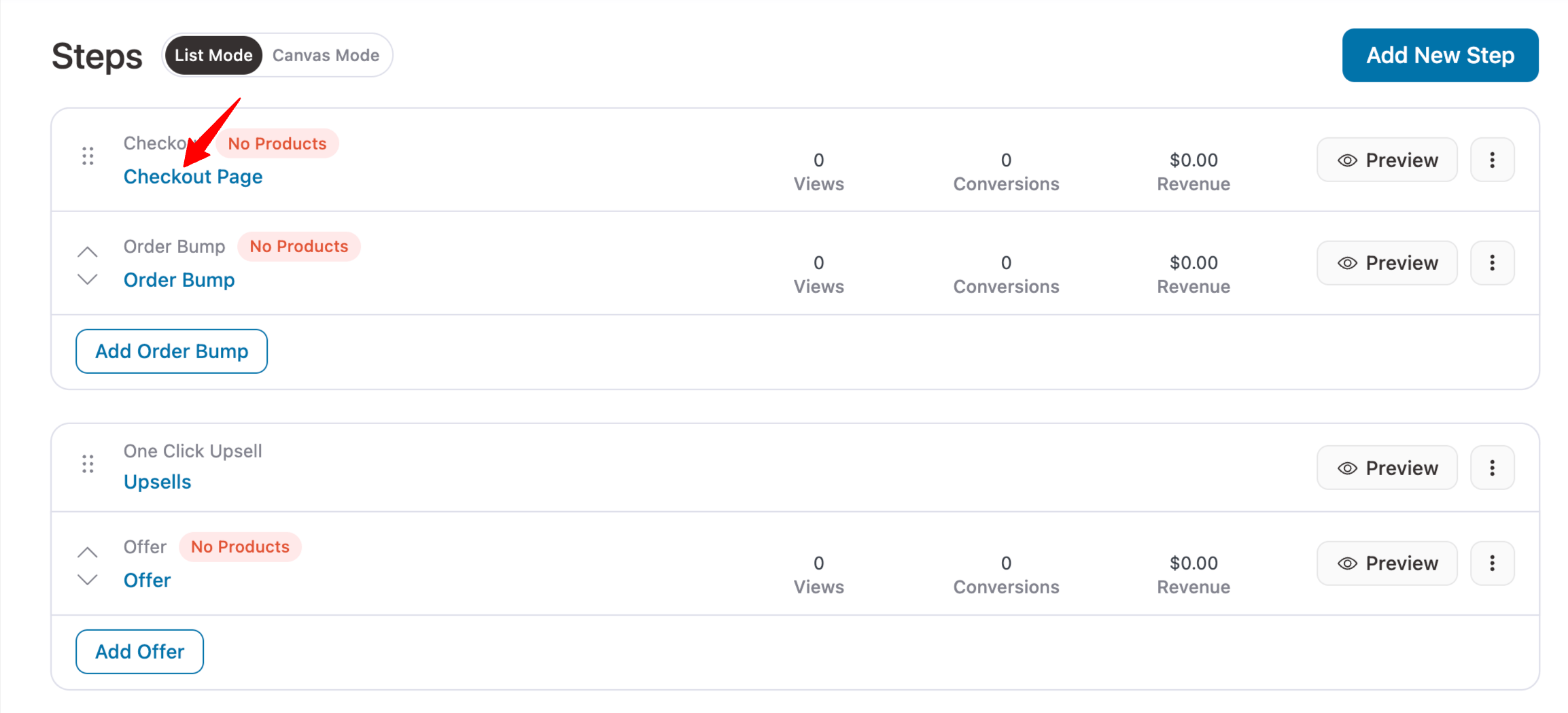
Now, click on the "Edit Elementor Template" option to customize the content of the WordPress order form page.
Changing the Logo
75% of consumers say a logo is the most essential brand identifier. Hence, you need a good logo on your WordPress order form to make your brand recognizable.

Just click on the logo icon and add a new logo.
Changing the page content
With Elementor’s drag-and-drop interface, you can change the text, add new icons, and play with the colors and size of the text - all with ease!

Editing Checkout Page Sections
If you want to customize certain sections of the checkout page, you can do that too!
Just click on the section you want to edit and make the customizations under the Edit Checkout Form section.
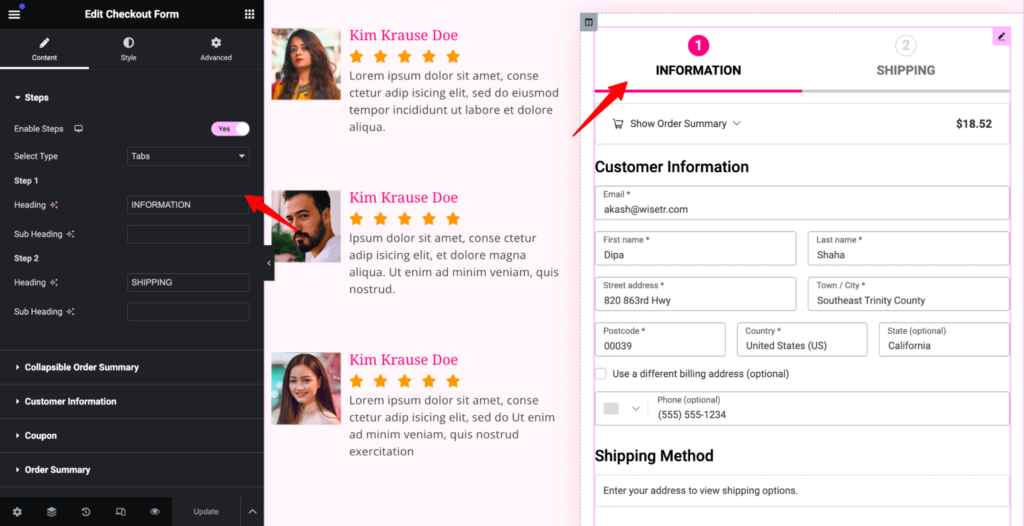
You can customize the content of the checkout page. After making the changes, click on Update to save.
Step 3: Add products to your order form
Now we want to add the products field to the WordPress order form so users can see and choose from the products.
Note: The Stunner template we're using already has the Products field.
If your template doesn't have it, scroll down to the Checkout Form Fields section. Then drag and drop the Products field into your WordPress order form.
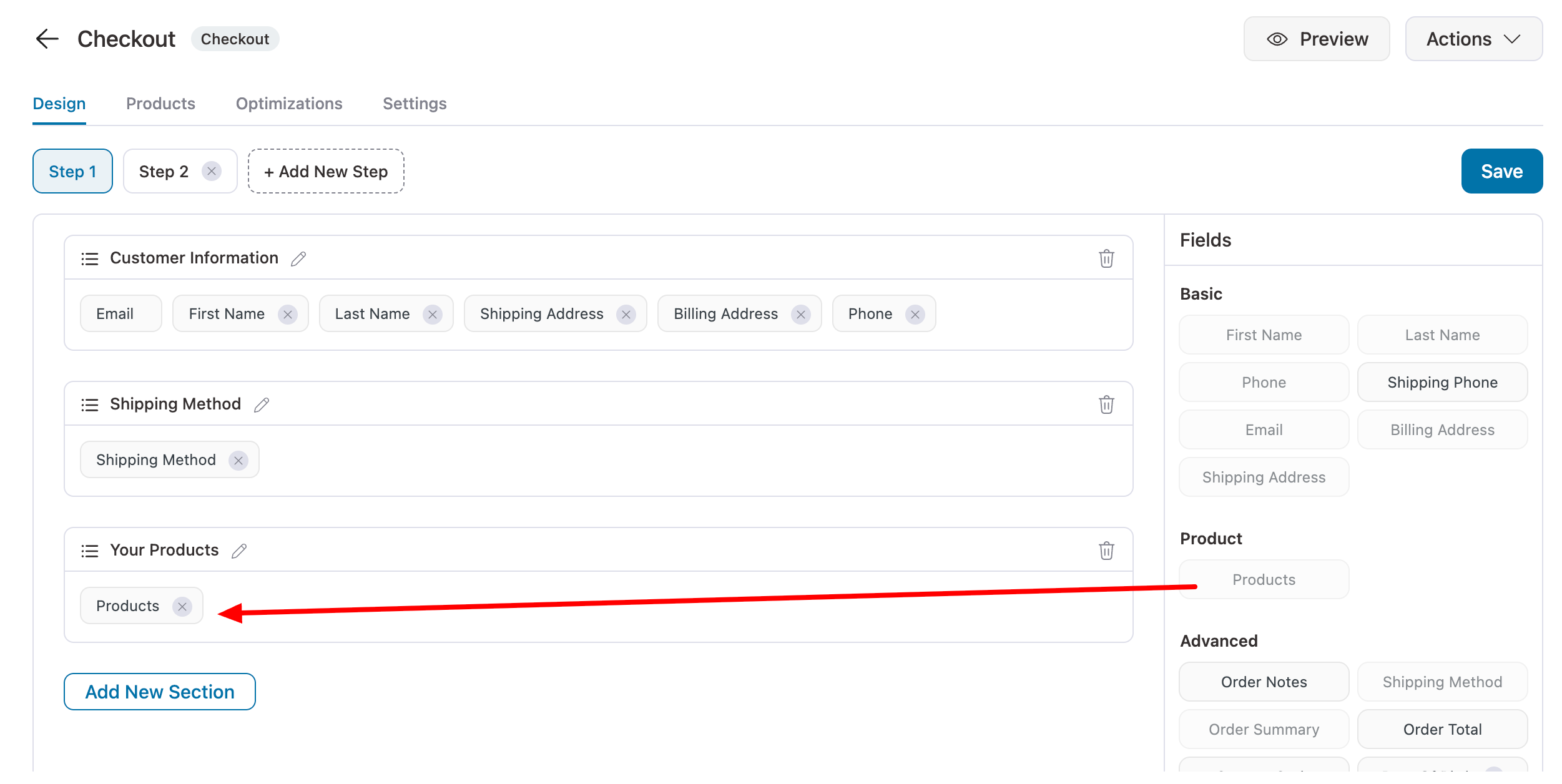
With the beginner-friendly field editor, you can shuffle the sections and add/remove/manage the fields with the convenient drag-and-drop interface.
Breaking down your online order form into sections simplifies the filling process for users.
You can display your selected products on the checkout page. You can either display a single product or multiple products.
The buyers can easily choose one or more products and place their order.
To add products, head to the Products section. Click on Add Product, search for the product you want to add, and hit Add.
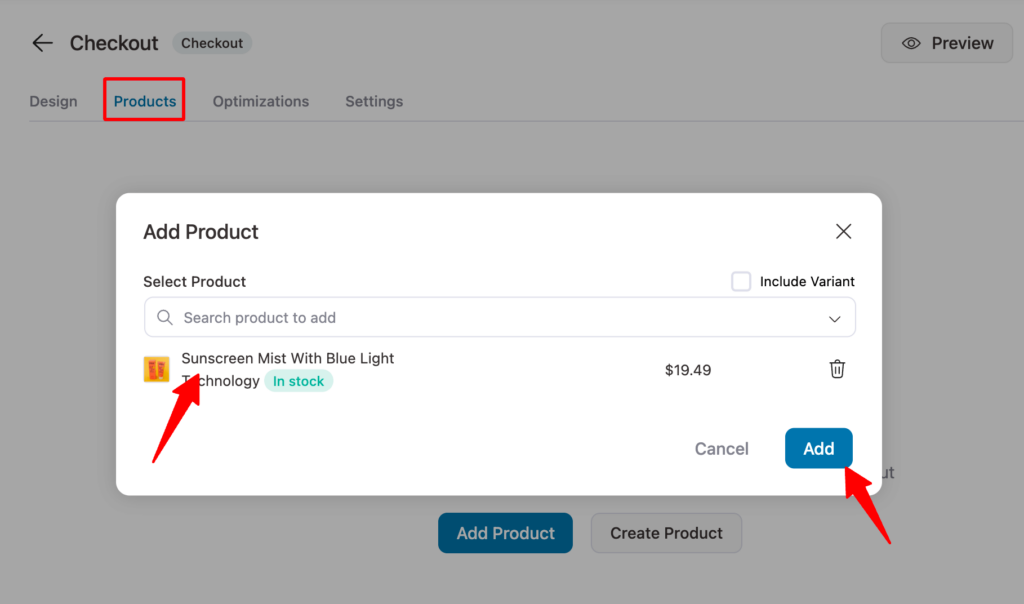
To add multiple products, click on Add New Products again and repeat the steps. You can add as many products as you want.
You can offer discounts on the product as well.
With product selection settings, you can allow your customers to choose any of the multiple products or only one product (a single product with multiple variants or prices).
You can even force sell all the products. When the customer lands on the checkout page, all the products will be automatically added to the cart.
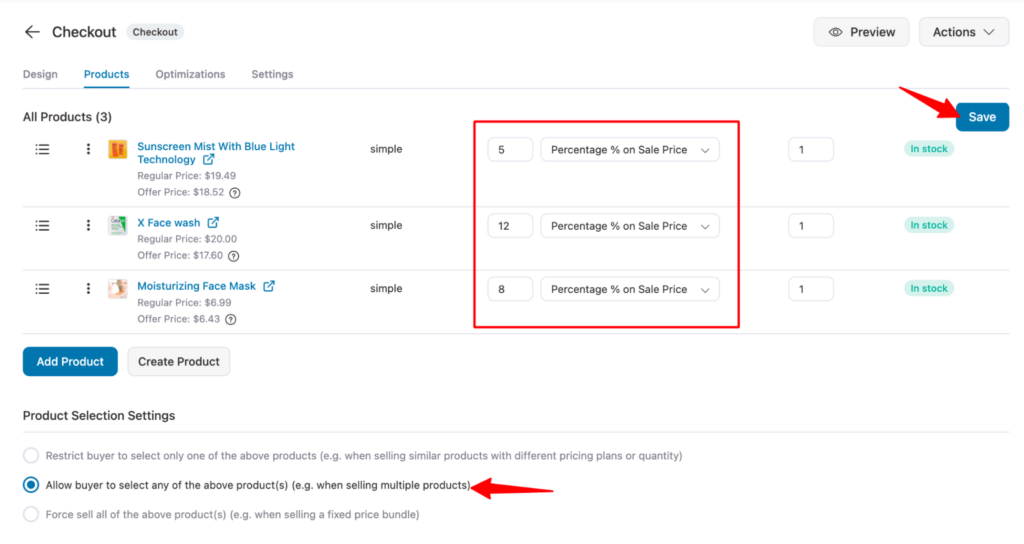
Save the changes when you have set up your products.
This is how the multi-product WordPress order form will look on the checkout.

Your customers can even adjust the quantity of a product.
Now that you have added the products to your WordPress order form, let’s customize it to look on-brand.
Note: Like the checkout page, you can customize the thank you page.
Step 4: Enable express payment options (optional)
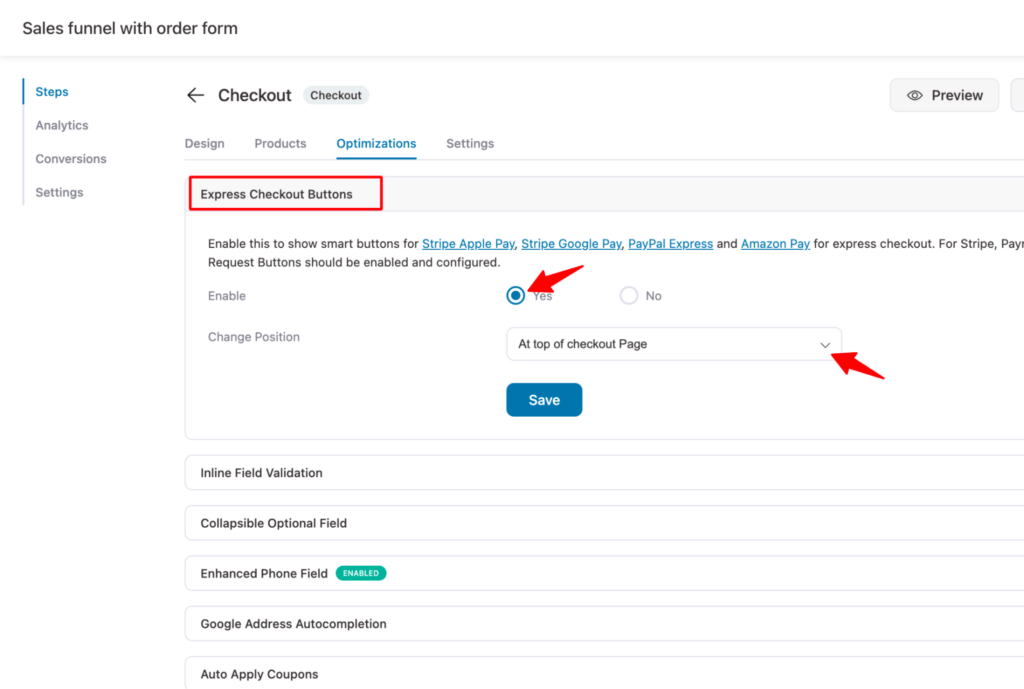
Offer express payment options such as Apple Pay, Google Pay, PayPal Express, etc.
By introducing a swift and hassle-free payment alternative for your users, you can enhance their experience.
Navigate to the Optimizations tab and enable the option under Express Checkout Buttons. You can also choose the position of the express buttons.

Step 5: Share the WordPress order form link with your audience
Now that you have set up your WordPress online order form, it’s time to share it.
You can easily copy the link on the Design tab of the Checkout step with a single click.
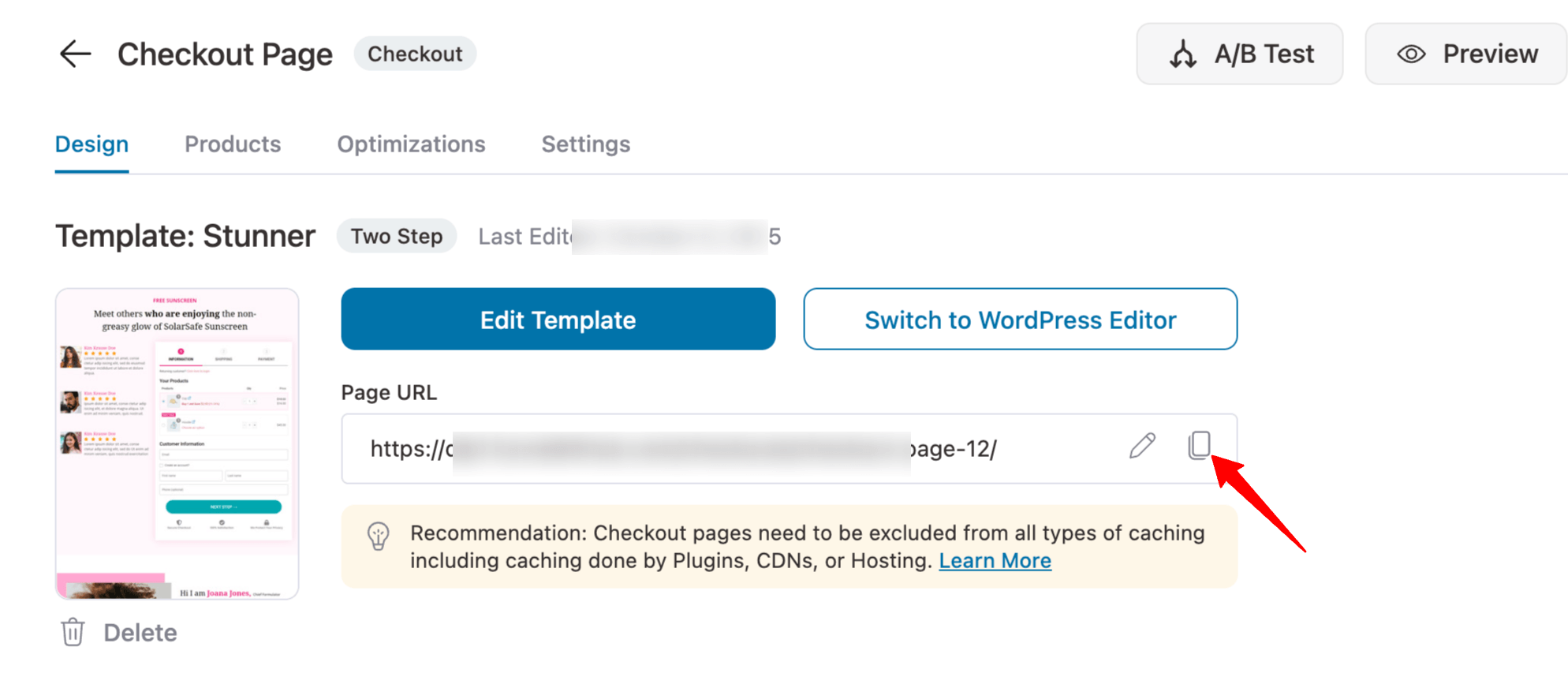
Your WordPress order form will open in a new tab. Copy the URL and share it in your Facebook groups or other social media profiles like Instagram, Twitter, Pinterest, and more.
You can even bring in paid traffic via Google Ads. You can also share the link with your audience directly in emails or SMSs.
The beauty of an order form is that the user will directly land on the checkout page, and they can complete their payment in minutes.
You also minimize the risk of users browsing through your store, getting lost, and abandoning the purchase.
Bonus: Adding Custom Fields to Your WordPress Order Form
If you want to add custom fields such as gift wrapping or special instructions to your order form, you can easily do that using FunnelKit.
To do this, navigate to the Checkout Fields section and click the “Add New Field” button.
Then, choose the field type, fill out the necessary details, and click Add to create your custom field.
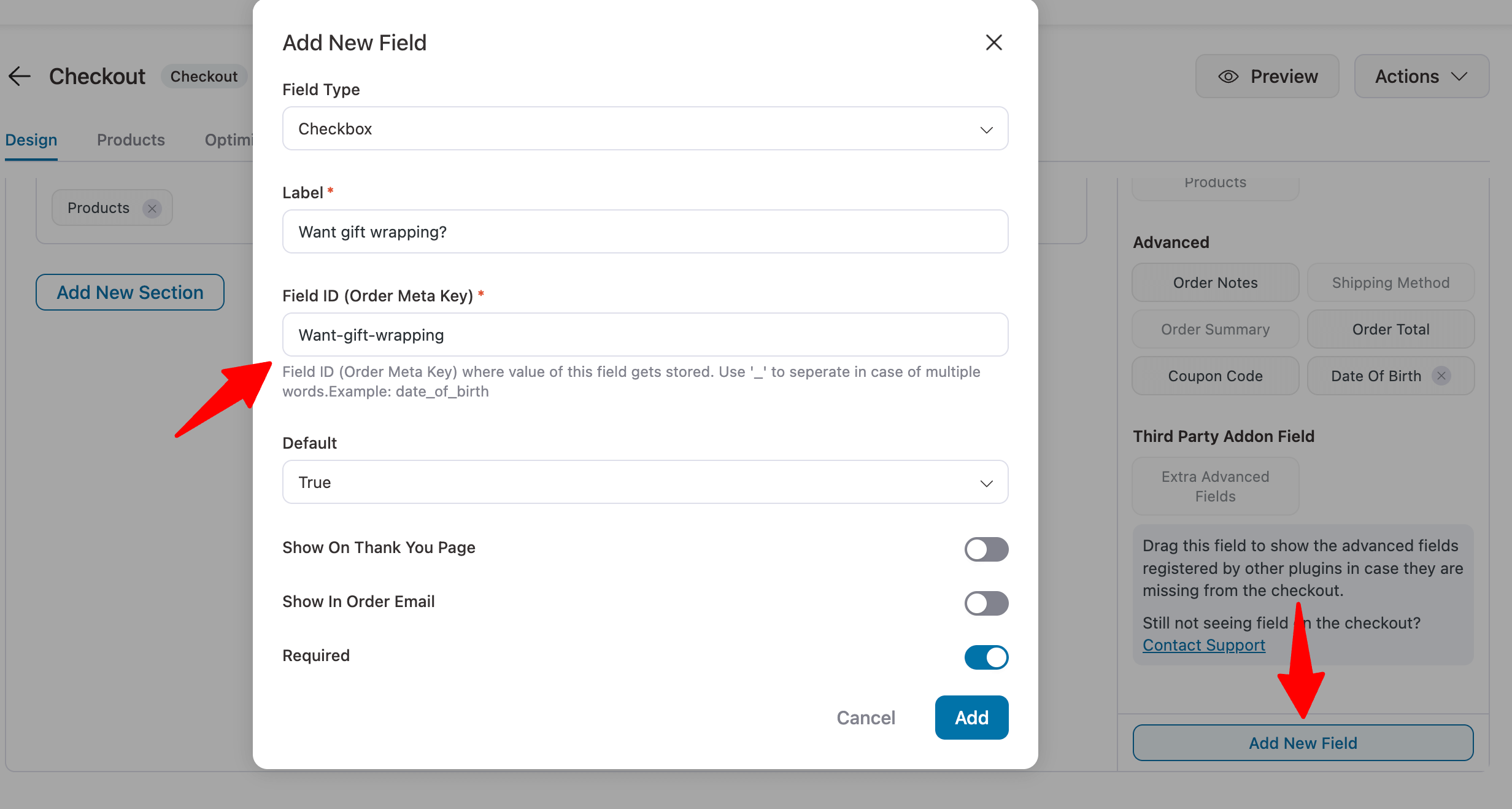
After creating the custom field, simply drag and drop it to your order form.
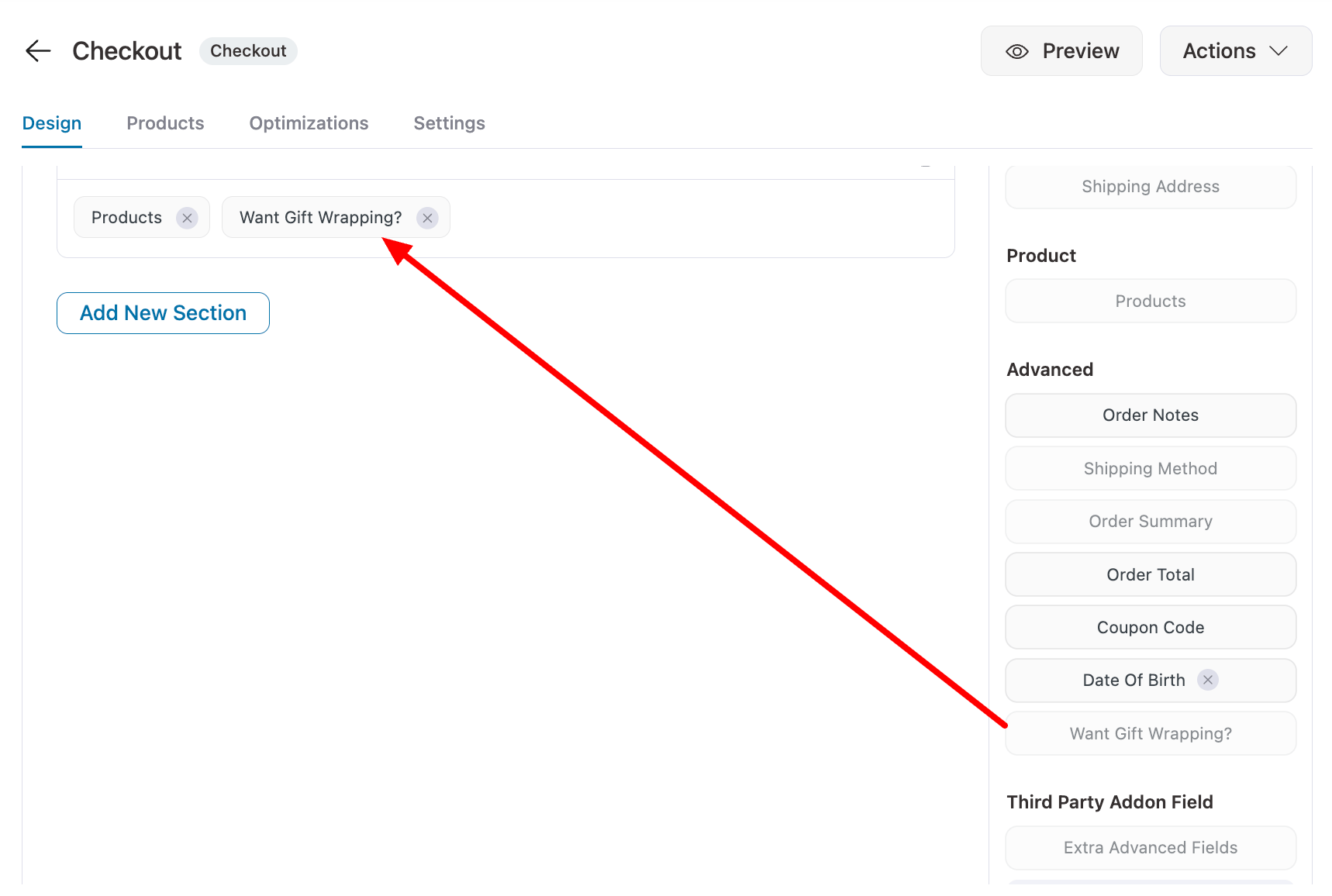
Remember to update the settings. You can follow the same process to add multiple custom fields to your WordPress order form.
7 Order Form Plugins We Tested
We installed each plugin on a clean WordPress install, built the same bakery form in every one, and pushed live test payments through Stripe.
Same three products, same quantity field, same file upload, same conditional delivery field, same total.
1. FunnelKit Funnel Builder
| Best For | WooCommerce store owners who want sales funnels and an optimized checkout, including an order form |
| Active Installations | 40,300+ (WordPress.org) |
| Pricing | Free version on WordPress.org. Paid plans from $99.50/yr (1 site) |
FunnelKit Funnel Builder is the only plugin on this list that treats the order form as one step in a full sales flow.
Rather than a standalone form that collects payment, FunnelKit builds a multi-step funnel: landing page → order form → one-click upsell → thank-you page, with order bumps optional at the form itself.
In our testing, FunnelKit took 8 minutes from install to a live multi-step order form. The pre-built Stunner template (and others as well) included optimized field order, trust badges, and express checkout placement out of the box.
Standout features:
- Pre-built funnel templates (single-page and multi-step order forms)
- Order bumps and one-click upsells natively, not via an add-on
- Express checkout for Apple Pay, Google Pay, and PayPal Express
- A/B testing, file upload fields, and order summary
- Tight integration with FunnelKit Automations for abandoned-cart recovery
Limitations:
- Upsell, A/B testing, and analytics features require the Plus plan or higher, not the Basic one
- More opinionated than a generic form builder. If you need form data that doesn't map to a WooCommerce order, you’ll fight the structure
Verdict: If your goal is to build optimized conversion flow and maximize average order value in WooCommerce, FunnelKit is purpose-built for that job.
2. WPForms
| Best For | WooCommerce store owners who want sales funnels and an optimized checkout, including an order form |
| Active Installations | 6 million+ (WordPress.org) |
| Pricing | Free (Lite). Paid plans start at $49.50/yr Basic. Payment forms require Pro at $199.50/yr (first year) |
WPForms is the most-installed form plugin on WordPress for a reason: its drag-and-drop interface is the gentlest learning curve in this category.
Their order form template library includes 141+ pre-built variants, such as takeout orders, T-shirt sales, and service bookings, so most users can ship a working form in under 10 minutes by customizing a template.
Standout features:
- 2,000+ form templates with 141+ in the Order category
- AI form builder (describe what you need, and it builds the form)
- Stripe, PayPal, Square, and Authorize.Net native integrations
- Conditional logic and multi-page forms on Pro
Limitations:
- Order/payment fields require the Pro plan ($199.50/yr first year)
- No native sales funnel or upsell features
- Orders captured in WPForms don’t natively appear as WooCommerce orders with inventory tracking
Verdict: If your priority is a simple order form without any upselling features, WPForms wins.
3. Bit Form
| Best For | Small businesses needing lightweight order forms with payments and flexible fields |
| Active Installations | 10,000+ (WordPress.org) |
| Pricing | Generous free version. Affordable pricing. Pro starts at $25/year and $99 for lifetime for 1 site |
Bit Form is a lightweight WordPress form builder for custom order forms without a full online store.
Its drag-and-drop builder supports product choices, quantities, calculations, conditional logic, file uploads, and multi-step layouts. You can collect customer details and accept payments through Stripe, PayPal, Razorpay, or Mollie without any extra add-ons.
Standout features:
- Unlimited forms and submissions in the free version
- Conditional logic, multi-step forms, calculations, and file uploads
- Multiple payment field options like Stripe, PayPal, Razorpay, and Mollie
- 50+ integrations with platforms like CRM, email, spreadsheets, and automation
Limitations:
- Smaller template library than some established form builders
- Payment fields require Bit Form Pro
- Better suited to custom order forms than WooCommerce order management
Verdict: Choose Bit Form if you want an affordable WordPress order form builder with flexible fields, payment options, and a lightweight setup.
4. Gravity Forms
| Best For | Developers and technical users building complex, custom data-driven forms |
| Active Installations | N/A |
| Pricing | Payment collection available from Pro $159/yr (3 sites, payments included). Elite $259/yr (unlimited sites) |
Gravity Forms is the form plugin that powers more enterprise WordPress sites than any other.
The interface feels dated compared to WPForms, but the depth of customization, the third-party add-on ecosystem (GravityView, Gravity Flow, Gravity Perks), and the consistent renewal pricing make it the long-term value pick for serious builders.
Standout features:
- Advanced conditional logic with no hidden tier gates
- 30+ official add-ons cover most CRM, email, payment, and workflow integrations without third-party purchases
- Multi-page forms with progress bars and save-and-continue let long order forms keep completion rates up
Limitations:
- No free version; paid only
- Interface feels less polished than newer plugins
- Steeper learning curve for non-technical users
Verdict: If you build sites for clients or maintain a complex form-heavy site, Gravity Forms is the most cost-predictable serious tool. Skip it if "drag-and-drop in 5 minutes" is your priority.
5. Formidable Forms
| Best For | Quote forms, mortgage calculators, custom pricing forms, and anything math-heavy |
| Active Installations | 300,000+ (WordPress.org) |
| Pricing | Lite version free. Business $159.60/yr first year (required for payments) |
Formidable Forms' killer feature is its calculation engine. Where other plugins let you add a simple subtotal, Formidable supports complex multi-step math, conditional pricing, and data-driven views, you can build a full quote calculator with branching logic that other form plugins can't match.
Standout features:
- The most powerful calculation engine of any WordPress form plugin
- Formidable views display form submissions on the front-end as directories, listings, or dashboards
- Repeater fields for variable-length data
- Stripe, PayPal, and Authorize.Net integration
Limitations:
- Payment processing requires the Business tier ($159.60)
- Steeper learning curve than WPForms or Fluent Forms
- The lite (free) version is intentionally limited
Verdict: Pick Formidable if your order form needs to calculate something complex, including custom pricing, configurators, or service quotes. Overkill for simple product orders.
6. Fluent Forms
| Best For | Sites where speed and price both matter |
| Active Installations | 700,000+ (WordPress.org) |
| Pricing | Free version. Pro from $59/yr (1 site) |
Fluent Forms has quietly become the budget-pick favorite in the WordPress form space.
The free version is genuinely usable (unlike WPForms Lite, which gates basic features), and the Pro version at $59/yr is half the price of WPForms Pro with comparable feature parity for order forms.
Standout features:
- Lightweight, loads faster than WPForms or Gravity Forms
- Stripe, PayPal, Mollie, Square, and Razorpay integrations
- Conditional logic and multi-step forms on Pro
- Same renewal price (no first-year discount trick)
Limitations:
- Smaller template library than WPForms
- Less mature add-on ecosystem than Gravity Forms
- Some documentation gaps for advanced setups
Verdict: If you want most of WPForms' functionality at half the price and a lighter footprint, Fluent Forms is the value pick.
7. WP Simple Pay
| Best For | Single-product sellers and service businesses that only need Stripe |
| Active Installations | 9,000+ (WordPress.org) |
| Pricing | Free (Lite). Pro from $49.50/year |
WP Simple Pay is a Stripe-powered payment form generator. If you don't need shipping addresses, product variants, or anything beyond "click button → pay", it's the fastest path to a working order page.
Standout features:
- Set up in under 5 minutes, connect Stripe, pick a template and publish
- Apple Pay and Google Pay come free via Stripe
- Recurring payments and installment plans on Pro
- No transaction fees beyond Stripe's standard rate
Limitations:
- Stripe only, no PayPal, no Authorize.Net
- No native product catalog or shipping fields
- Not a true order form for multi-product stores
Verdict: Perfect for single-product sellers, donation pages, course sales, and consulting deposits. Wrong tool for a multi-product order form.
6 Proven Tips to Optimize Order Forms That Move Completion Rates
You have set up your online order form without leaving your WordPress dashboard and are ready to see the orders and profits roll in - but wait!
Here are five powerful bonus tips to boost conversions and profits from the order form.
Tip 1: Add order bumps and upsells
Order bumps are complementary suggestions that buyers can add to their carts with just a click!
Relevant order bumps can significantly boost your AOV.
This is how one-click order bumps look on your checkout page. The item is added to the buyer’s cart with just one click.
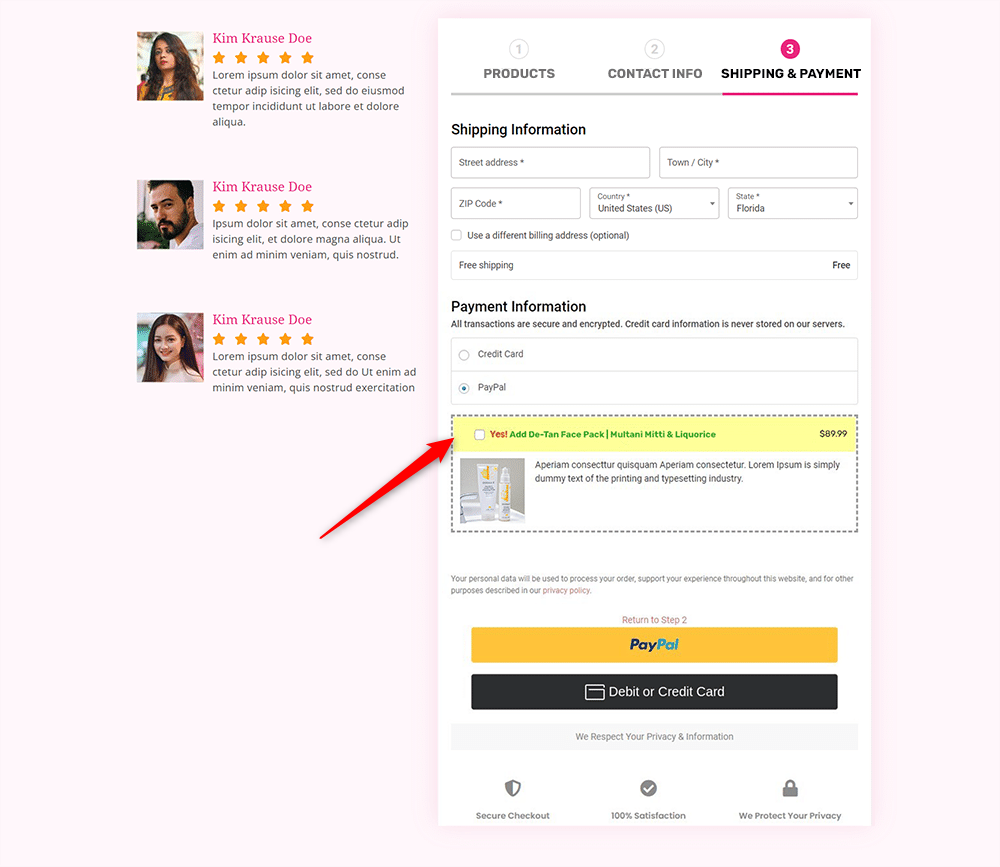
Along with an order bump, you can always add a pre-purchase or a post-purchase upsell offer. This way, you can pitch your premium products to a buyer who is highly interested in your products.

You can even add post-purchase upsell offers, giving new buyers a special offer or a discount bundle.
This way, you can take advantage of the customer’s buying momentum and squeeze more sales and profits from the same sale.
You can implement order bumps and upsell offers to squeeze more profits from the same sale. However, if you want to go with only one, refer to our guide on upsells vs. order bumps.
Tip 2: Keep the checkout form simple with important fields first
Every field is friction, and most order forms carry two or three that nobody reads. Cut the form to what you will actually use.
Keep your checkout form clean and focused. Start with product selection, follow with email and phone, then request shipping and payment details.
FunnelKit’s smart field editor lets you rearrange fields, capture emails early, and create a faster, abandonment-proof checkout experience.
Tip 3: Follow up with users who abandon the order form
Most WooCommerce marketers use abandoned cart recovery emails. The same approach works for WordPress order forms.
Capture emails early so you can follow up if users drop off. Timely emails and SMS follow-ups can recover lost sales, especially with a dynamic time-bound discount.
FunnelKit Automations lets you automate the entire process and recover potential revenue.
Tip 4: Add express payment options and speed up checkout
Baymard’s study shows 9% of shoppers abandon carts due to unavailable payment methods and 4% due to declined cards.
Offering express payment options like PayPal, GPay, Amazon Pay, and Apple Pay is essential to reduce abandonment.

You can even let your buyers pay in installments. This way, buyers can afford to pay if they buy in bulk.
Tip 5: Set up a post-purchase email sequence
WooCommerce sends order form notifications, but you can fully customize them.
Use the visual email builder to design sleek notifications, adjust colors, add media, and include product suggestions.
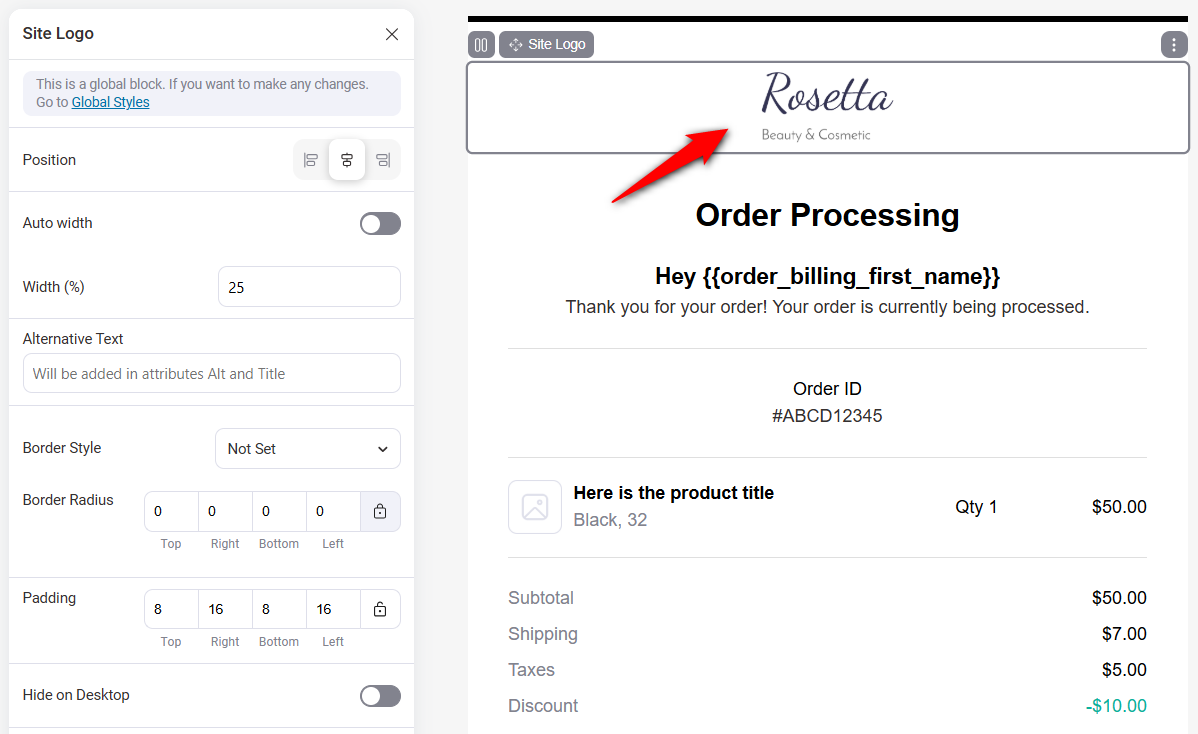
Your post-purchase email sequence can include transactional emails (order confirmation, shipping confirmation), promotional emails (cross-selling, product recommendations), and even retention emails (discount emails).
You can go a step further by incorporating purchase review emails, product education emails, and winback emails.
To learn more about how to set up a post-purchase email sequence that clicks with shoppers, refer to our complete guide on the post-purchase email sequence.
Frequently Asked Questions
Integrating payment gateways with your WordPress order form is simple. Integrate with popular payment gateways like Stripe, PayPal, Apple Pay, and Google Pay.
Yes, you can track detailed conversion data from your WordPress order form using FunnelKit.
It captures key information such as Order ID, Name, Email, Phone, Date, Total Spent, Referrers, Device, and more.
This data lets you analyze your sales performance, monitor user behavior, and optimize your order form for higher conversions over time.
No, WordPress and WooCommerce do not include a built-in feature to create order forms.
You need a form builder plugin to add custom order forms to your site.
The best WordPress order form plugins include:
- FunnelKit - Perfect for creating high-converting order forms, sales funnels, and integrations.
- WPForms - Great for beginners with drag-and-drop features.
- Gravity Forms - A good option for advanced users with extensive add-ons
These plugins offer customizable templates, payment gateway integration, and more.
If you build your order form with FunnelKit, you can easily customize the design using popular page builders like Elementor, Divi, Oxygen, and more. FunnelKit integrates seamlessly with these builders, allowing you to drag and drop elements, adjust colors, fonts, and layouts to match your brand’s style and create a fully personalized order form.
A single-step order form collects all the necessary details (product selection, billing, and payment) on one page, while a multi-step order form breaks the process into multiple stages, often improving user experience and reducing cart abandonment.
FunnelKit Funnel Builder, WPForms Pro, Gravity Forms (all paid tiers), Formidable Forms Pro, and Fluent Forms Pro include native file upload fields. Set explicit file size limits (the default is often only 2 MB) and whitelist safe file types.
Use FunnelKit for a detailed order summary, including cart total, shipping, and taxes; Formidable Forms for complex calculations (multi-variable pricing, configurators); Gravity Forms for advanced logic with code hooks; or WPForms Pro for simple subtotal math. Always test calculations on mobile before publishing.
Ready to Create Your Own WordPress Order Form?
An order form is the cheapest way to shorten the distance between wanting a product and paying for it.
A form plugin gets you there with no store installed, and for a service business or a small campaign, that is the correct move.
But if WooCommerce is already running, the checkout is the bottleneck everything else flows through.
Build the form on the checkout instead.
The lifts are small individually, but they compound: one less field, one more wallet option, one order bump, and the exact same traffic starts paying more.
Beyond just collecting the order, explore how FunnelKit Funnel Builder integrates with order bumps, one-click upsells, and cart abandonment recovery to compound revenue from the same traffic.
Editorial Team
October 9, 2026A downsell gives customers a cheaper option after they turn down your main offer. If you show it too soon, you might convince them to skip the original offer and...

Editorial Team
October 8, 2026WooCommerce guest checkout lets shoppers buy from your store without creating an account. They enter an email, their billing details, and payment, and the order goes through. It's a built-in...

Editorial Team
October 7, 2026WooCommerce upsells are products you recommend in place of the one a shopper is viewing, usually a better or higher-priced version of it. WooCommerce has a built-in upsell field for...