

WooCommerce automation can tell you when a product is running low, but it won’t chase up a shopper who left something in their cart.
WooCommerce handles things like order emails, stock alerts, and webhooks out of the box. But cart recovery, follow-up emails, and order syncing need an extra tool.
For example, say you run a pet supplies store with 300 orders a month.
If you spend five minutes copying order details, adding tags, and sending emails for each one, that’s 25 hours of manual work every month.
And that doesn’t include the shoppers who leave items in their carts and never hear from you again.
This guide breaks down what WooCommerce can automate on its own and the 14 workflows worth adding.
We’ll compare the main WooCommerce automation tools by price, then walk through an abandoned cart workflow using a WordPress plugin. No code required.
Quick answer: Start with three workflows: abandoned cart recovery, post-purchase follow-ups, and low-stock alerts.
A WordPress automation plugin can handle customer emails and SMS, while WooCommerce webhooks, Zapier, or Make can send order data to Google Sheets, Slack, or your CRM.
The comparison table below has the pricing and free plans for each option.
Table of Contents
- 1 What is WooCommerce Automation?
- 2 Does WooCommerce Have Built-In Automation?
- 3 3 Ways to Automate WooCommerce
- 4 14 WooCommerce Workflows Worth Automating
- 4.1 1. Recover abandoned carts
- 4.2 2. Welcome first-time buyers
- 4.3 3. Follow up after delivery and ask for a review
- 4.4 4. Cross-sell and remind customers to reorder
- 4.5 5. Win back customers who went quiet
- 4.6 6. Send birthday and anniversary offers
- 4.7 7. Generate coupons automatically
- 4.8 8. Tag and segment customers by behavior
- 4.9 9. Send order status updates
- 4.10 10. Email shipment tracking numbers automatically
- 4.11 11. Sync inventory and alert on low stock
- 4.12 12. Automate invoices, tax and accounting
- 4.13 13. Protect subscription renewals
- 4.14 14. Send order data to Google Sheets, Slack, or your CRM
- 5 Which Workflows to Set Up First
- 6 Best Automation Plugins and Tools for WooCommerce (2026)
- 7 How Much Automation Costs
- 8 How to Set Up Your First Automation Without Code
- 9 Why Automations Stop Running (Or Emails Stop Sending)
- 10 7 Best Practices to Keep Your Automations Profitable
- 11 Frequently Asked Questions
- 12 Start Automating Your WooCommerce Store Today!
What is WooCommerce Automation?
WooCommerce automation lets you handle store tasks automatically when something specific happens.
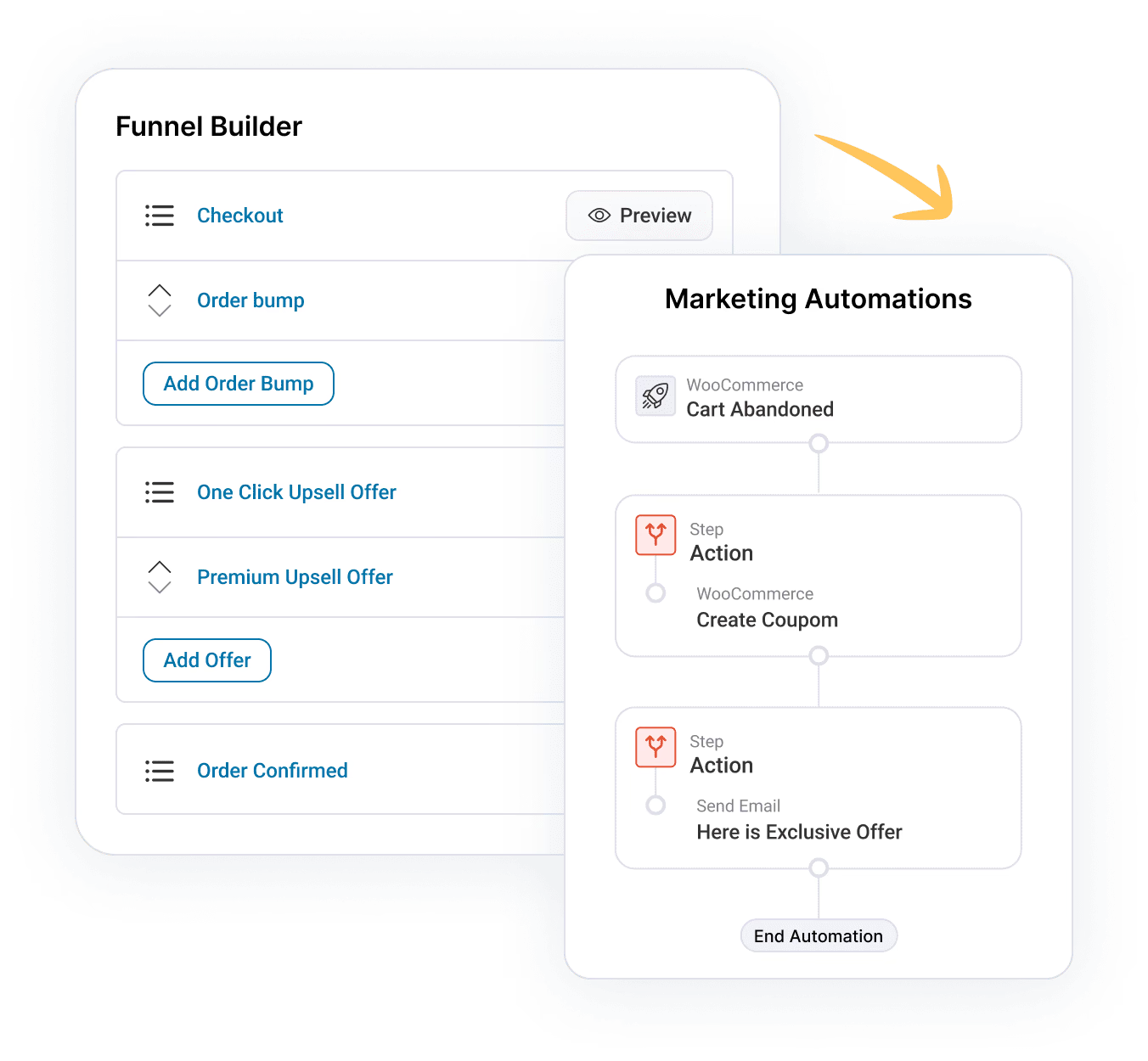
Each automation has three basic parts: a trigger, optional conditions, and one or more actions.
Once it’s set up, the rule runs on its own, whether it’s 3 a.m. or noon.
Triggers, conditions, and actions
| Part | What it does | Example |
|---|---|---|
| Trigger | The event that starts the automation | A shopper leaves a bag of dog food in the cart for one hour |
| Condition | A filter that decides whether the automation should run | The cart is over $25 and the shopper hasn’t ordered since |
| Action | What happens next | Send a reminder email that shows the cart items |
Different tools use different names for these parts.
AutomateWoo or FunnelKit Automations calls them triggers, rules, and actions. Zapier calls a workflow a Zap, while Uncanny Automator calls it a recipe.
The names change, but the basic logic is the same.
Customer-facing vs back-office automation
Customer-facing automations are the emails, messages, and offers shoppers see. These include cart reminders, welcome emails, review requests, and win-back offers.
The goal is to bring in new orders and encourage existing customers to buy again.
Back-office automations happen behind the scenes. They can update order statuses, flag low stock, create invoices, or send order data to other tools.
Most stores need both types of automation, and you may find that different tools work better for each.
Does WooCommerce Have Built-In Automation?
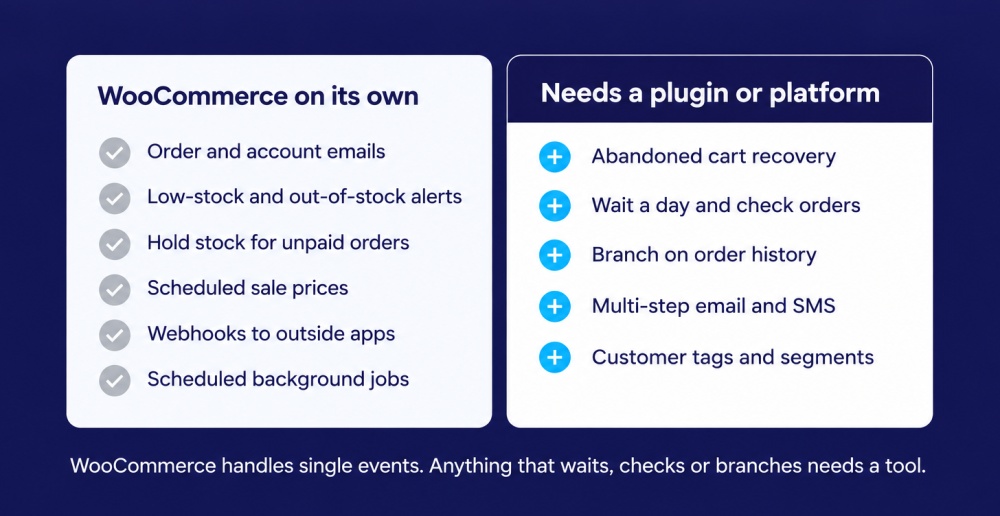
Yes, but mostly for basic store operations because WooCommerce handles order emails, stock notifications, some order status changes, and background tasks without any extra plugin.
What it doesn’t have is abandoned cart recovery, marketing sequences, customer segmentation, or most integrations with outside apps.
Order and account emails
WooCommerce automatically sends transactional emails for new orders, processing or completed orders, refunds, and new customer accounts.
You can turn each email on or off and change things like the text and colors from the email settings.
The default emails are pretty basic, though.
That’s why many stores use a plugin to customize WooCommerce order emails with their branding, product recommendations, and other details.
Stock notifications and low-stock thresholds
WooCommerce has settings for both low-stock and out-of-stock thresholds.
When a product reaches either limit, WooCommerce can email you. You can also choose to hide out-of-stock products from your catalog.
Another useful setting that’s easy to miss is Hold stock.
It releases stock from unpaid pending orders after the time limit you set, making those items available for sale again.
Order status changes and scheduled sales
Orders containing only virtual and downloadable products can move to Completed as soon as payment clears.
Physical orders normally stay in Processing until you or a plugin marks them as complete.
You can also schedule sale prices with start and end dates. For example, set up a weekend sale, and WooCommerce can end it automatically on Monday.
Webhooks
WooCommerce webhooks can send a notification to a URL when something happens in your store, such as a new order or an updated customer record.
Tools like Zapier, Make, CRMs, and custom apps can receive those notifications and take the next step.
You can create webhooks from the advanced WooCommerce settings.
WooCommerce also keeps delivery logs, which are useful when a webhook stops working.
Scheduled actions
WooCommerce uses scheduled actions to run background tasks, including order notifications, payment processing, and plugin-added jobs.
If you’re looking for a built-in WooCommerce scheduler, scheduled actions are the closest thing.
The WooCommerce status screen shows pending, completed, and failed actions, so it’s a good place to check when something that should happen automatically gets stuck.
Where native automation stops
WooCommerce’s built-in automation is useful for individual store events, but it doesn’t handle longer customer journeys.
It can’t wait a day, check whether someone has placed an order, and then decide what to do next.
It also can’t branch based on order history or run a multi-step marketing sequence.
That’s where WooCommerce automation plugins and integration tools come in.
They add the triggers, conditions, and actions you need for more advanced workflows.
3 Ways to Automate WooCommerce
Most WooCommerce automation falls into one of three places: inside WooCommerce itself, inside WordPress with a plugin, or in a cloud-based integration platform.
The right choice depends on what you’re trying to automate. You don’t need one tool to handle everything.
| Approach | Where it runs | How you pay | Best for | Main limitation |
|---|---|---|---|---|
| WooCommerce built-in | Inside your store | Free | Order emails, stock alerts, webhooks | No customer journeys or conditions |
| WordPress automation plugin | Inside WordPress | Usually a flat yearly license | Customer emails, SMS, segmentation, cart recovery | Connects only to the apps it supports |
| Integration platform (Zapier, Make) | In the cloud | Per task or per credit | Syncing orders with Sheets, Slack, CRMs and accounting tools | Costs grow with order volume |
The choice also depends on the kind of workflow you’re building.
In one Reddit thread about automating WooCommerce orders, store owners recommended Make and Zapier for sending order data to Google Sheets and Google Drive.
The person asking had initially planned to code the setup but ended up building it in Make after some testing and found it fairly easy to put together.
Customer messaging is a different story.
If you’re sending lots of emails or SMS messages, a WordPress automation plugin can be more cost-effective because you’re usually paying for the license rather than for every task or message.
14 WooCommerce Workflows Worth Automating
These workflows fall into two groups, i.e., marketing and operations.
For each one, we’ll look at the trigger, what happens next, which tools can handle it, and the metric to watch.
1. Recover abandoned carts
If you’re deciding where to start with WooCommerce automation, abandoned cart recovery is a good first choice.
It can bring back sales you would otherwise lose.
- Trigger: A shopper enters their email and leaves items in their cart for a set period, usually 15 to 60 minutes.
- Action: Send three messages: a reminder within the first hour, a follow-up around 24 hours later that addresses common objections, and a small incentive after 48 to 72 hours.
- What to measure: Recovery rate (recovered carts divided by recoverable carts) and revenue recovered per message.
Say a store has a $60 average order value. Recovering five carts a week brings back $300 in weekly revenue, or roughly $15,600 over a year.
Keep two things in mind before treating that figure as guaranteed revenue.
Cart recovery only works when you have the shopper’s email address.
Many people leave before entering it, so putting the email field early in checkout can help, but the sequence will still reach only some abandoned carts.
The discount in the third message has a cost, too.
If regular customers learn that leaving a cart leads to a discount, they may start waiting for it.
For a pet store where customers already reorder food every month, free shipping may be a better offer. You could also skip the incentive altogether.
The setup section later in this guide walks through this exact sequence.
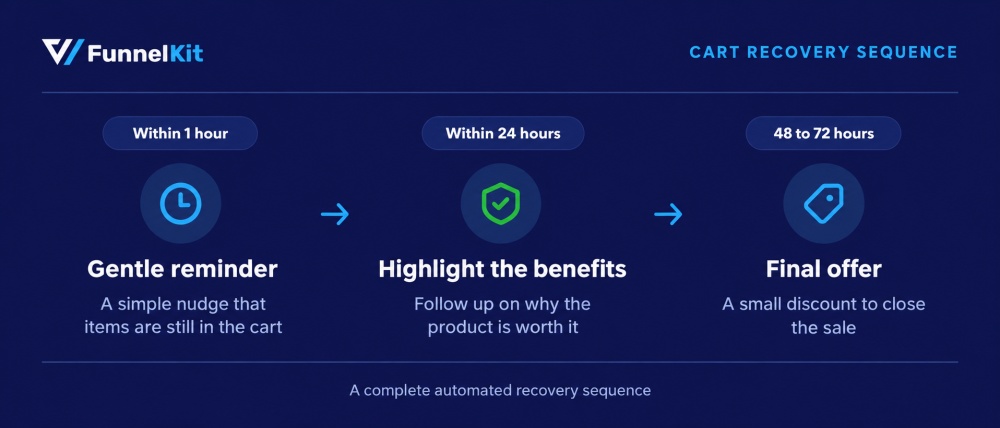
Plugins like FunnelKit Automations let you set up automated email and SMS sequences triggered by the 'Cart Abandoned' event.
You can even personalize messages with cart items and names, and offer dynamic discount coupons to bring users back.
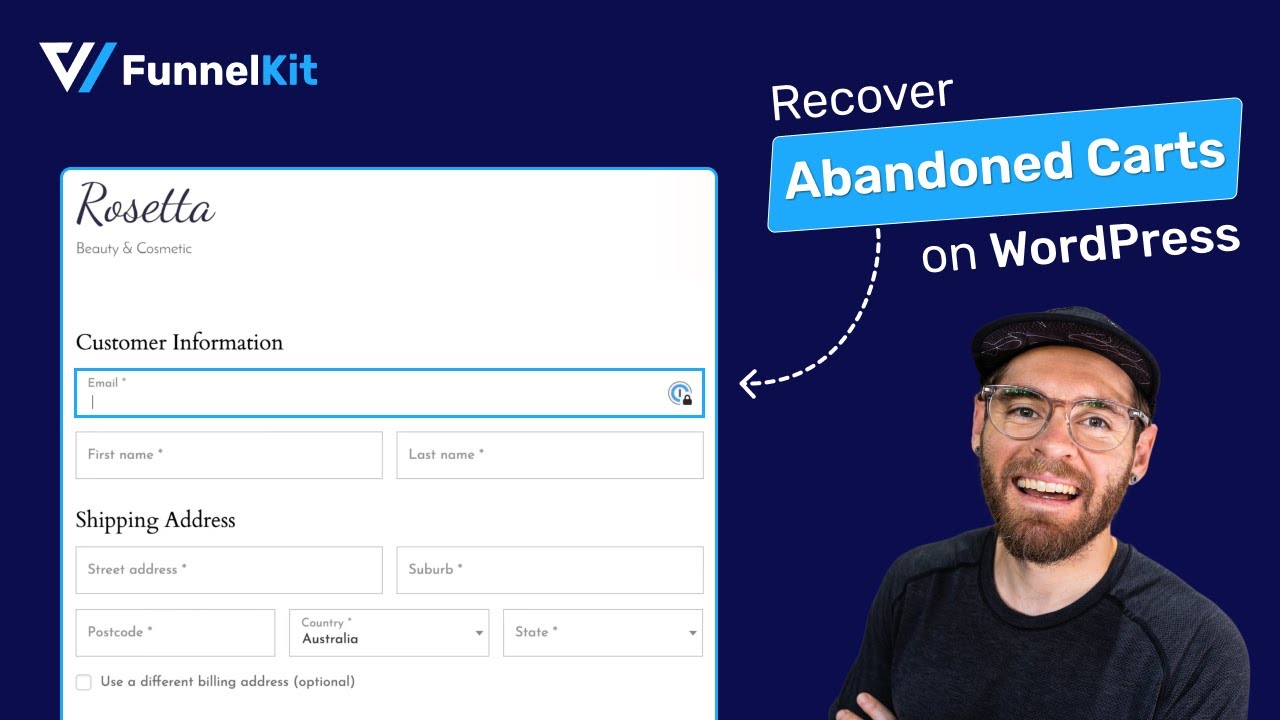
Here's the complete tutorial to reduce drop-offs and recover carts that slip away:
For timing, subject lines, and email examples, see our guide to building an abandoned cart recovery sequence.
2. Welcome first-time buyers
In the days right after a first order, new customers pay the most attention.
It’s a good time to set expectations, help them get value from the product, and give them a reason to come back.
Trigger the series when someone places their first order or signs up for your email list.
Send two to four emails over the next couple of weeks.
Start with a simple thank-you and what they can expect, then share tips for using the product, a bit about your brand, and a relevant cross-sell when it makes sense.
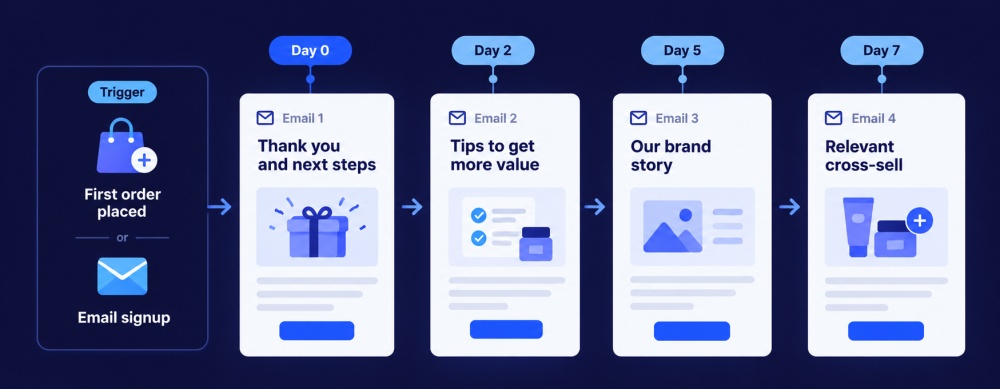
FunnelKit Automations, Omnisend, Klaviyo, and most WordPress automation plugins with a “first order” trigger can handle this workflow.
The main metric to watch is the percentage of new customers who place a second order within 60 days.
3. Follow up after delivery and ask for a review
A follow-up can help reduce buyer’s remorse, while a review gives future shoppers more confidence in the product.
The timing matters, so base both on delivery rather than the order date.
If shipping takes a week, asking for a review right after the order makes little sense.
- Trigger: Mark the order as Completed, or mark it as delivered if your tracking tool reports delivery.
- Action: Send care or how-to tips a few days after delivery. About a week later, send a review request with a direct link to the product review form.
- Tool options: FunnelKit Automations, Customer Reviews for WooCommerce for photo and video reviews, or your email automation plugin.
- What to measure: Reviews collected per 100 orders and the refund rate for reviewed products.
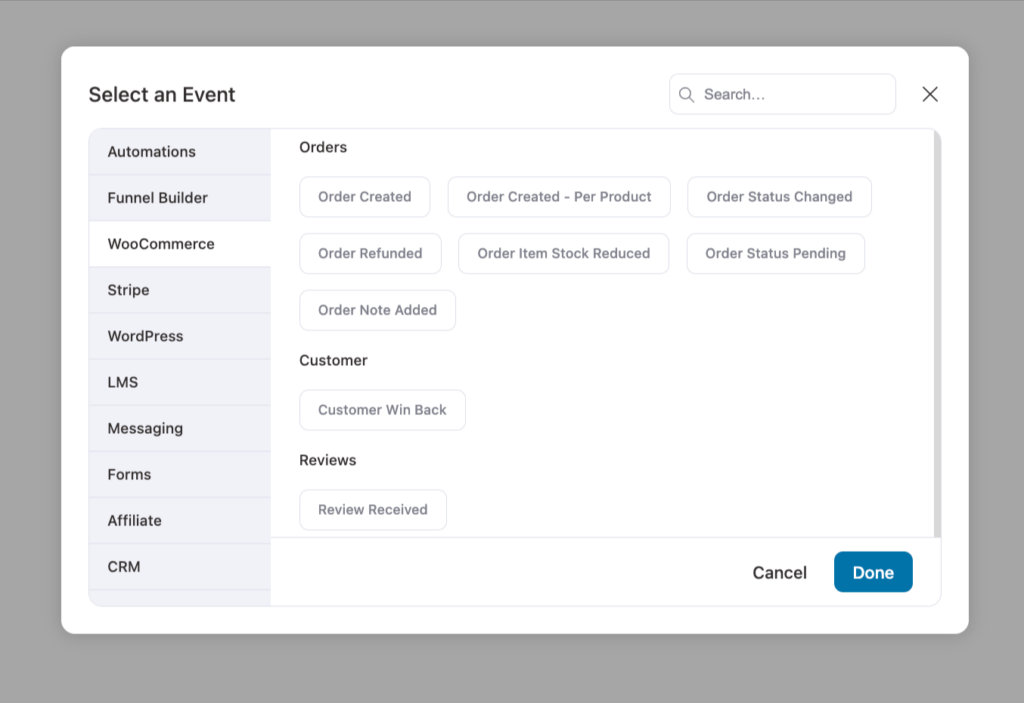
See our examples of post-purchase follow-up emails.
4. Cross-sell and remind customers to reorder
If a bag of dog food usually lasts a customer 30 days, sending a reminder on day 25 gives them time to reorder before they run out.
If you wait until day 31, they may have already bought it somewhere else.
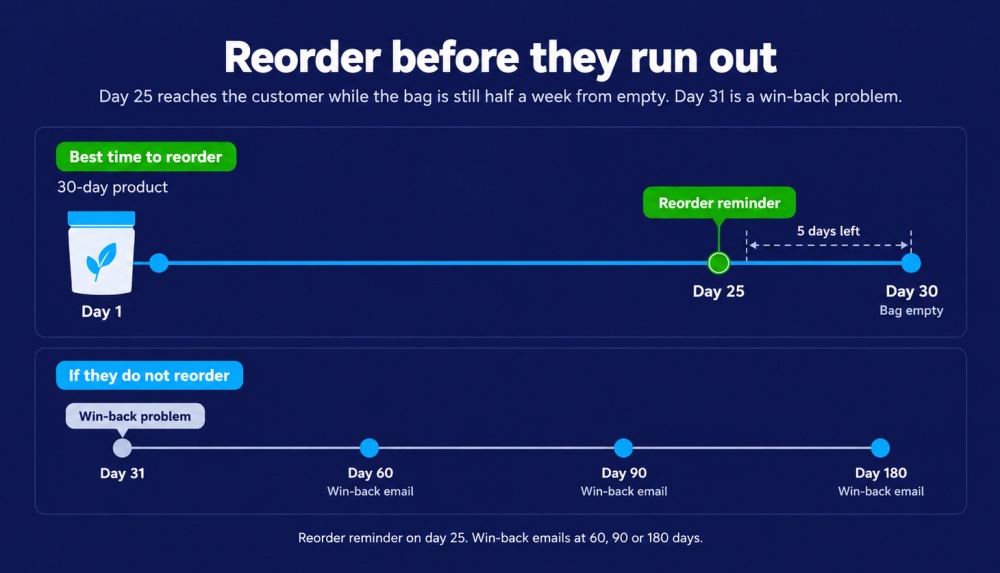
- Trigger: A customer buys a specific product or category, or enough time has passed since their last order based on the product’s usual usage cycle.
- Action: Recommend related products by email, or send a one-click reorder link for regularly purchased products.
- Tool options: Product Recommendations for WooCommerce or FunnelKit Automations for on-site suggestions and follow-up messages.
- What to measure: Revenue per recipient and repeat-purchase rate.
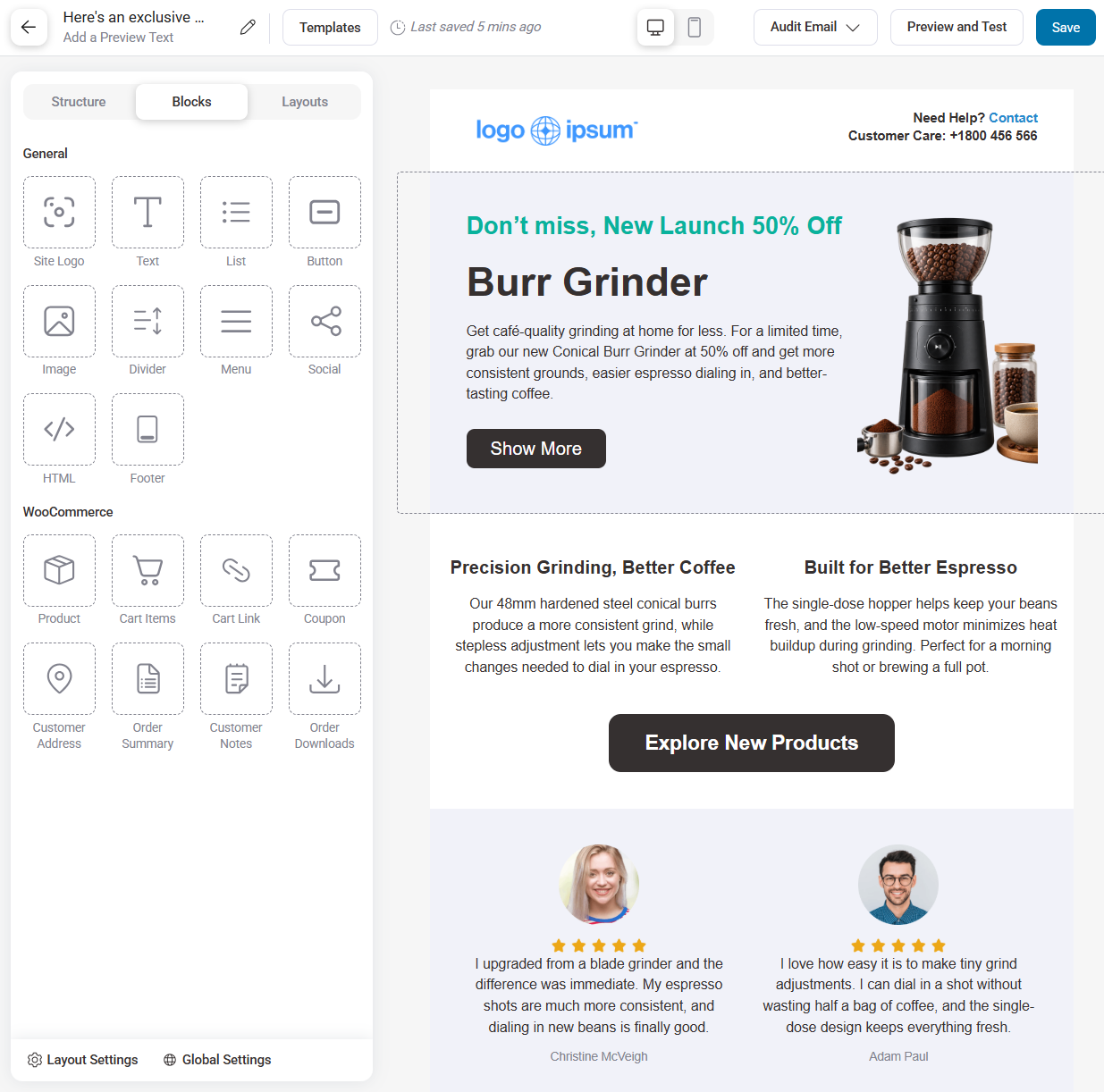
See our guides to automated product recommendations and WooCommerce upsells.
5. Win back customers who went quiet
Some customers stop buying after one or two orders. A win-back sequence gives you a chance to bring them back before they move on to a competitor.
Start the sequence after a set number of days without a purchase.
Base that window on your usual reorder cycle, whether that’s 60, 90, or 180 days. Two or three messages are usually enough.
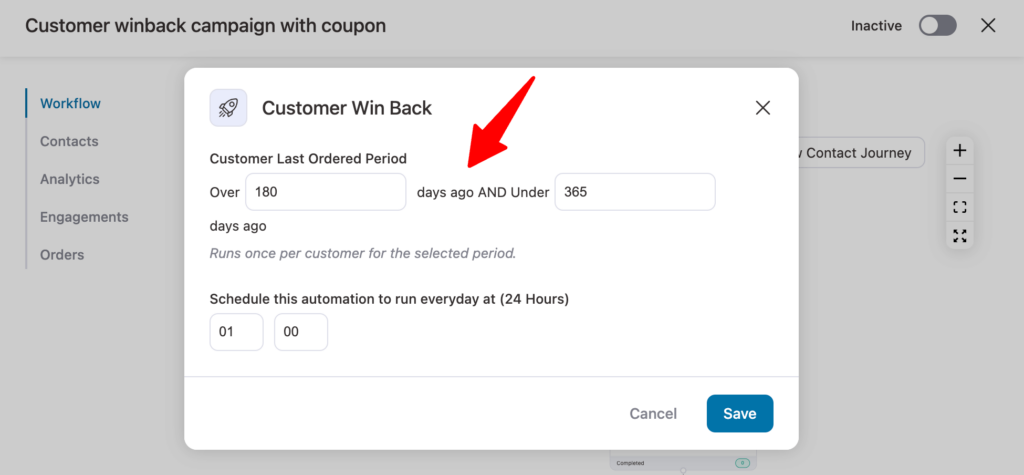
Ask what changed, show them what’s new, and finish with a time-limited offer.
FunnelKit Automations, AutomateWoo, and Klaviyo can all run this type of automation.
Track your reactivation rate, but watch unsubscribes too. A campaign that brings back a few customers while driving many people off your list isn’t doing much for you.
See our guide to building a win-back campaign in WooCommerce.
6. Send birthday and anniversary offers
Birthday and anniversary offers can feel personal, but they only work if you have the date.
Ask for a birthday as an optional field during signup or checkout, or use the anniversary of the customer’s first order instead.
Then send a short email or SMS with a coupon that expires after a set period.
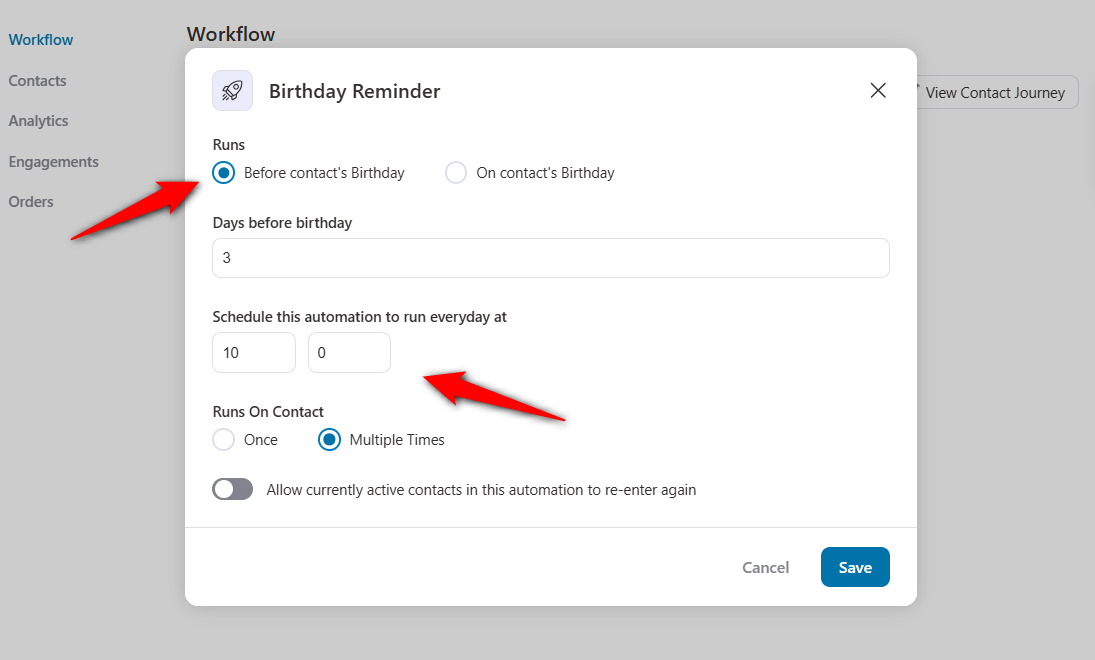
AutomateWoo with its birthdays add-on, Klaviyo, and Omnisend can handle this type of WooCommerce automation.
Track the coupon redemption rate and revenue per send.
If a customer doesn’t provide a date, they simply won’t enter the workflow.
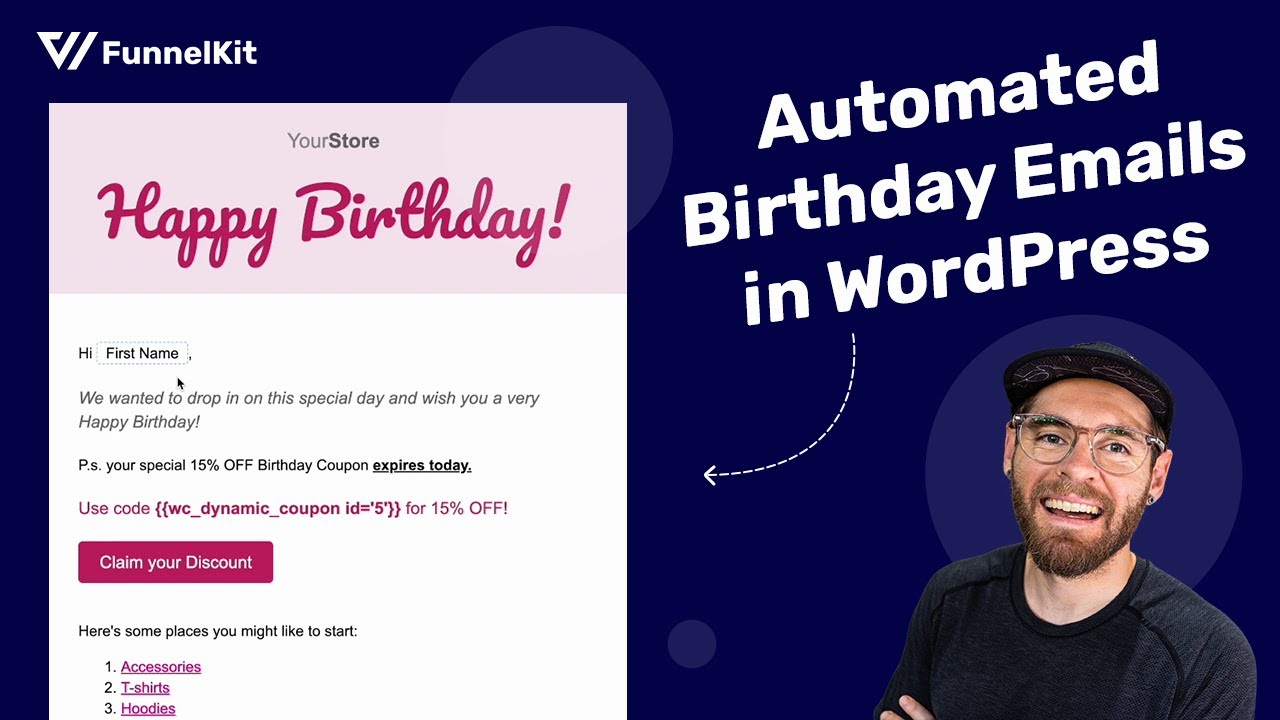
Learn about these reminders in our video tutorial:
7. Generate coupons automatically
Creating coupon codes by hand takes time, and generic codes often end up on coupon sites.
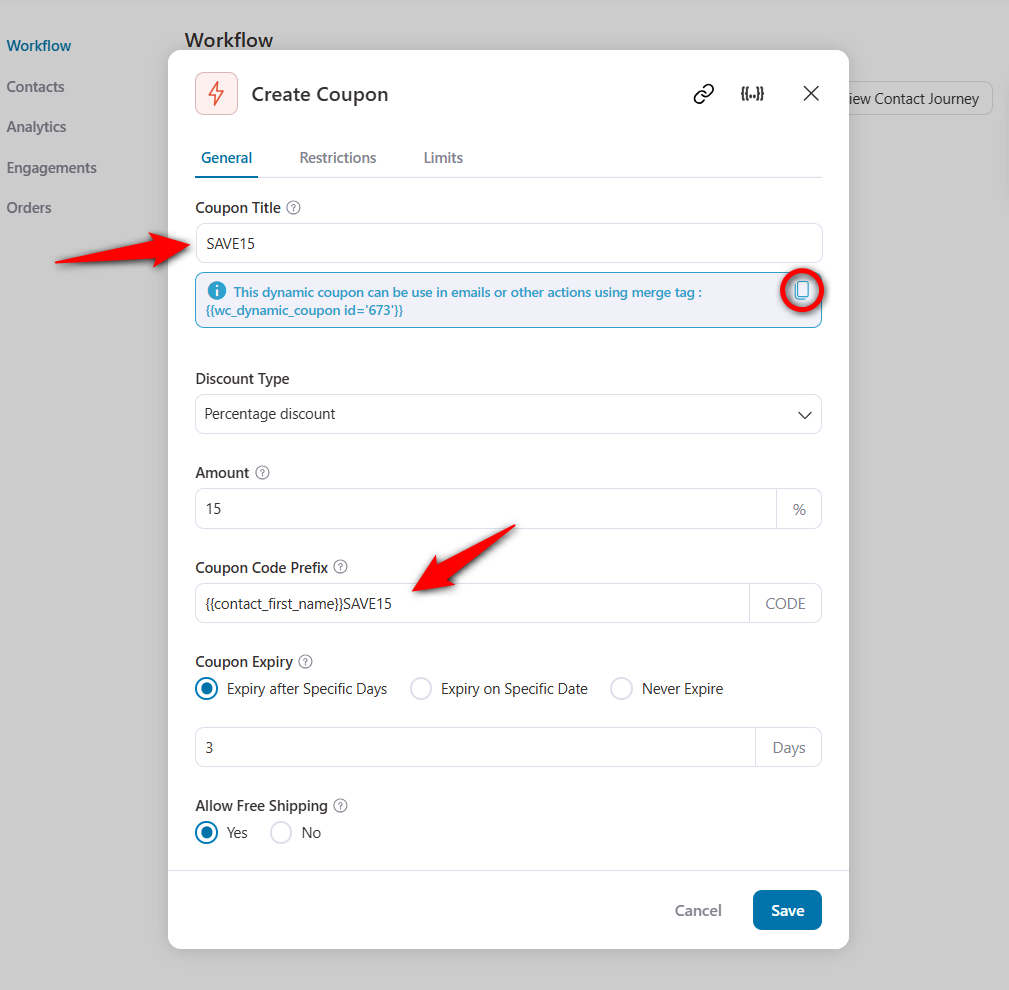
Automatically generated codes are unique, can expire on a schedule, and can be included directly in the message where they’re needed.
- Trigger: A workflow reaches a step where an incentive makes sense, such as the final cart reminder, a win-back email, or a thank-you message after a review.
- Action: Generate a unique, single-use coupon with an expiry date and include it in the email. You can also use coupon links or cart rules to apply the discount automatically, so shoppers don’t have to copy and paste a code.
- Tool options: Most WooCommerce automation plugins can generate unique coupon codes. For on-site discounts, see how to auto-apply coupons at checkout.
- What to measure: Compare the cost of the discounts with the additional revenue they generate.
As with cart recovery, it’s usually better to save the incentive for the final message than to offer a discount right away.
Check out our guide to create dynamic coupons in WooCommerce.
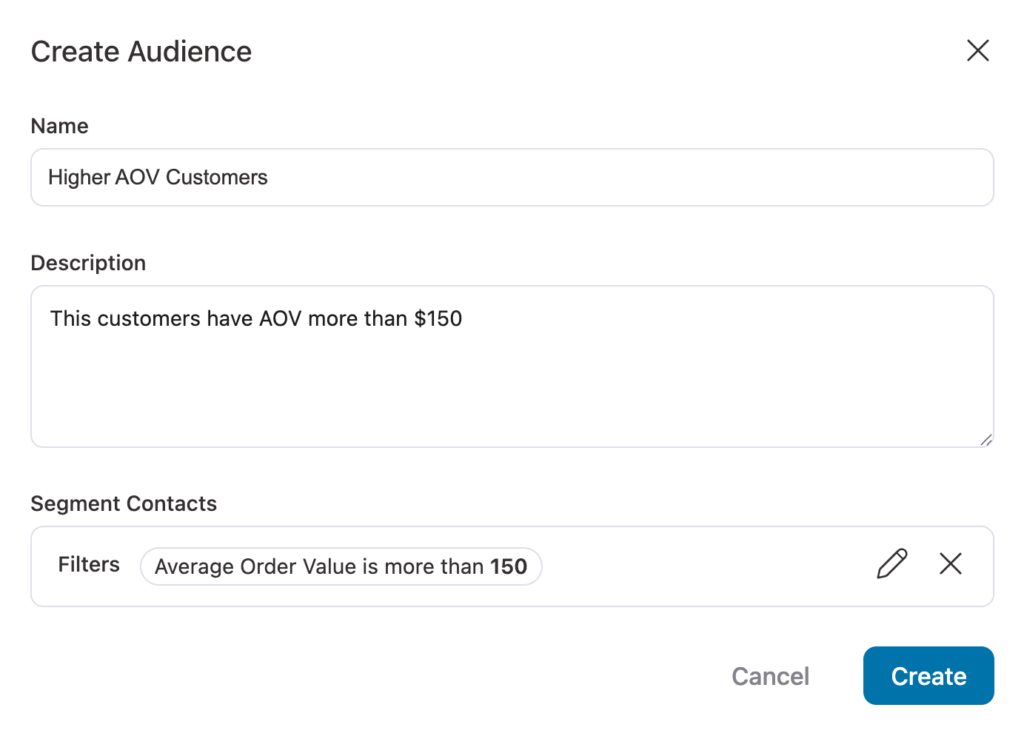
8. Tag and segment customers by behavior
Sending the same email to everyone usually means many customers get messages that aren’t relevant.
Tags let you group customers based on what they actually do, and you can use those tags to control other workflows.
For example, you can tag customers by lifetime spend to identify your best buyers, by purchase frequency to separate one-time buyers from regular customers, or by inactivity to flag customers who haven’t ordered in 90 days.
Product and category tags can be useful too.
At the pet store, someone who buys a dog collar could get a “dog owner” tag and stop receiving promotions for cat toys.
- Trigger: An order is completed, a customer reaches a spending threshold, or a set period passes without a purchase.
- Action: Add or remove tags. For example, when a customer spends $200 in total, add a “VIP” tag and use it to enroll them in a loyalty sequence.
- Tool options: FunnelKit Automations, Klaviyo, or an external CRM such as ActiveCampaign connected through an integration.
- What to measure: Revenue and email engagement for each segment.
9. Send order status updates
Automatic status updates can cut down on “where is my order?” emails and help your team spot the orders that actually need attention.
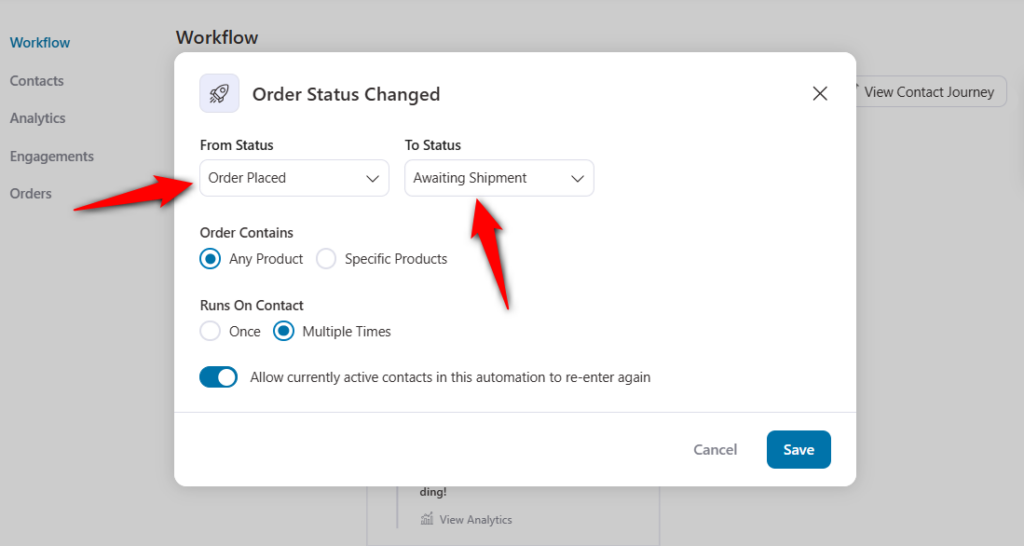
- Trigger: An order status changes, such as Processing, On hold, Completed, Cancelled, or Refunded.
- Action: Send the customer an email, SMS, or WhatsApp message. At the same time, alert your team when something needs attention, such as a failed payment or an order stuck on hold. A status rules plugin such as Order Status Rules for WooCommerce can also move orders between statuses automatically.
- Tool options: Your automation plugin for customer messages, an SMS provider such as Twilio, and Zapier’s WhatsApp templates for new-order alerts.
- What to measure: Order-status support tickets per 100 orders.
Refunds and cancellations work in much the same way. Plugins such as Return Refund and Exchange for WooCommerce let customers request a refund or exchange from their account.
The request can then move through predefined statuses, with the right email sent at each step.
10. Email shipment tracking numbers automatically
Customers shouldn’t have to email you just to find their tracking link.
As soon as you add a tracking number to an order, send the customer the carrier, tracking number, and a direct tracking link.
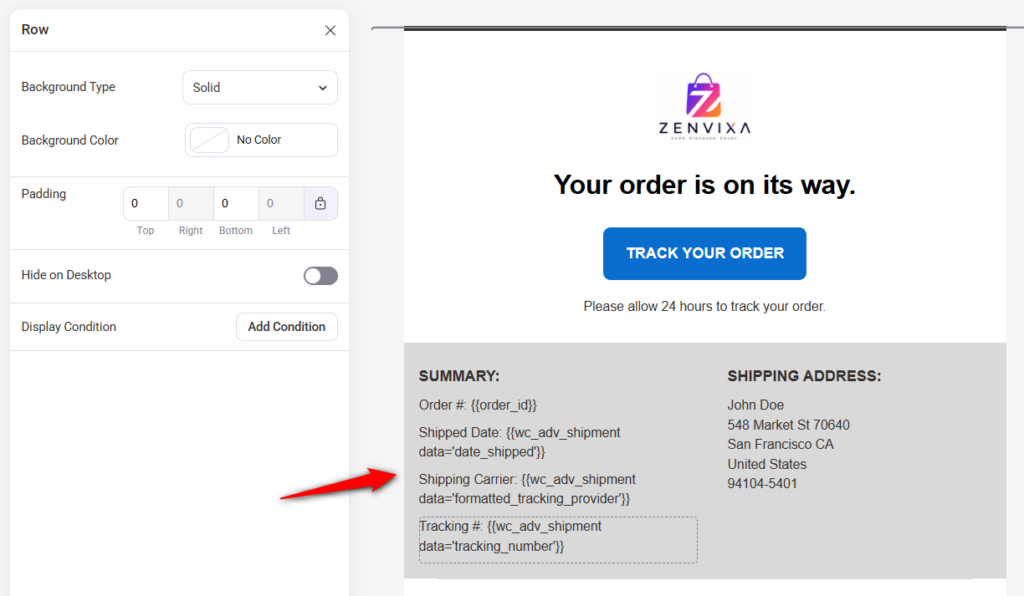
The same details should also appear in their account.
Advanced Shipment Tracking for WooCommerce and Orders Tracking for WooCommerce can handle this.
You can pair either one with your email plugin to send branded tracking emails.
The main metric to watch is the number of tracking-related support tickets.
11. Sync inventory and alert on low stock
As your catalog grows, checking stock manually gets harder and easier to miss.
Inventory automation keeps product availability up to date and warns you before a popular item runs out.
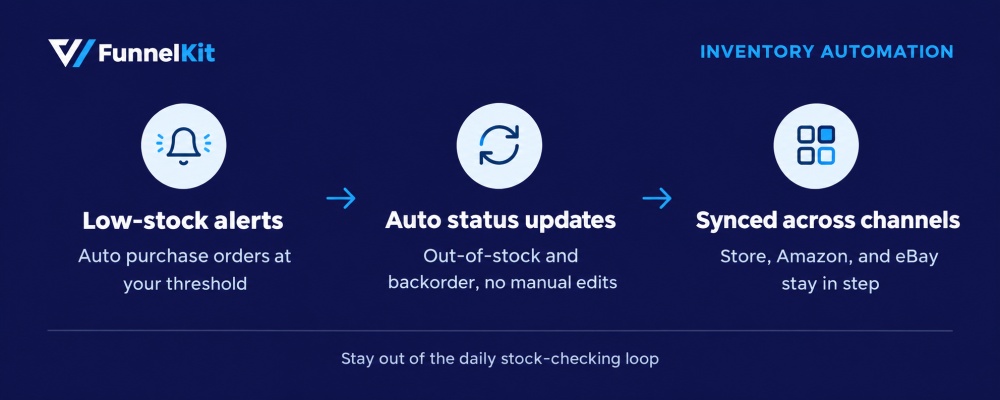
- Trigger: Stock falls below your set threshold, or a scheduled supplier feed updates inventory.
- Action: Send an alert to your purchasing team by email or Slack, and automatically mark products as out of stock or available for backorder. You can also schedule imports from supplier CSV or XML feeds and sync inventory across your store and marketplaces such as Amazon or eBay to avoid overselling.
- Tool options: WooCommerce’s native stock thresholds, WP All Import for scheduled supplier feeds, and a multichannel inventory tool. Dropshipping stores can use a supplier platform such as AutoDS to monitor prices and stock.
- What to measure: Stockouts and oversold orders per month.
12. Automate invoices, tax and accounting
Invoices, tax calculations, and bookkeeping are easy places for a manual mistake to turn into a costly problem.
Automating them keeps the paperwork moving without someone having to handle every order.
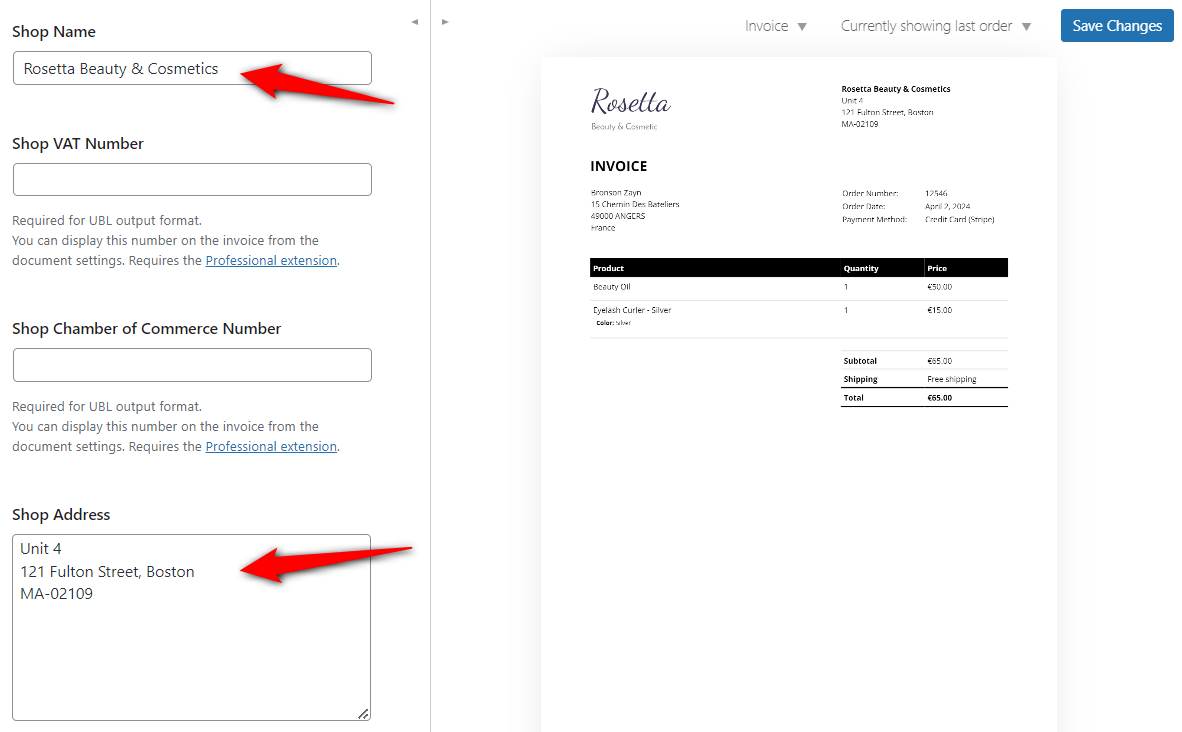
- Trigger: An order is paid or marked as completed.
- Action: Generate a PDF invoice and attach it to the order email. Calculate tax at checkout based on the customer’s location, then send the order to your accounting software as an invoice or sales receipt.
- Tool options: PDF Invoices and Packing Slips for WooCommerce, a tax service such as WooCommerce Tax or TaxJar, and Zapier or Make templates for QuickBooks, Xero, or Zoho Books.
- What to measure: Hours spent on bookkeeping each month.
If you sell in the EU, keep another requirement in mind. The Omnibus Directive requires stores to show the lowest price charged during the previous 30 days alongside a discounted price.
Some plugins can track and display this automatically.
See our guide on how to automate WooCommerce tax and fix common checkout tax errors.
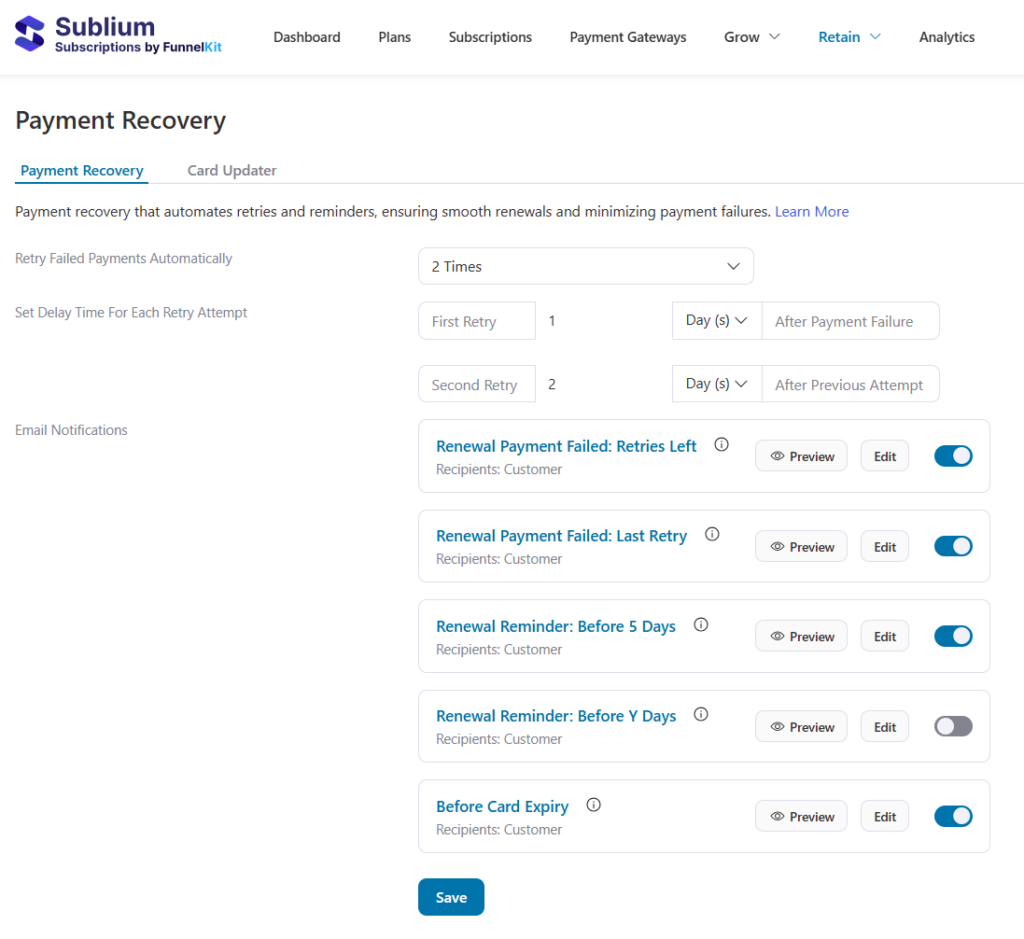
13. Protect subscription renewals
A failed card payment on renewal day can cancel a subscription even when the customer still wants the product.
Renewal reminders and payment retries can recover many of those payments before they turn into lost customers.
- Trigger: A renewal is coming up, a renewal payment fails, or a saved card is about to expire.
- Action: Remind customers before the renewal date. If a payment fails, retry it on a schedule and send an email with a link to update their payment details.
- Tool options: WooCommerce Subscriptions paired with an automation plugin for renewal reminders and dunning emails. Sublium, built by our team, includes payment recovery that retries failed payments and helps customers update their card details.
- What to measure: Failed-payment recovery rate and involuntary churn.
14. Send order data to Google Sheets, Slack, or your CRM
This is the kind of workflow the Reddit thread mentioned earlier.
Order data often needs to go somewhere beyond WooCommerce, whether that’s a spreadsheet, team chat, or CRM.
| Workflow | Integration platform route | WordPress route |
|---|---|---|
| Log every new order in Google Sheets | Zapier or Make Google Sheets template | Uncanny Automator’s Google Sheets action |
| Alert your team in Slack about high-value orders | Zapier with a filter step on order total | An automation plugin with a Slack integration, or a webhook |
| Sync customers to ActiveCampaign, HubSpot or Mailchimp | Zapier or Make CRM templates | The CRM’s own WooCommerce plugin or a WordPress connector |
- Trigger: A new order or new customer.
- Action: Add a row to a spreadsheet, send an alert to your team, or create or update a CRM contact.
- What to measure: Manual data-entry time saved and sync errors.
If all you need is to send WooCommerce data to another app, a webhook connected to Make or Zapier is usually the simplest setup.
If the pet store uses all three workflows above, each order can trigger three separate actions.
We’ll break down what that can cost in the pricing section.
Which Workflows to Set Up First
The first three WooCommerce automations should solve your biggest problem right now, whether that’s lost sales, repeat purchases, or too much manual work.
| Store type | First three automations | Tool type to start with |
|---|---|---|
| New store, under 50 orders a month | Cart recovery, welcome email, review request | Free version of a WordPress automation plugin |
| Growing store | Cart recovery, post-purchase cross-sell, win-back | WordPress automation plugin, Pro tier |
| Subscription store | Renewal reminders, failed-payment recovery, cancellation win-back | Subscription plugin plus an automation plugin |
| High-volume or operations-heavy store | Orders to Sheets or ERP, low-stock alerts, Slack alerts for exceptions | Integration platform plus webhooks |
| Dropshipping store | Supplier stock and price sync, tracking updates, cart recovery | Dropshipping platform plus an automation plugin |
Best Automation Plugins and Tools for WooCommerce (2026)
We make FunnelKit Automations, so it’s included in this comparison. We’ve evaluated it using the same criteria as the other tools.
You can also browse the official WooCommerce Marketplace for more automation extensions.
How we evaluated these tools:
We looked at five things for each tool:
- How deeply it connects with WooCommerce events
- Whether it runs inside WordPress or in the cloud
- How pricing changes as your store grows
- What you get on the free plan
- How much setup is involved if you don’t code
Prices are based on each vendor’s published pricing as of October 2026. Pricing can change, so check the vendor’s site before buying.
| Tool | Type | Best for | Free option | Paid from | Watch out for |
|---|---|---|---|---|---|
| WooCommerce built-in | Native features | Order emails, stock alerts, webhooks | Included | Free | No cart recovery or multi-step journeys |
| FunnelKit Automations | WordPress plugin | Email, SMS and CRM inside WordPress, with revenue reporting per automation | Free version | $99.50/year | Conditional branching and segmentation require Pro |
| AutomateWoo | WordPress plugin made by Woo | Trigger and rule-based follow-ups, subscription events | None | $159/year | Birthday, referral, and wishlist workflows need extra add-ons or extensions |
| FluentCRM | WordPress plugin | Stores that also run courses or memberships | Free version | $129/year | You set up and pay for your own email sending service |
| Klaviyo | Cloud email and SMS platform | High-volume retention marketing and predictive analytics | Up to 250 profiles and 500 emails a month | Scales with active profiles | Cost rises with list size, and customer data lives off your site |
| Omnisend | Cloud email and SMS platform | Email, SMS and push notifications in one flow | Up to 250 contacts and 500 emails a month | Scales with contacts | Free plan emails carry Omnisend branding |
| Uncanny Automator | WordPress connector | Linking WooCommerce with other plugins and apps | Free version with 250 app credits | $149/year | Conditions, delays and some triggers require Pro |
| OttoKit | Cloud connector | AI-assisted workflows across apps | 250 tasks a month | $108/year | Every completed action counts as a task |
| Zapier | Integration platform | Fast setup across thousands of apps | 100 tasks a month, two-step Zaps | $19.99/month, billed annually | Every action step is a task, so costs climb with orders |
| Make | Integration platform | Branching workflows such as Sheets and Drive sync | 1,000 credits a month, 2 active scenarios | $9/month, billed annually | Steeper learning curve than Zapier |
Where FunnelKit Automations fits
FunnelKit Automations runs inside WordPress, so your contact and order data stays on your own site.
You pay a yearly license rather than per task, and it reports revenue for each automation and email, making it easier to see which workflows generate revenue.
For an independent view, see WPBeginner’s FunnelKit Automations review.
For deeper comparisons, see our roundup of AutomateWoo alternatives and our list of WooCommerce marketing plugins.
How Much Automation Costs
WooCommerce automation can cost nothing, or it can run into several hundred dollars a month.
The real difference usually comes down to how the tool charges, not just its advertised price.
- Flat yearly license: WordPress plugins such as FunnelKit Automations, AutomateWoo, FluentCRM, and Uncanny Automator charge a set price per site each year, regardless of order volume. The catch is email deliverability. You’ll usually pay separately for an email sending service, and if messages start landing in spam, you’re responsible for fixing it.
- Per contact: Cloud platforms such as Klaviyo and Omnisend are free up to about 250 contacts. The price increases as your list grows, while email sending is included.
- Per task or credit: Integration platforms such as Zapier, Make, and OttoKit charge based on the actions a workflow completes. Costs increase as you process more orders or add more steps to each workflow.
So if your store sends every order to a Google Sheet, a Slack channel, and its CRM. At 300 orders a month, that's three actions per order.
- On Zapier, that’s about 900 tasks a month. The free plan’s 100 tasks would run out within the first few days, and even the 750-task entry tier wouldn’t cover the full month. At 1,000 orders a month, you’d need about 3,000 tasks, so the free tier wouldn’t last long.
- On Make, assuming roughly one credit per module per run, you’d use about 900 to 1,200 credits a month. That puts you right around the free plan’s 1,000-credit limit. The Core plan’s 10,000 credits would cover the store at 300 orders and still leave plenty of room at 1,000 orders, which would use roughly 3,000 to 4,000 credits.
- With a WordPress automation plugin such as FunnelKit Automations that supports all three actions, the cost stays tied to the yearly license ($99.50/year). Whether the store processes 300, 1,000, or 10,000 orders, the license price doesn’t change.
Per-task pricing can still make sense for low-volume workflows where each task is valuable.
But for high-volume, per-order work and customer messaging, keeping the automation inside WordPress can help keep costs predictable.
How to Set Up Your First Automation Without Code
You can build this without writing any code. We’ll use FunnelKit Automations, a WordPress-native email, SMS, and CRM plugin.
It comes with prebuilt recipes for common WooCommerce workflows, plus a visual builder for setting up triggers, conditions, and actions.
Its reports also show how much revenue each automation generates.
FunnelKit Automations has a free version with abandoned cart recovery and a visual automation builder.
The Pro plan starts at $99.50/year and adds conditional branching, contact segmentation, and more advanced workflows.
Follow the step-by-step instructions below.
Step 1: Connect SMTP to send emails
Before setting up your first workflow, make sure your site can actually deliver email.
By default, WordPress sends email through your web host. Those messages can easily end up in spam.
Connect an SMTP or transactional email service so your automated emails have a better chance of reaching the inbox.
Note: To compare SMTP options, see our guide on how to fix WooCommerce email deliverability.
Step 2: Import the cart recovery recipe and set the trigger
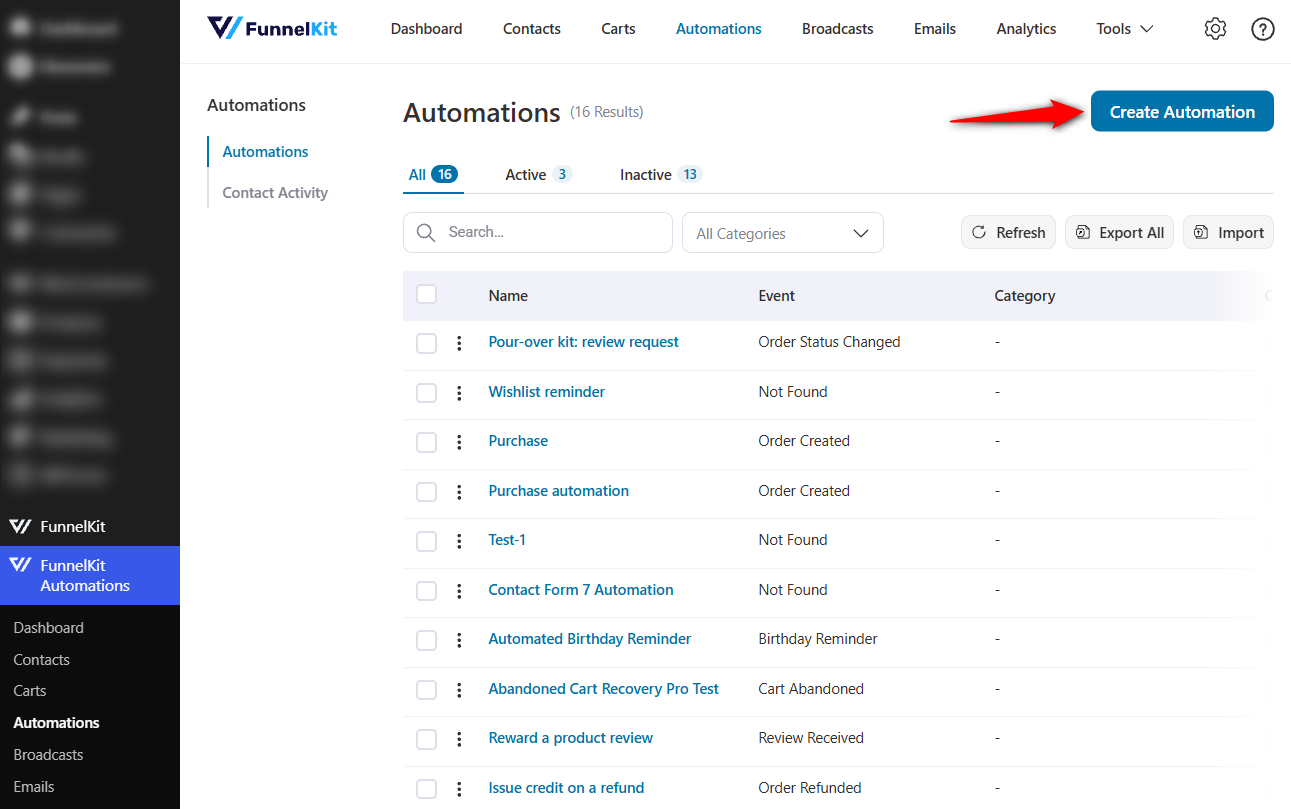
Go to FunnelKit Automations ⇨ Automations, click 'Create New Automation'.
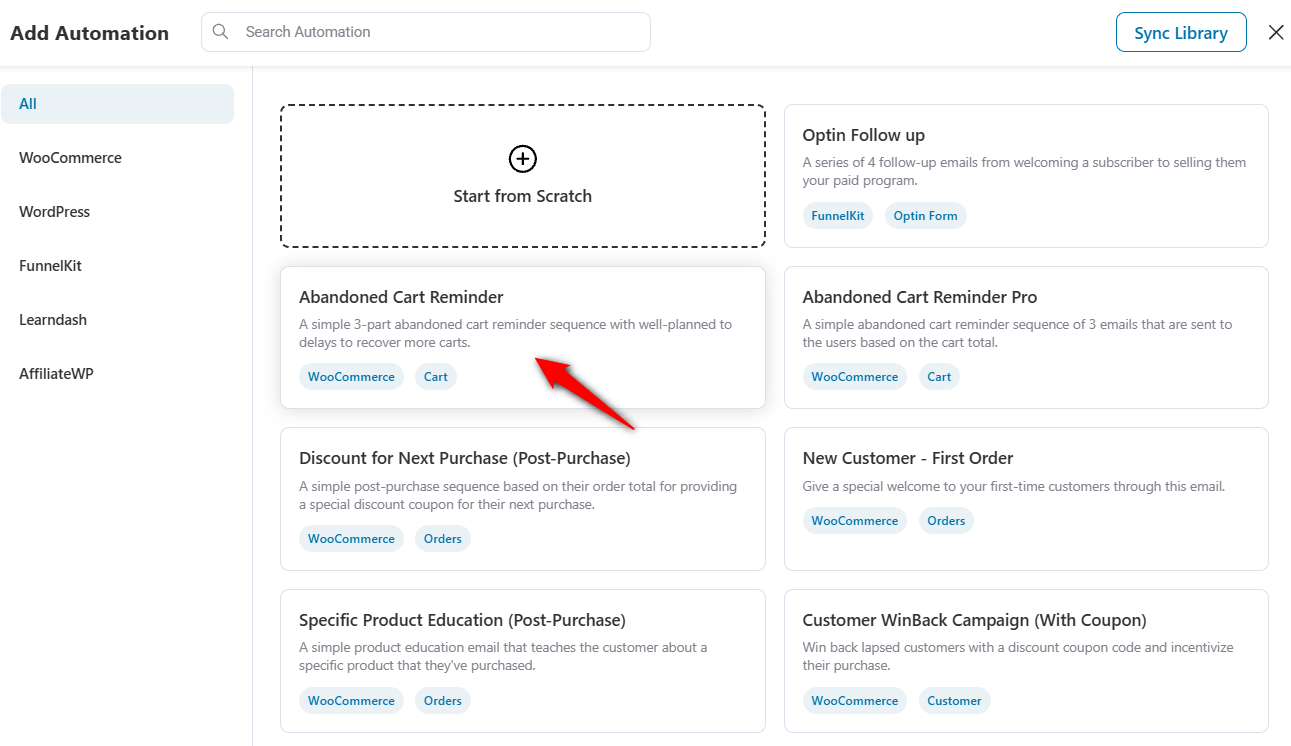
Choose the abandoned cart recipe instead of starting from scratch.
The recipe already includes the Cart Abandoned trigger, timing, and prewritten emails.
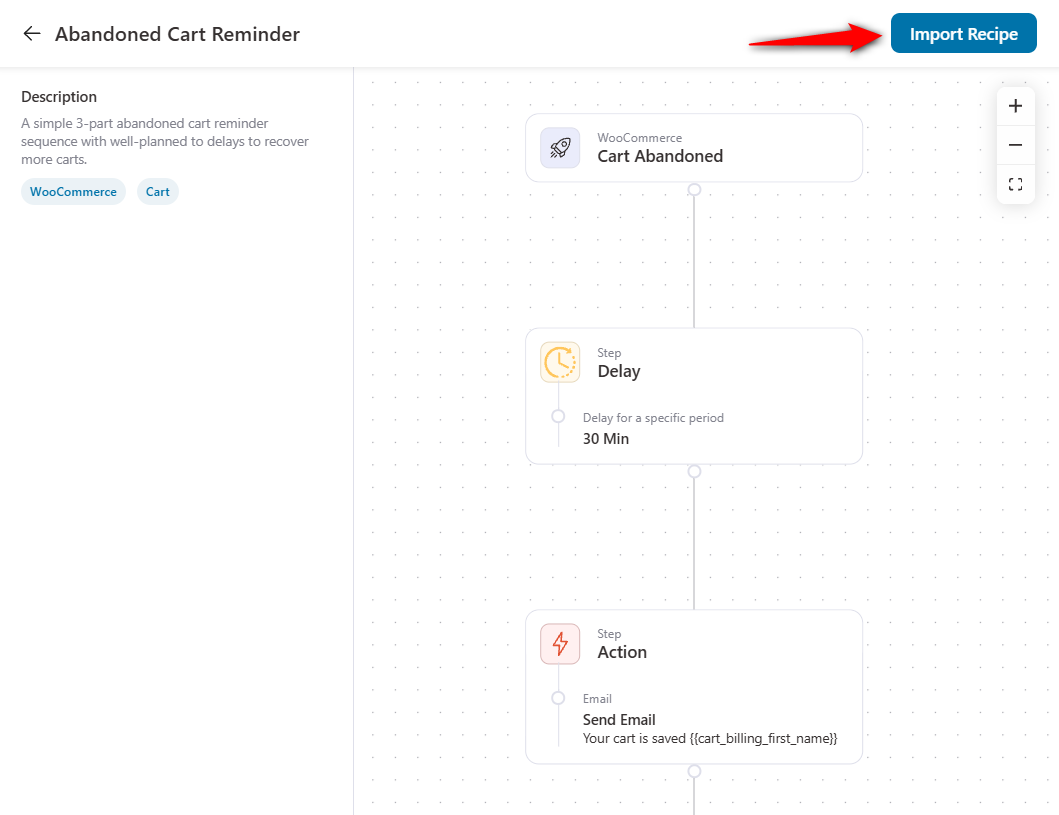
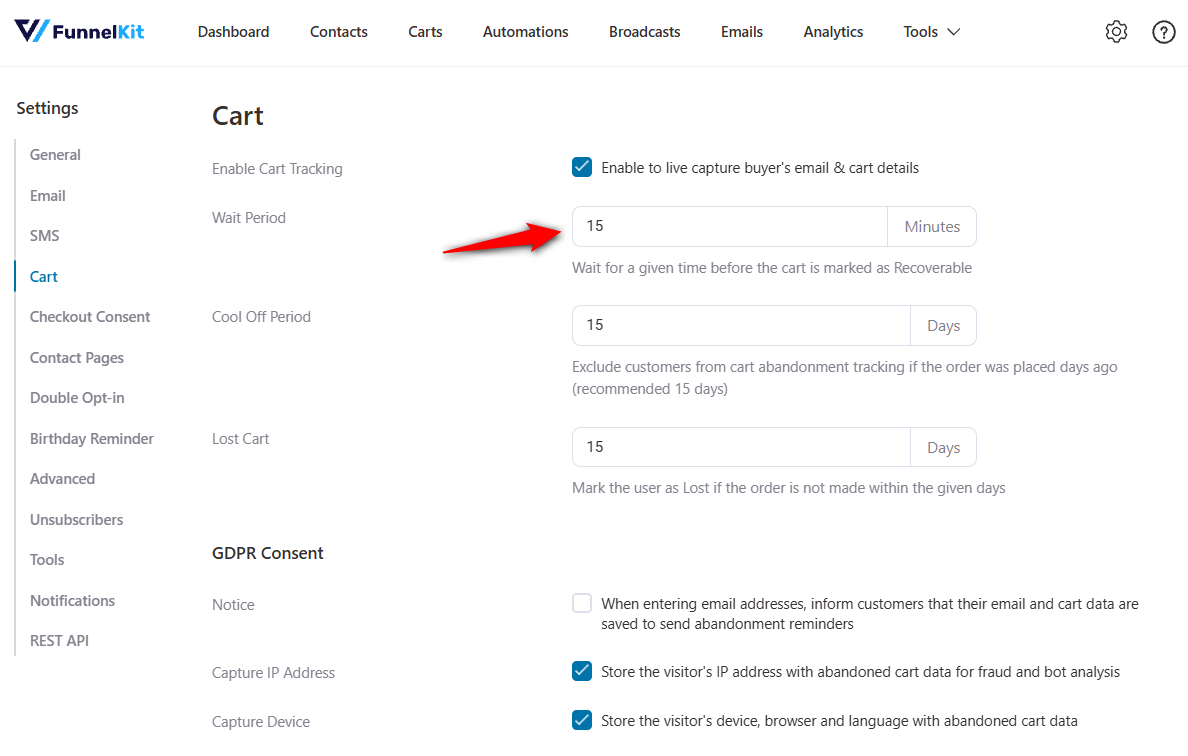
Next, decide how long a cart should remain inactive before it counts as abandoned.
For most stores, 15 to 30 minutes is a reasonable starting point. A shorter wait can catch shoppers who are still comparing prices or checking another tab.
Configure it inside FunnelKit Automations settings.
Step 3: Add conditions and exit rules
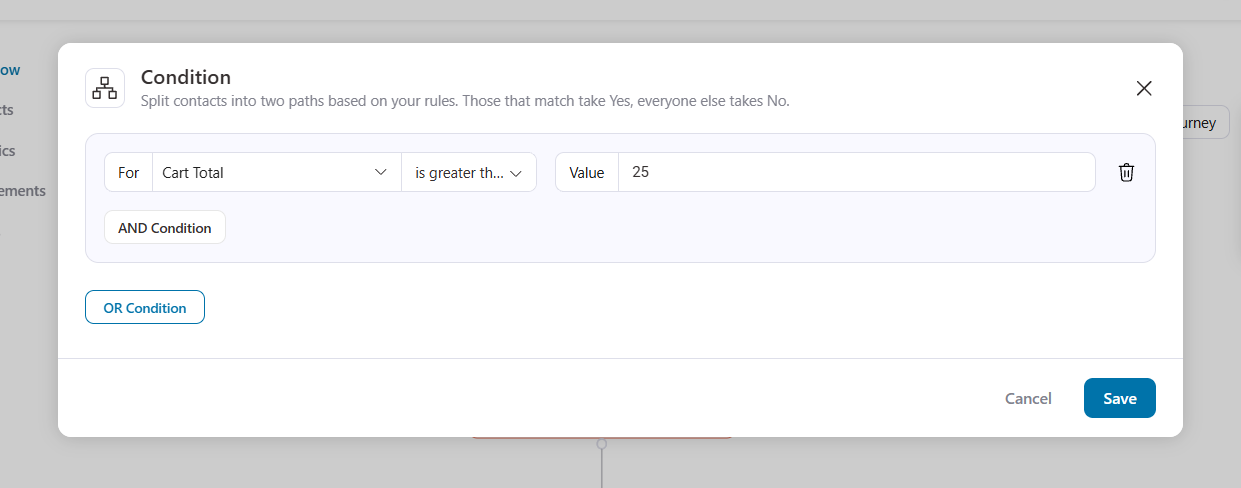
Conditions help keep the sequence relevant. If small orders aren’t worth multiple reminders, set a minimum cart value.
Let's set a $25 minimum could stop a cart containing an item from triggering three emails.
You can also exclude shoppers who already bought the same products in a separate order.
Then make sure the automation stops as soon as the customer completes the purchase.
There’s no reason to send a cart reminder for an order that has already been placed.
This exit rule is one of the most important parts of any cart recovery flow.
Step 4: Customize the three recovery emails
This is where most of your setup time should go. Each email has a different purpose:
- Email 1, about one hour after abandonment
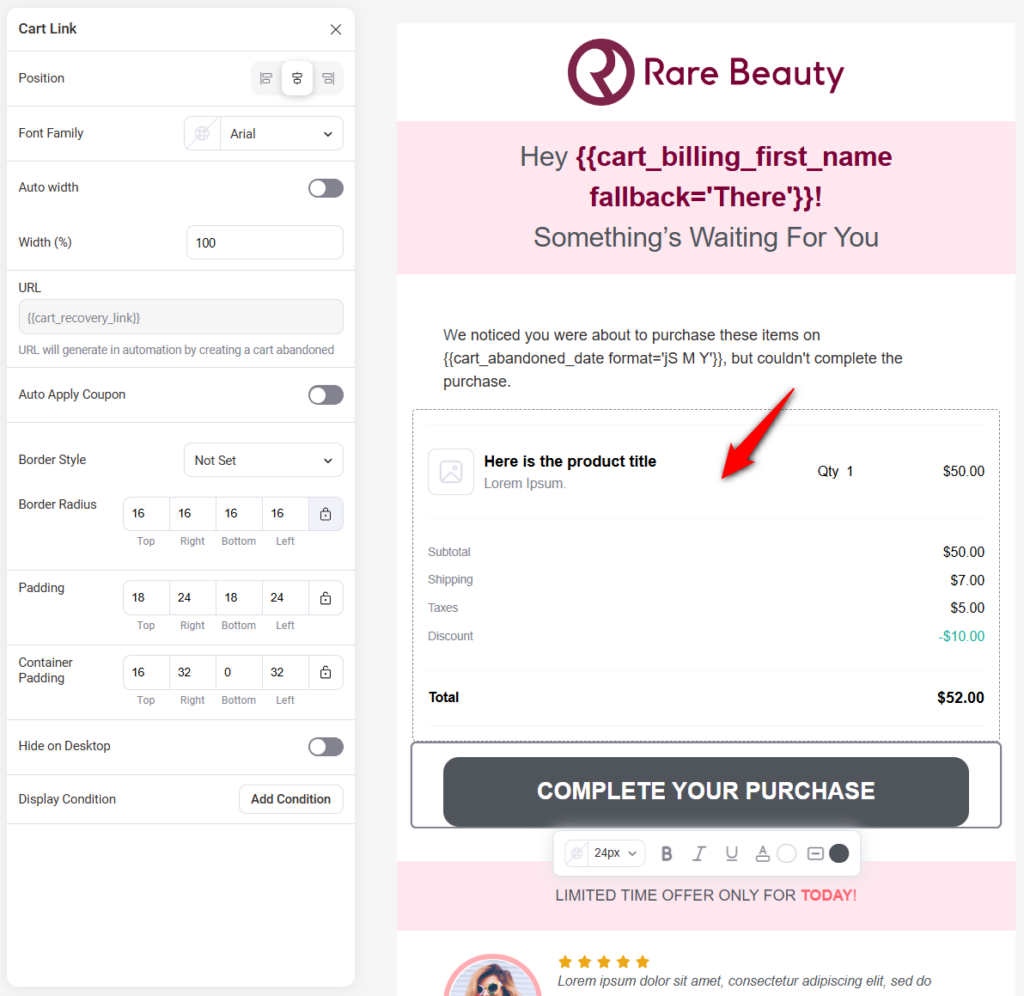
Keep it short and useful. Use merge tags to show the product image, name, and price from the cart, then add one button that takes the shopper back to checkout.
Skip the discount for now.
- Email 2, about 24 hours later
Address the questions that may be holding the shopper back.
Mention shipping costs and delivery times, especially if the cart contains something heavy like a large bag of food.
Then explain your returns policy and include ratings or reviews for the products in the cart.
- Email 3, between 48 and 72 hours later
If your margins allow it, add an incentive. You could generate a unique, single-use coupon or offer free shipping.
Give it a short expiry, such as 48 hours, and make it clear that this is the final reminder.
Personalize the subject line with the shopper’s first name or product name. Preview every email on a phone because that’s where many shoppers will read it. Keep one clear call to action in each email.
If you collect phone numbers with SMS consent, you can also add a short text between email 1 and email 2.
SMS requires a connected provider such as Twilio.
Note: For subject line ideas and other timing options, see our guide to building an abandoned cart recovery sequence.
Step 5: Save, activate, and test the automation
Save the automation and switch it to active.
To test it, open your store in a private browser window, add the dog food to the cart, and go to checkout.
Enter a test email address that has never placed an order. Otherwise, the exclusion rule from Step 3 could skip the test.
Close the tab without placing the order. Once the idle time and first delay have passed, check that email 1 arrives with the correct products.
Click the link, complete the purchase, and make sure emails 2 and 3 stop.
Test this on your actual checkout page, whether your store uses the block checkout or the classic checkout.
For the first two weeks, monitor the automation report. Look at how many carts were captured, how many were recovered, and how much revenue each email generated.
Why Automations Stop Running (Or Emails Stop Sending)
When a WooCommerce automation suddenly stops, the cause is usually one of the issues below. Check them in order.
- WP-Cron isn’t firing: WordPress relies on site visits to run scheduled tasks, so low-traffic stores can end up with delayed or batched emails. Ask your host to set up a real server cron job that triggers WP-Cron every few minutes.
- Scheduled actions are stuck: Check the scheduled actions list under the WooCommerce status screen. A long list of overdue or failed actions often points to a WP-Cron problem or a plugin conflict.
- Emails send but never arrive: Emails sent through your host’s default mail function can fail spam checks. Use an SMTP or transactional email service, and make sure your domain has SPF, DKIM, and DMARC set up correctly.
- Caching or security plugins are blocking background requests: Exclude your cart, checkout, and account pages from page caching. Also check that your firewall isn’t blocking the background requests your automation plugin needs to run.
- A webhook has been disabled: WooCommerce can disable a webhook after repeated delivery failures. Check its status and delivery logs, fix the receiving URL, and then re-enable the webhook.
- The conditions never match: An automation waiting for a tag that never gets applied won’t run. Send a test contact through the workflow and check the automation log to see exactly where it stops.
7 Best Practices to Keep Your Automations Profitable
- Judge each automation by the revenue it generates
Privacy features in email apps such as Apple Mail can inflate open rates, so don’t rely on opens alone.
Track conversion rate, revenue per recipient, and revenue per workflow instead.
The number that matters most is revenue per workflow compared with what the tool costs you.
- Hold out a small control group
Leave about 10% of eligible customers out of a workflow for a month, then compare their results with the group that received it.
You’ll miss out on some recovered revenue during the test, so keep the holdout group small.
- Cap how often one customer hears from you
Several workflows can easily overlap. A limit such as one marketing message per day can help prevent message fatigue and unsubscribes.
- Give each job to one tool
If two plugins send cart reminders, customers could receive both.
Decide which tool owns each workflow, then turn off the duplicate automation.
- Keep transactional and marketing consent separate
Order updates can go to every buyer, but marketing emails and SMS need clear opt-in under GDPR, TCPA, and similar rules.
- Track the hours saved by operations workflow
Before automating a manual task, note how long it takes to complete.
Then compare that with the time spent each month after automation.
- Review every workflow each quarter
Check for expired coupons, discontinued products, broken links, and copy that’s no longer accurate.
A workflow can keep running long after the offer or product it was built around has changed.
Frequently Asked Questions
It depends on the job. For customer emails and cart recovery, FluentCRM and FunnelKit Automations both offer free versions that run inside WordPress.
For connecting WooCommerce to other plugins and apps, start with the free version of Uncanny Automator.
AutomateWoo suits stores that want Woo’s own extension and a trigger, rule and action model, but it has no free version.
FunnelKit Automations adds a built-in CRM, broadcast emails, and revenue reporting, with a free version to start.
Our AutomateWoo alternatives guide compares them feature by feature.
FluentCRM fits well when WooCommerce is one of several systems on your site, such as an LMS or a membership plugin.
FunnelKit Automations is built mainly around WooCommerce events like carts, orders and checkout.
Both have free versions, so test the workflows you need in each before you buy.
Klaviyo is stronger on predictive analytics and suits brands that sell on several platforms.
A WordPress plugin keeps customer data on your site and usually costs less as your list grows, because its price isn’t tied to profiles.
Klaviyo’s free plan covers up to 250 active profiles and 500 emails a month.
Yes. Developers can use WooCommerce action hooks, such as woocommerce_order_status_changed, together with Action Scheduler to queue tasks.
Custom code gives full control but needs maintenance every time WooCommerce updates, so most stores use a plugin for customer messaging.
Yes. Most automation plugins send SMS through a provider such as Twilio, and Zapier offers WhatsApp notification templates for new orders.
Collect clear SMS consent at checkout before you send any marketing texts.
Partly. Order status emails, tracking updates, refund request routing and chatbots handle the routine questions.
Complex issues still need a person, but taking the routine ones off the queue cuts ticket volume.
Shopify includes Shopify Flow, a built-in app for automating store workflows.
WooCommerce relies on plugins and integrations instead, giving you more choice of tools and keeping data on your own server.
The trade-off is that you choose and maintain those tools yourself. Our WooCommerce vs Shopify comparison covers the wider differences.
Start Automating Your WooCommerce Store Today!
None of these workflows will transform your WooCommerce store on its own.
Cart recovery might bring back $300 a week. A reorder reminder can reach customers before they run out of their supplies, while a customer tag keeps specific emails out of their inbox.
Sending orders to a spreadsheet also gives some of those 25 hours back.
Each one is a small improvement, but they add up. Once a workflow is running, it keeps doing its job on every order without someone having to remember to run it.
Start with abandoned carts. Get that sequence working, check the numbers after two weeks, and then move on to the post-purchase follow-up and low-stock alert.
If you want to manage email, SMS, and CRM automation inside WordPress with one yearly license, that’s what we built FunnelKit Automations for.
It lets you automate your campaigns, send email/SMS broadcasts, and manage customers effectively.
Editorial Team
October 11, 2026You can customize the WooCommerce cart page with the Cart block, a page builder like Elementor, or CSS and PHP snippets. Which method works for you depends on the cart...
Editorial Team
October 9, 2026A WooCommerce discount lowers what a shopper pays, either through a reduced product price or a code entered at checkout. Out of the box, WooCommerce gives you two ways to...
Editorial Team
October 9, 2026A downsell gives customers a cheaper option after they turn down your main offer. If you show it too soon, you might convince them to skip the original offer and...